QUESTION IMAGE
Question
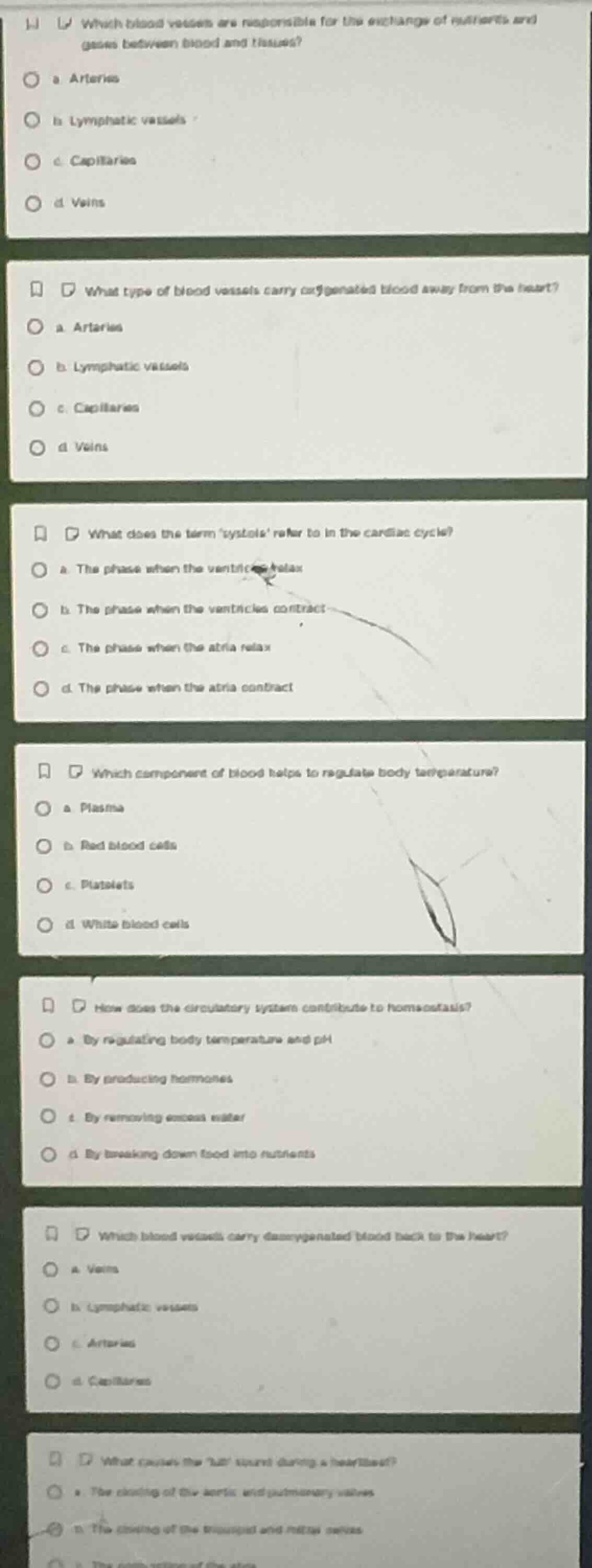
which blood vessels are responsible for the exchange of nutrients and gases between blood and tissues?
a. arteries
b. lymphatic vessels
c. capillaries
d. veins
what type of blood vessels carry oxygenated blood away from the heart?
a. arteries
b. lymphatic vessels
c. capillaries
d. veins
what does the term systole refer to in the cardiac cycle?
a. the phase when the ventricles relax
b. the phase when the ventricles contract
c. the phase when the atria relax
d. the phase when the atria contract
which component of blood helps to regulate body temperature?
a. plasma
b. red blood cells
c. platelets
d. white blood cells
how does the circulatory system contribute to homeostasis?
a. by regulating body temperature and ph
b. by producing hormones
c. by removing excess water
d. by breaking down food into nutrients
which blood vessels carry deoxygenated blood back to the heart?
a. veins
b. lymphatic vessels
c. arteries
d. capillaries
what causes the lub sound during a heartbeat?
a. the closing of the aortic and pulmonary valves
b. the closing of the tricuspid and mitral valves
c. the contraction of the atria
- Capillaries have thin walls that allow nutrient and gas exchange between blood and tissues.
- Arteries are thick-walled vessels that carry oxygenated blood away from the heart (except the pulmonary artery).
- Systole in the cardiac cycle specifically refers to the contraction phase of the heart ventricles.
- Plasma, the liquid component of blood, helps distribute heat and regulate body temperature.
- The circulatory system maintains homeostasis by transporting substances that regulate body temperature and blood pH.
- Veins (except the pulmonary vein) carry deoxygenated blood back to the heart.
- The "lub" heart sound is caused by the closing of the atrioventricular (mitral and tricuspid) valves at the start of ventricular contraction.

Snap & solve any problem in the app
Get step-by-step solutions on Sovi AI
Photo-based solutions with guided steps
Explore more problems and detailed explanations
- c. Capillaries
- a. Arteries
- b. The phase when the ventricles contract
- a. Plasma
- a. By regulating body temperature and pH
- a. Veins
- b. The closing of the tricuspid and mitral valves