QUESTION IMAGE
Question
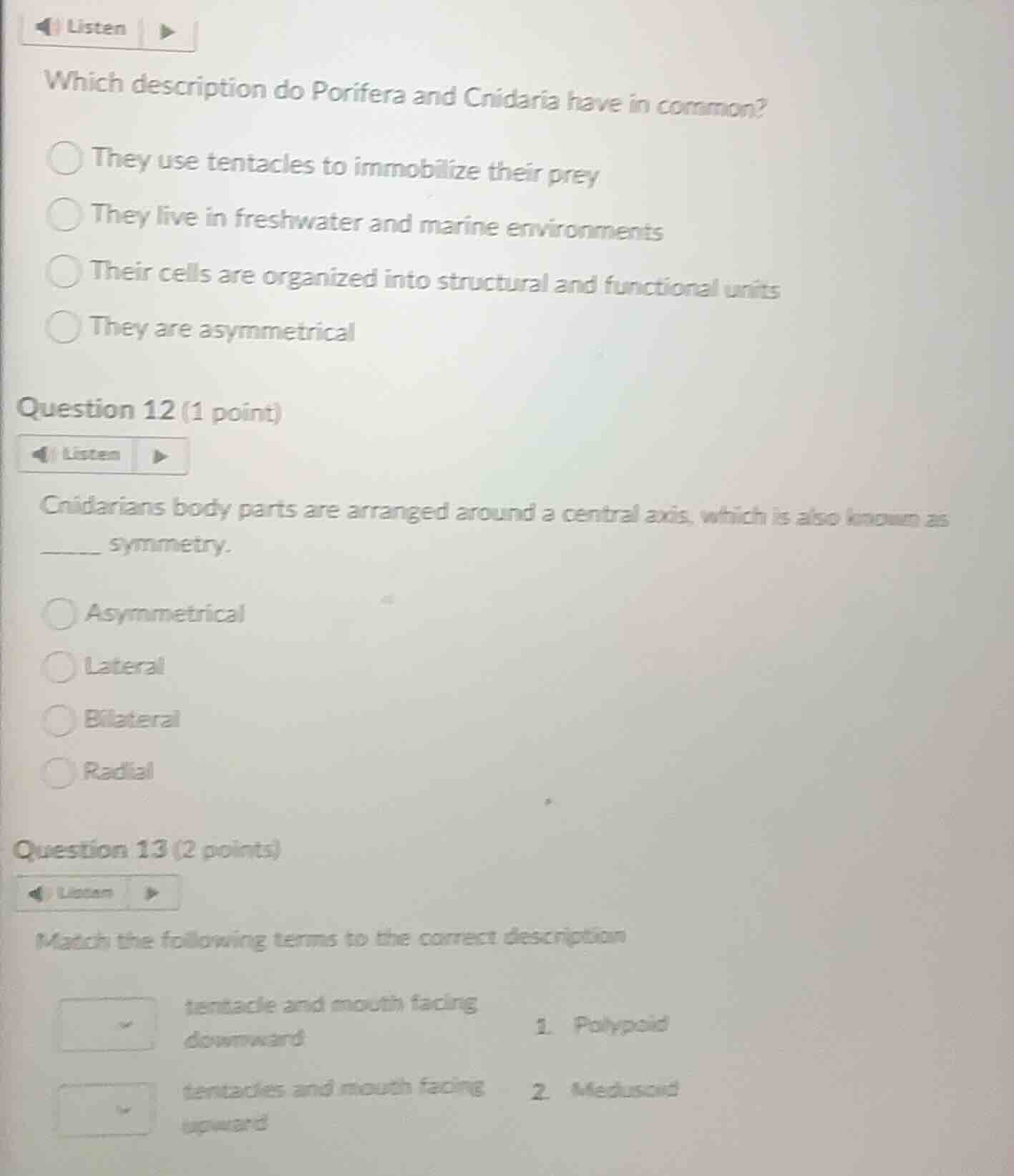
which description do porifera and cnidaria have in common?○ they use tentacles to immobilize their prey○ they live in freshwater and marine environments○ their cells are organized into structural and functional units○ they are asymmetricalquestion 12 (1 point)cnidarians body parts are arranged around a central axis, which is also known as ______ symmetry.○ asymmetrical○ lateral○ bilateral○ radialquestion 13 (2 points)match the following terms to the correct descriptiontentacle and mouth facing downward 1. polypoidtentacles and mouth facing upward 2. medusoid
For the first question:
- Porifera (sponges) lack tentacles, so the first option is incorrect.
- Porifera are mostly marine, some freshwater; Cnidaria live in both, so this is a shared trait.
- Porifera have no true tissues/functional units, while Cnidaria have tissues, so the third option is wrong.
- Cnidaria have radial symmetry, not asymmetry, so the fourth option is incorrect.
For Question 12:
Cnidarians have body parts arranged around a central axis, which defines radial symmetry. Asymmetrical has no axis, lateral is not a standard body symmetry term, bilateral has a single plane dividing into mirror halves, so radial is correct.
For Question 13:
- Polypoid (polyp) forms of cnidarians are sessile, with tentacles and mouth facing upward.
- Medusoid (medusa) forms are free-floating, with tentacles and mouth facing downward.

Snap & solve any problem in the app
Get step-by-step solutions on Sovi AI
Photo-based solutions with guided steps
Explore more problems and detailed explanations
- They live in freshwater and marine environments
- Radial
- tentacle and mouth facing downward: 2. Medusoid
tentacles and mouth facing upward: 1. Polypoid