QUESTION IMAGE
Question
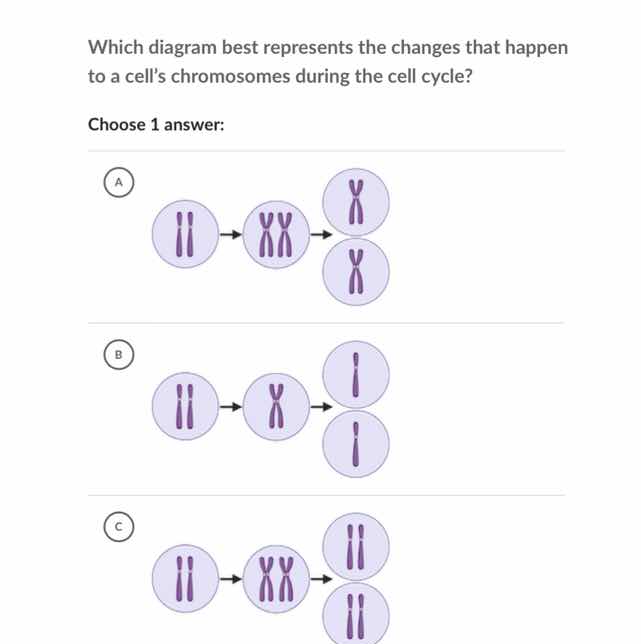
which diagram best represents the changes that happen to a cells chromosomes during the cell cycle? choose 1 answer: a diagram a b diagram b c diagram c
Brief Explanations
- Recall the cell cycle (specifically mitosis) chromosome changes: Interphase (chromosomes replicate, becoming sister chromatids held by a centromere, appearing as "X" - shaped). Then mitosis (prophase, metaphase, anaphase, telophase) leads to sister chromatids separating and each new cell receiving a full set of chromosomes (same as parent cell's chromosome number and structure, with single - stranded chromosomes or re - forming into double - stranded after replication in next cycle? Wait, no: During cell cycle, before mitosis, chromosomes duplicate (S phase) to form sister chromatids (so each chromosome has two chromatids, X - shaped). Then during mitosis, sister chromatids separate, and each daughter cell gets a set of chromosomes. After cell division, the daughter cells have chromosomes that will replicate again in the next cell cycle.
- Analyze each option:
- Option A: The daughter cells have X - shaped chromosomes. But after mitosis, the sister chromatids have separated, so the daughter cells should have single - chromatid chromosomes (which will replicate in the next S phase to become X - shaped again). So A is incorrect.
- Option B: The middle stage has a single X - shaped chromosome? No, during S phase, chromosomes replicate, so if the parent cell has two double - stranded chromosomes (the initial two - chromatid? Wait, no, the initial cell (before S phase) has chromosomes as single chromatids? Wait, maybe better to think: In a normal diploid cell, before S phase, chromosomes are single - stranded (let's say two chromosomes, each single chromatid). After S phase (replication), each chromosome has two sister chromatids (X - shaped). Then during mitosis, sister chromatids separate, so each daughter cell gets a single - stranded chromosome (which will replicate in the next S phase). But in option B, the middle chromosome is single - chromatid? No, that's not right. Wait, maybe I messed up. Wait, the correct process: Start with a cell with chromosomes (e.g., two chromosomes, each as a pair of sister chromatids? No, no. Let's take a simple case: A cell has 2 chromosomes (diploid, 2n). In G1, chromosomes are unreplicated (each is a single chromatid). In S phase, they replicate, so each chromosome has two sister chromatids (so the chromosome looks like X, with two chromatids). Then in mitosis, the sister chromatids separate, and each daughter cell gets a chromosome (single chromatid) that is identical to the original G1 chromosome. Then, in the next cell cycle, these will replicate again. But in the diagram, the starting cell (first circle) has two chromosomes (each as two chromatids? Wait, no, the first circle in each option has two vertical lines, maybe representing two chromosomes, each single chromatid. Then after replication (middle circle), they become X - shaped (two chromatids per chromosome). Then after cell division (two circles), each daughter cell should have two chromosomes, each single chromatid (which will replicate in the next S phase to become X - shaped again). Wait, no, maybe the initial cell is in G1, with two chromosomes (each single chromatid). After S phase (replication), each chromosome has two sister chromatids (so X - shaped). Then during mitosis, sister chromatids separate, so each daughter cell gets a chromosome (single chromatid) that is the same as the G1 chromosome. But in option C, the daughter cells have two chromosomes, each as two chromatids? No, wait, option C: The starting cell has two chromosomes (two vertical lines, maybe single chromatid). Then after replication (middle cell, X - sha…

Snap & solve any problem in the app
Get step-by-step solutions on Sovi AI
Photo-based solutions with guided steps
Explore more problems and detailed explanations
C