QUESTION IMAGE
Question
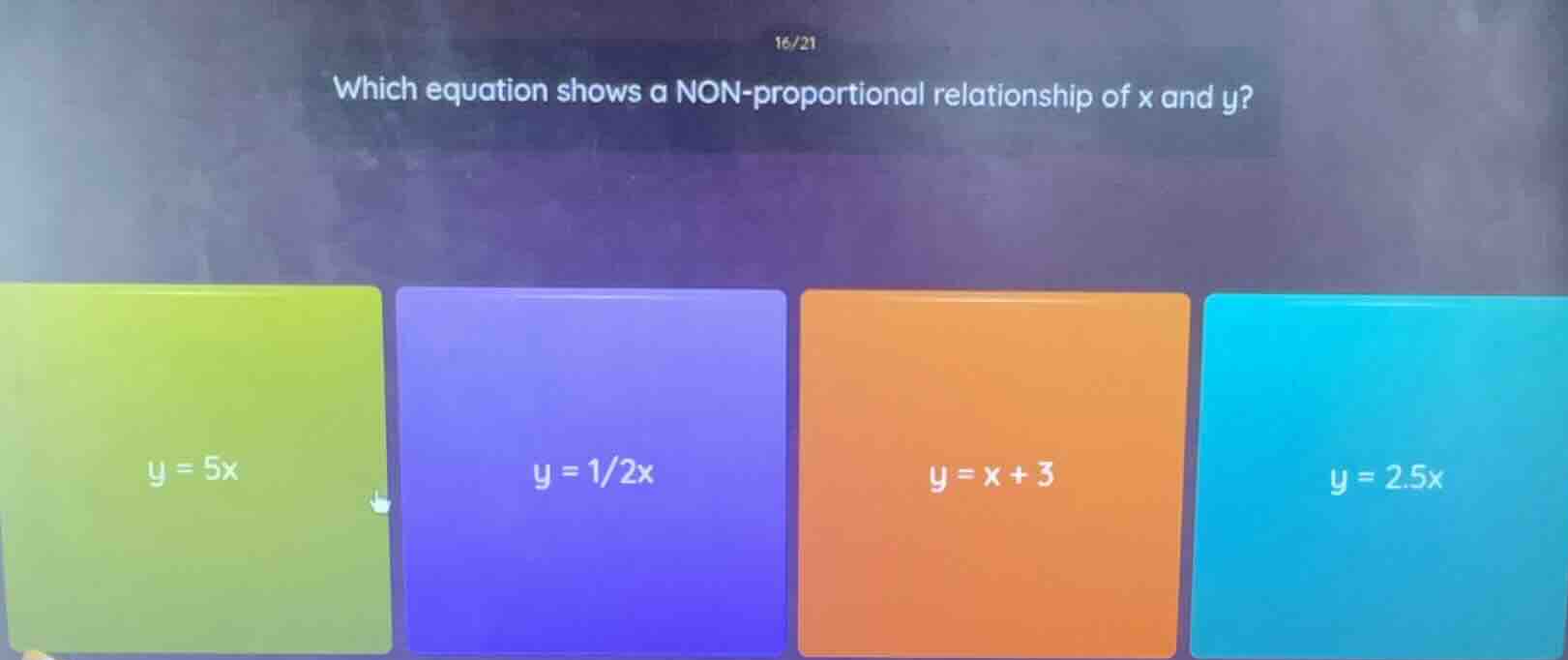
which equation shows a non-proportional relationship of x and y?
$y = 5x$
$y = 1/2x$
$y = x + 3$
$y = 2.5x$
Step1: Recall proportional relationship form
A proportional relationship between \( x \) and \( y \) is of the form \( y = kx \), where \( k \) is a constant (the constant of proportionality), and this line passes through the origin \((0,0)\) (when \( x = 0 \), \( y = 0 \)). A non - proportional relationship has the form \( y=kx + b\) where \( b
eq0\) (it is a linear equation with a non - zero y - intercept).
Step2: Analyze each equation
- For \( y = 5x \): This is in the form \( y=kx\) with \( k = 5 \). When \( x = 0 \), \( y=0\), so it is a proportional relationship.
- For \( y=\frac{1}{2}x \): This is in the form \( y = kx\) with \( k=\frac{1}{2}\). When \( x = 0 \), \( y = 0 \), so it is a proportional relationship.
- For \( y=x + 3 \): This is in the form \( y=kx + b\) with \( k = 1 \) and \( b=3
eq0\). When \( x = 0 \), \( y=3
eq0\), so it does not pass through the origin and is a non - proportional relationship.
- For \( y = 2.5x \): This is in the form \( y=kx\) with \( k = 2.5 \). When \( x = 0 \), \( y=0\), so it is a proportional relationship.

Snap & solve any problem in the app
Get step-by-step solutions on Sovi AI
Photo-based solutions with guided steps
Explore more problems and detailed explanations
The equation that shows a non - proportional relationship of \( x \) and \( y \) is \( y=x + 3 \) (the orange option: \( y=x + 3 \)).