QUESTION IMAGE
Question
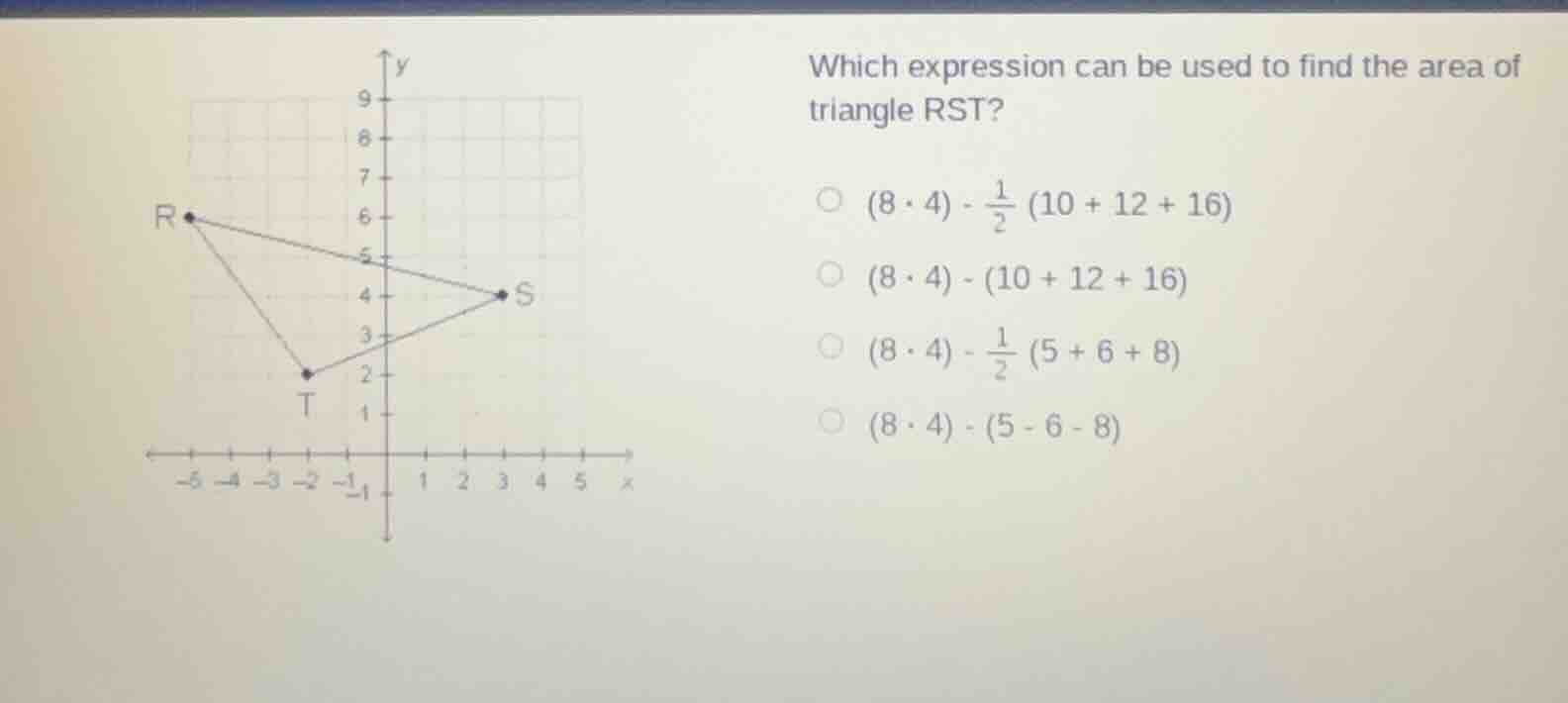
which expression can be used to find the area of triangle rst? (8·4) - \frac{1}{2} (10 + 12 + 16) (8·4) - (10 + 12 + 16) (8·4) - \frac{1}{2} (5 + 6 + 8) (8·4) - (5 - 6 - 8)
Step1: Identify the bounding rectangle
The triangle RST can be enclosed in a rectangle. The length of the rectangle is 8 (from x=-5 to x=3, but actually from the grid, the horizontal length is 8 units) and the height is 4 (vertical from y=2 to y=6? Wait, actually, looking at the coordinates: R is at (-5,6), S at (3,4), T at (-1,2). The bounding rectangle would have width from x=-5 to x=3, so 8 units, and height from y=2 to y=6, so 4 units. Area of rectangle is \(8 \times 4\).
Step2: Calculate areas of the three right triangles outside RST
We need to subtract the areas of the three right triangles from the rectangle's area to get RST's area.
First triangle: base 5 (from x=-5 to x=0? Wait, R(-5,6) to T(-1,2): horizontal distance 4? Wait, maybe better to use coordinates.
Wait, the three triangles:
- Triangle 1: with vertices R(-5,6), (-5,2), T(-1,2). Base 4 (vertical from y=2 to y=6), height 4 (horizontal from x=-5 to x=-1). Area: \(\frac{1}{2} \times 4 \times 4 = 8\)? Wait, no, maybe the given options have 10,12,16. Wait, maybe my initial approach is wrong. Wait the options have (8*4) - 1/2 (10+12+16). Let's check:
Area of rectangle: 8*4=32.
Now, the three triangles outside RST:
First triangle: area \(\frac{1}{2} \times 5 \times 4\)? Wait, no, maybe the three triangles have areas 10/2, 12/2, 16/2? Wait, the first option is (8*4) - 1/2 (10+12+16). Let's compute 10+12+16=38, half of that is 19. 32-19=13? Wait, maybe the three triangles have areas 5,6,8? No, the first option has 10,12,16. Wait, let's recalculate:
Wait, maybe the three triangles:
- Area 1: \(\frac{1}{2} \times 5 \times 4 = 10\) (wait, 5*4/2=10)
- Area 2: \(\frac{1}{2} \times 6 \times 4 = 12\) (6*4/2=12)
- Area 3: \(\frac{1}{2} \times 8 \times 4 = 16\) (8*4/2=16)
Wait, no, 54/2=10, 64/2=12, 84/2=16? Wait, no, 54/2 is 10, 64/2 is 12, 84/2 is 16? Wait, no, 54/2=10, 62/2=6? No, maybe the vertical and horizontal distances.
Wait, the first triangle: base 5, height 4: area 10 (1/254=10)
Second triangle: base 6, height 4: area 12 (1/264=12)
Third triangle: base 8, height 4: area 16 (1/284=16)? No, 1/282=8? Wait, I'm confused. But the first option is (8*4) - 1/2 (10+12+16). Let's check:
84=32. 10+12+16=38. 1/238=19. 32-19=13. Let's see if that makes sense.
Alternatively, the other options:
(8*4) - (10+12+16) = 32-38=-6, impossible.
(84) - 1/2 (5+6+8)=32 - 1/219=32-9.5=22.5, not matching.
(8*4) - (5-6-8)=32 - (-9)=41, impossible.
So the first option is the only one that makes sense, as we subtract half the sum of the three triangle areas (since each triangle's area is 1/2baseheight, so sum of areas is 1/2(sum of baseheight), which is 1/2*(10+12+16)).

Snap & solve any problem in the app
Get step-by-step solutions on Sovi AI
Photo-based solutions with guided steps
Explore more problems and detailed explanations
\((8 \cdot 4) - \frac{1}{2} (10 + 12 + 16)\) (the first option)