QUESTION IMAGE
Question
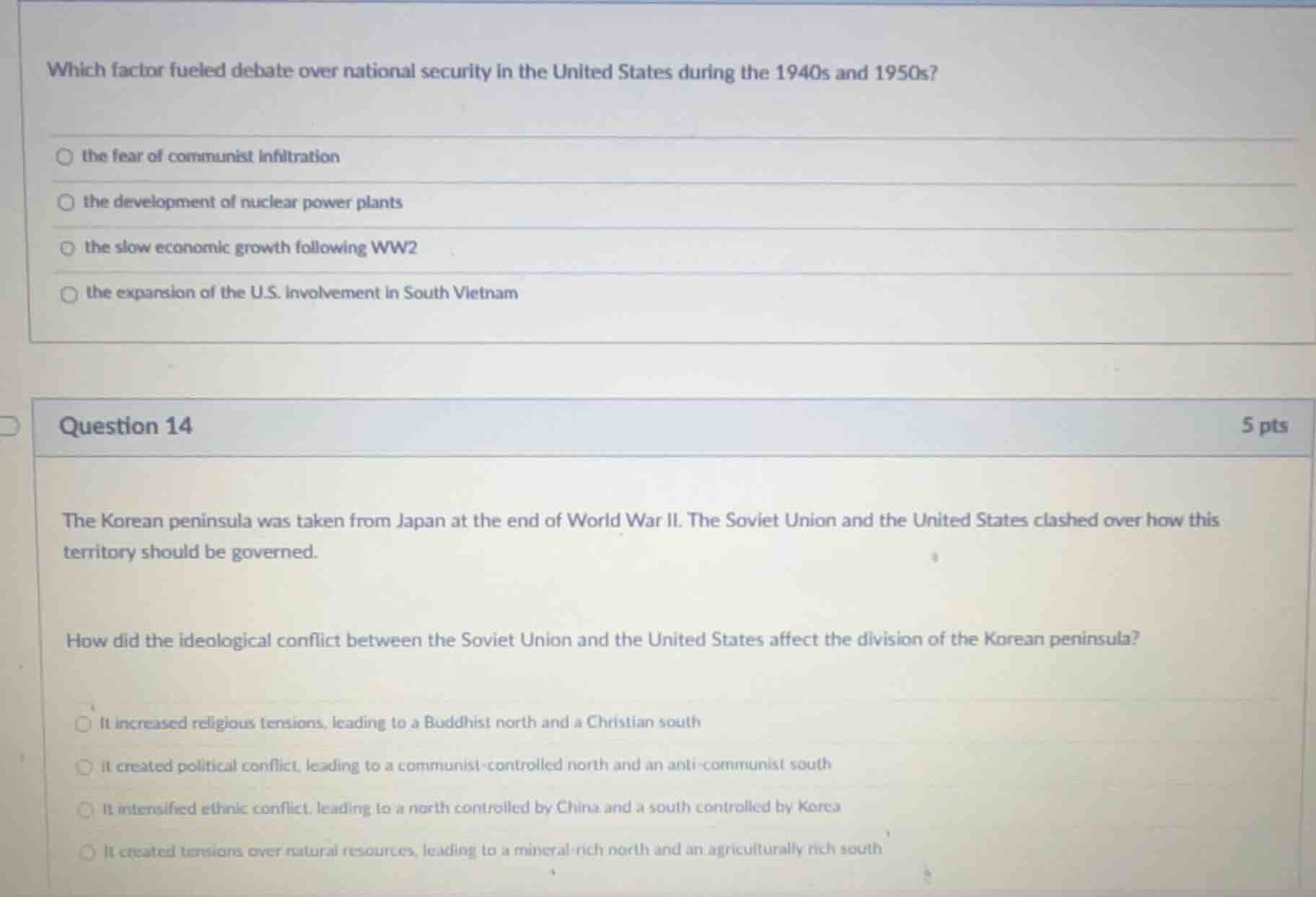
which factor fueled debate over national security in the united states during the 1940s and 1950s? the fear of communist infiltration the development of nuclear power plants the slow economic growth following ww2 the expansion of the u.s. involvement in south vietnam question 14 5 pts the korean peninsula was taken from japan at the end of world war ii. the soviet union and the united states clashed over how this territory should be governed. how did the ideological conflict between the soviet union and the united states affect the division of the korean peninsula? it increased religious tensions, leading to a buddhist north and a christian south it created political conflict, leading to a communist - controlled north and an anti - communist south it intensified ethnic conflict, leading to a north controlled by china and a south controlled by korea it created tensions over natural resources, leading to a mineral - rich north and an agriculturally rich south
First Question (Which factor fueled debate over national security in the US during 1940s - 1950s?)
- Analyze each option:
- "the fear of communist infiltration": During the 1940s - 1950s, the Cold War was ongoing, and the US had a strong fear of communist infiltration (McCarthyism era), which fueled national security debates.
- "the development of nuclear power plants": Nuclear power plant development was not a major national security debate fuel in the 1940s - 1950s (focus was on nuclear weapons and communism).
- "the slow economic growth following WW2": Post - WW2 US had economic growth (boom), not slow growth.
- "the expansion of the U.S. involvement in South Vietnam": US involvement in Vietnam escalated later (1960s), not in 1940s - 1950s.
- Analyze the ideological conflict (capitalism vs communism) between US and USSR:
- The Soviet Union was communist, the US was anti - communist. After WWII, the Korean peninsula was divided. The Soviet - controlled north became communist, and the US - influenced south became anti - communist.
- "It increased religious tensions...": Korea's division was not religious - based.
- "It intensified ethnic conflict...": The division was ideological, not ethnic (same ethnicity in Korea).
- "It created tensions over natural resources...": The division was ideological, not resource - based.

Snap & solve any problem in the app
Get step-by-step solutions on Sovi AI
Photo-based solutions with guided steps
Explore more problems and detailed explanations
the fear of communist infiltration