QUESTION IMAGE
Question
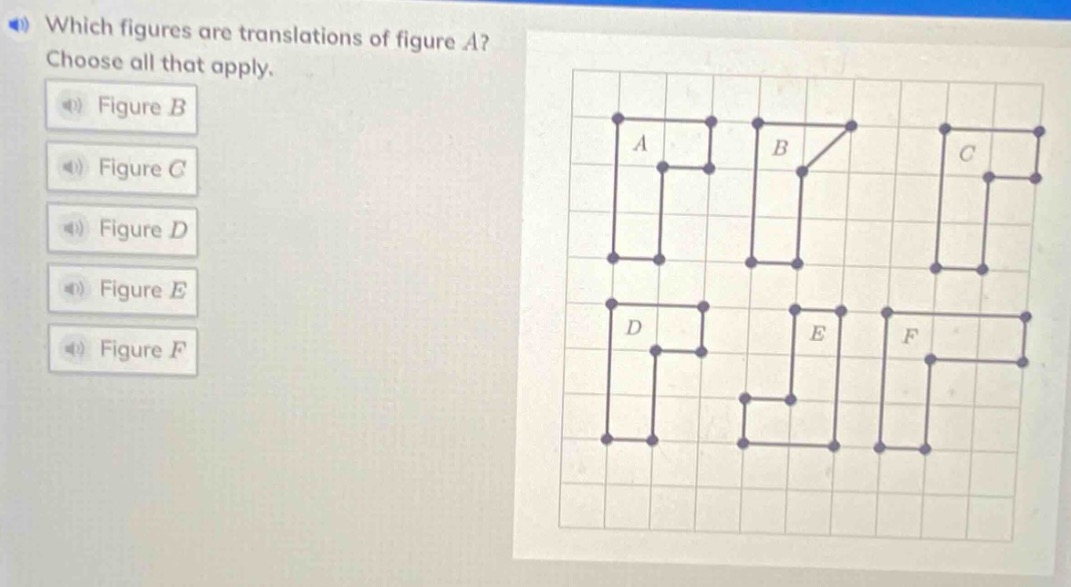
which figures are translations of figure a? choose all that apply. figure b figure c figure d figure e figure f
Step1: Recall translation definition
A translation is a rigid transformation that slides a figure without rotating, reflecting, or changing its shape/size. So we check each figure against Figure A for shape, size, and orientation (no rotation/reflection).
Step2: Analyze Figure B
Figure B has a slanted side where Figure A has a vertical/horizontal side. So it's a reflection or rotation? No, shape changed (angle), so not a translation.
Step3: Analyze Figure C
Figure C: Same shape as A (all right angles, same number of segments, same structure). Slid (translated) horizontally/vertically. No rotation/reflection, same size/shape. So translation.
Step4: Analyze Figure D
Figure D: Same shape as A, same structure (right angles, same segment connections). Slid (translated) down. No rotation/reflection, same size/shape. So translation.
Step5: Analyze Figure E
Figure E: Has a different structure (the "notch" is in a different place, or it's a reflection/rotation? Let's see: A has a small square attached on the right? Wait, no, A's shape: let's visualize A: a larger rectangle with a smaller square attached on the right (top part). E's shape: the smaller square is on the left bottom? So it's a rotation or reflection. So not a translation.
Step6: Analyze Figure F
Figure F: The shape is stretched? Wait, no, A's size: let's check the number of grid units. A: height, width. F: seems wider? Wait, no, maybe I missee. Wait, no: A, C, D: same shape (the small square is attached in the same relative position). F: the small square is attached, but the main rectangle is wider? Wait, no, maybe not. Wait, no: let's check the structure. A: a vertical rectangle with a horizontal square on top right? Wait, looking at the grid:
Figure A: top part: two horizontal dots, then a vertical down, then a horizontal left, etc. Wait, maybe better to see: Figure A, C, D have the same "L" - like shape with a small square attached in the same orientation. Figure F: the small square is attached, but the main rectangle is longer? No, wait, no—wait, Figure F: let's count the segments. A: let's say the main figure is a 3x2 rectangle? No, maybe the key is: translation preserves shape, size, and orientation (same direction of sides).
So Figure C: same as A, translated. Figure D: same as A, translated down. Figure F: wait, no—wait, maybe I made a mistake. Wait, the problem: let's re - check.
Wait, Figure A: structure: top horizontal, then down, then right, then down, etc. Wait, maybe the correct ones are C, D? Wait, no, maybe C, D, and... Wait, no, let's look again.
Wait, Figure C: same as A, moved right. Figure D: same as A, moved down. Figure F: does it have the same shape? Wait, Figure F: the small square is attached, but the main rectangle is wider? No, maybe not. Wait, maybe the answer is Figure C, Figure D, and maybe Figure F? No, wait, no—wait, the original Figure A: let's see the coordinates (assuming grid points). Let's assign coordinates:
Let’s say Figure A is at (x1,y1) to (x2,y2) with the small square. Figure C: same shape, shifted right. Figure D: same shape, shifted down. Figure F: the shape is different? Wait, no, maybe I messed up. Wait, the correct answers should be Figure C, Figure D, and maybe Figure F? No, wait, let's check the problem again.
Wait, the user's grid:
Top row: A, B, C
Middle row: D, E, F
So Figure A: top - left, Figure B: middle top, Figure C: top right.
Figure D: bottom left, Figure E: bottom middle, Figure F: bottom right.
Now, Figure A: shape: a vertical rectangle (height 3, width 1) with a horizontal square (wid…

Snap & solve any problem in the app
Get step-by-step solutions on Sovi AI
Photo-based solutions with guided steps
Explore more problems and detailed explanations
Figure C, Figure D