QUESTION IMAGE
Question
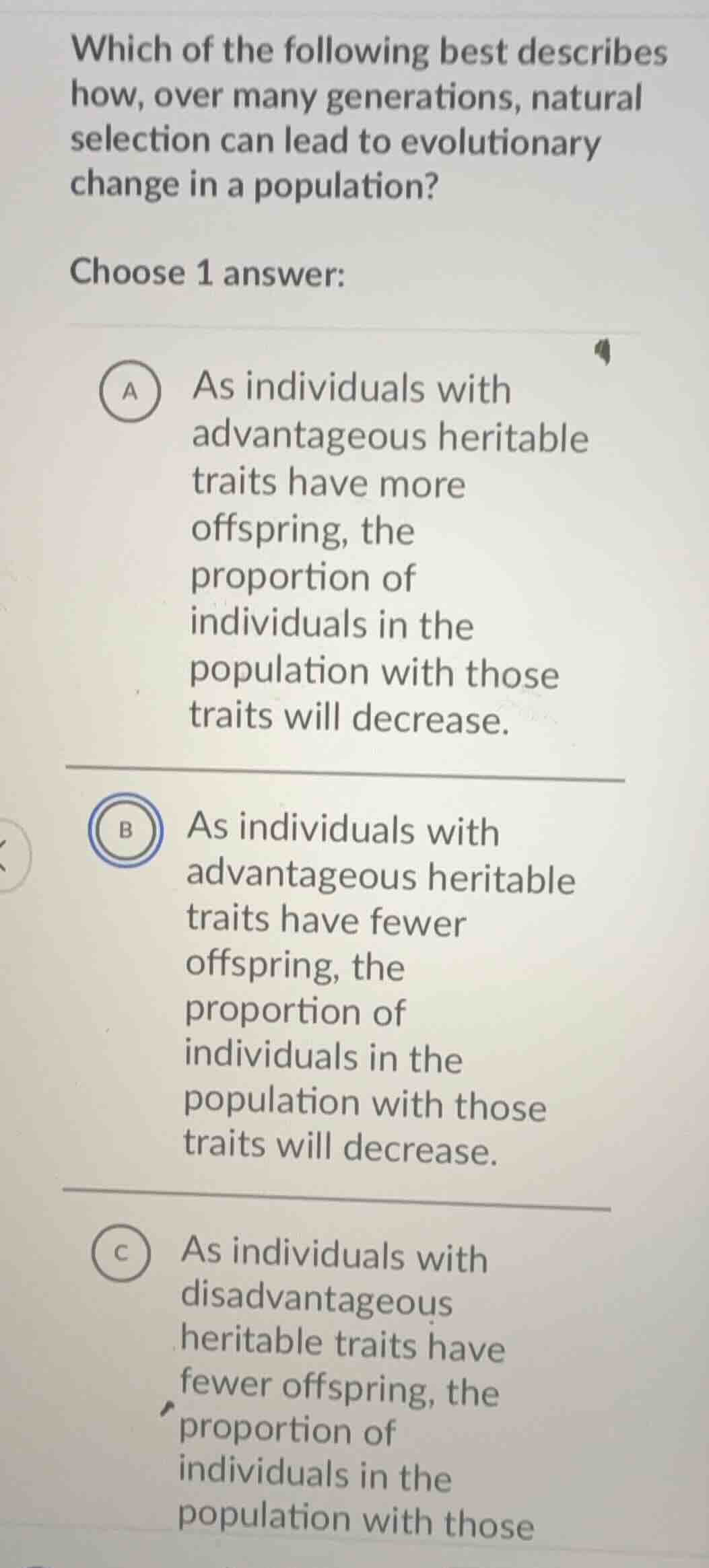
which of the following best describes how, over many generations, natural selection can lead to evolutionary change in a population? choose 1 answer: a as individuals with advantageous heritable traits have more offspring, the proportion of individuals in the population with those traits will decrease. b as individuals with advantageous heritable traits have fewer offspring, the proportion of individuals in the population with those traits will decrease. c as individuals with disadvantageous heritable traits have fewer offspring, the proportion of individuals in the population with those
To determine the correct answer, we analyze the concept of natural selection:
- Option A: If individuals with advantageous heritable traits have more offspring, the proportion of those traits in the population should increase, not decrease. So A is incorrect.
- Option B: Individuals with advantageous heritable traits should have more (not fewer) offspring to increase the proportion of those traits. So B is incorrect.
- Option C: Individuals with disadvantageous heritable traits are less likely to survive and reproduce, so they have fewer offspring. This leads to a decrease in the proportion of those disadvantageous traits in the population over generations, which is consistent with how natural selection drives evolutionary change. (Assuming the rest of option C, though cut off, follows this logic as it's the only one with a correct mechanism.)

Snap & solve any problem in the app
Get step-by-step solutions on Sovi AI
Photo-based solutions with guided steps
Explore more problems and detailed explanations
C. As individuals with disadvantageous heritable traits have fewer offspring, the proportion of individuals in the population with those traits will decrease.