QUESTION IMAGE
Question
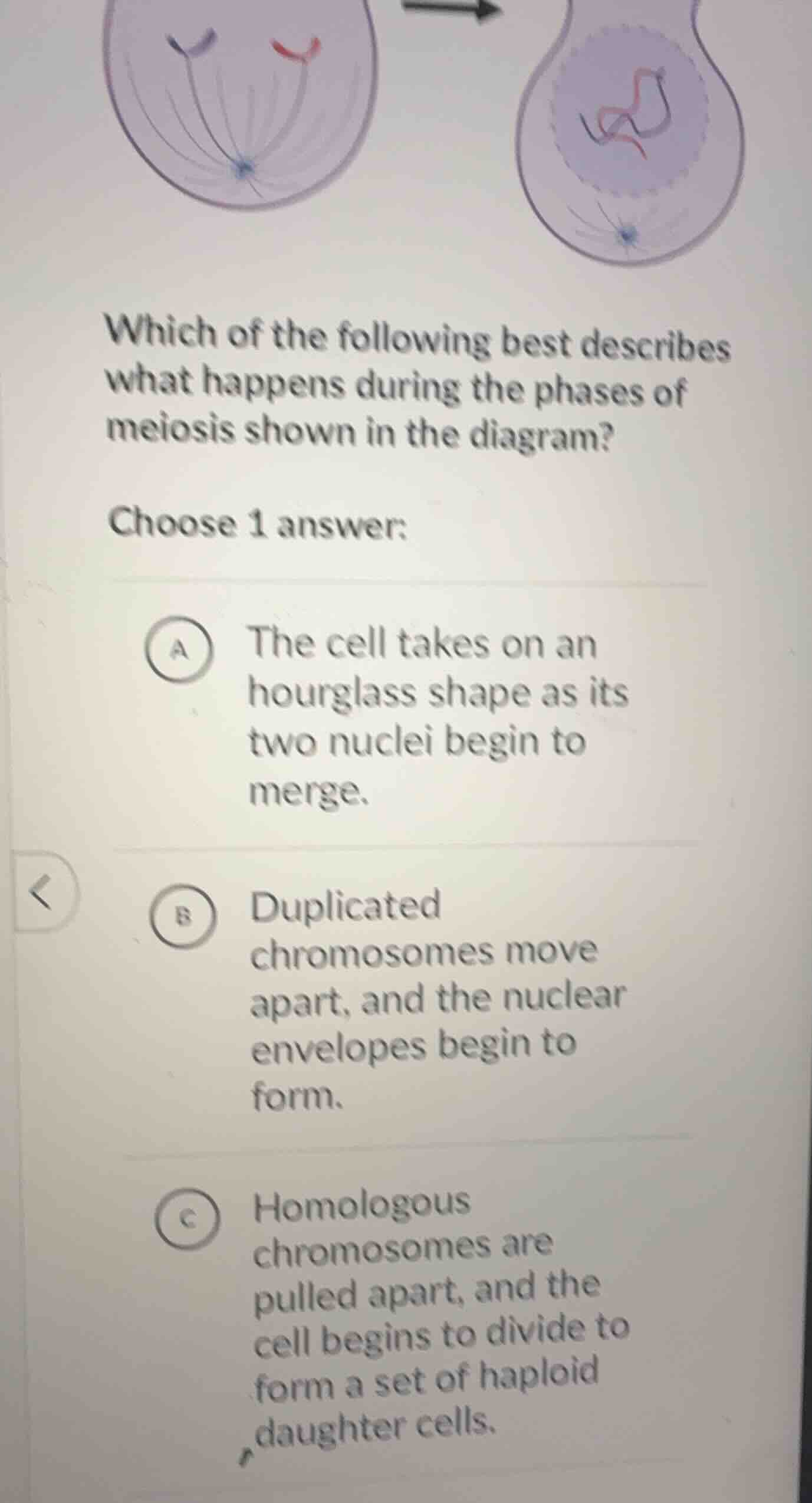
which of the following best describes what happens during the phases of meiosis shown in the diagram? choose 1 answer: a the cell takes on an hourglass shape as its two nuclei begin to merge. b duplicated chromosomes move apart, and the nuclear envelopes begin to form. c homologous chromosomes are pulled apart, and the cell begins to divide to form a set of haploid daughter cells.
Brief Explanations
- Analyze Option A: Nuclear merging is not a part of meiosis; meiosis involves nuclear division to form haploid cells, so A is incorrect.
- Analyze Option B: The description of duplicated chromosomes moving apart and nuclear envelopes forming matches the telophase stage of meiosis (or mitosis), but in the context of meiosis, after chromosome separation (like in anaphase II or telophase), this can occur. Wait, no—wait, let's re - check. Wait, the diagram: in the first cell, chromosomes are being pulled (maybe anaphase), then the second cell has nuclear envelopes forming? Wait, no, the key is: in meiosis, during telophase (after anaphase where chromosomes move), nuclear envelopes reform. But let's check Option C: Homologous chromosomes are pulled apart in anaphase I. But the diagram—if the first cell has two sets of chromosomes (maybe sister chromatids? Wait, no, the first cell: the chromosomes are moving, then the second cell has a nucleus forming. Wait, Option B: Duplicated chromosomes (sister chromatids) moving apart (anaphase) and nuclear envelopes forming (telophase). Option C: Homologous chromosomes are pulled apart in anaphase I, but after that, the cell divides. Wait, maybe the diagram is showing telophase or the end of anaphase and start of telophase. Let's re - evaluate:
- Option A: Nuclei merging is wrong, meiosis is about division, not fusion.
- Option B: Duplicated chromosomes (sister chromatids) moving apart (like in anaphase) and nuclear envelopes forming (telophase) is a correct description of the later stages of meiosis (or mitosis, but in meiosis, after chromosome movement, nuclear envelopes form as cells prepare to divide into haploid cells).
- Option C: Homologous chromosomes are pulled apart in anaphase I, but the diagram doesn't seem to show homologous chromosomes (since if it's after anaphase I, the cell would be dividing, but the diagram shows a single cell with a nucleus forming). So Option B is more accurate.

Snap & solve any problem in the app
Get step-by-step solutions on Sovi AI
Photo-based solutions with guided steps
Explore more problems and detailed explanations
B. Duplicated chromosomes move apart, and the nuclear envelopes begin to form.