QUESTION IMAGE
Question
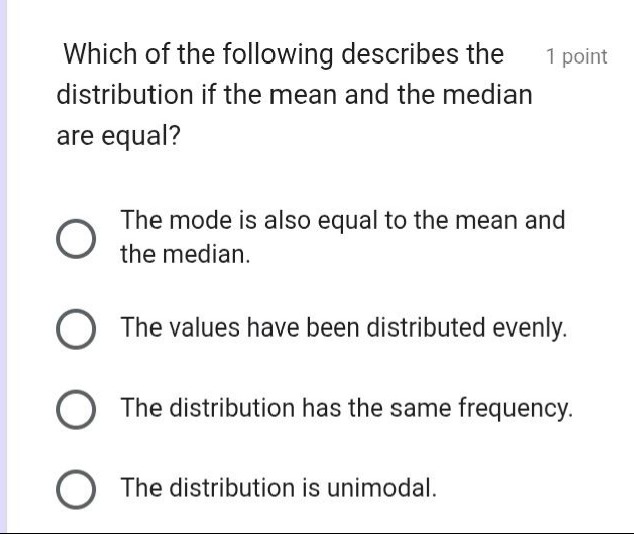
which of the following describes the distribution if the mean and the median are equal? the mode is also equal to the mean and the median. the values have been distributed evenly. the distribution has the same frequency. the distribution is unimodal.
- Analyze Option 1: In a symmetric (especially normal) distribution, mean = median = mode. If mean and median are equal, in a symmetric unimodal distribution, mode also equals them. But let's check others.
- Analyze Option 2: Even distribution (uniform) has mean = median (since all values equally likely, center is same), but uniform has no mode (or all modes), but the key here - if mean = median, a uniform distribution (values evenly distributed) has this property. Wait, but let's re - check. Wait, uniform distribution: all outcomes have equal probability. The mean and median of a uniform distribution over [a,b] is (a + b)/2, so they are equal. But let's check other options.
- Analyze Option 3: "Same frequency" is unclear. If all data points have same frequency, it's a uniform distribution (which is a type of even distribution), but the wording "same frequency" is not as accurate as "evenly distributed". Also, in a non - uniform but symmetric distribution (like normal), frequencies are not same (they follow a bell - curve), but mean = median. So this option is incorrect.
- Analyze Option 4: A unimodal distribution just has one mode. It can be skewed (e.g., a skewed unimodal distribution where mean ≠ median). So unimodality doesn't imply mean = median.
Now, re - evaluating: In a uniform distribution (values distributed evenly), mean and median are equal. Also, in a normal distribution (symmetric, unimodal), mean = median = mode. But the option "The values have been distributed evenly" (uniform distribution) has mean = median. Let's check the first option: "The mode is also equal to the mean and the median" - this is true for normal (symmetric unimodal) distributions, but is it always true when mean = median? No. For example, in a uniform distribution (evenly distributed, no mode or all modes), the mode doesn't exist (or is all values), so the mode can't be equal to mean/median (since there's no single mode). Wait, this is a mistake. Wait, uniform distribution: if we have a discrete uniform distribution (e.g., values 1,2,3 with equal frequency), the mode is all three values (multimodal), so mode is not equal to mean (2) and median (2). So the first option is incorrect.
The second option: "The values have been distributed evenly" (uniform distribution) - in continuous uniform, mean = median. In discrete uniform, mean = median. So this is a case where mean = median. The other options: "same frequency" is ambiguous, "unimodal" doesn't guarantee mean = median (skewed unimodal has mean ≠ median). So the correct answer is "The values have been distributed evenly".
Wait, but let's think again. In a symmetric distribution (like normal), which is unimodal, mean = median = mode. But in that case, the values are not evenly distributed (they are concentrated around the mean). So there's a conflict. Wait, maybe the question is looking for the most appropriate. Let's re - examine the options.
Wait, the key: If mean and median are equal, what does it imply? In a distribution where values are evenly distributed (uniform), mean = median. In a symmetric distribution (normal), mean = median = mode. But the option "The values have been distributed evenly" is a situation where mean = median. The option "The mode is also equal to the mean and the median" is only true for symmetric unimodal distributions, but not for uniform (which has no single mode). So the best answer is "The values have been distributed evenly".

Snap & solve any problem in the app
Get step-by-step solutions on Sovi AI
Photo-based solutions with guided steps
Explore more problems and detailed explanations
The values have been distributed evenly. (The option: The values have been distributed evenly)