QUESTION IMAGE
Question
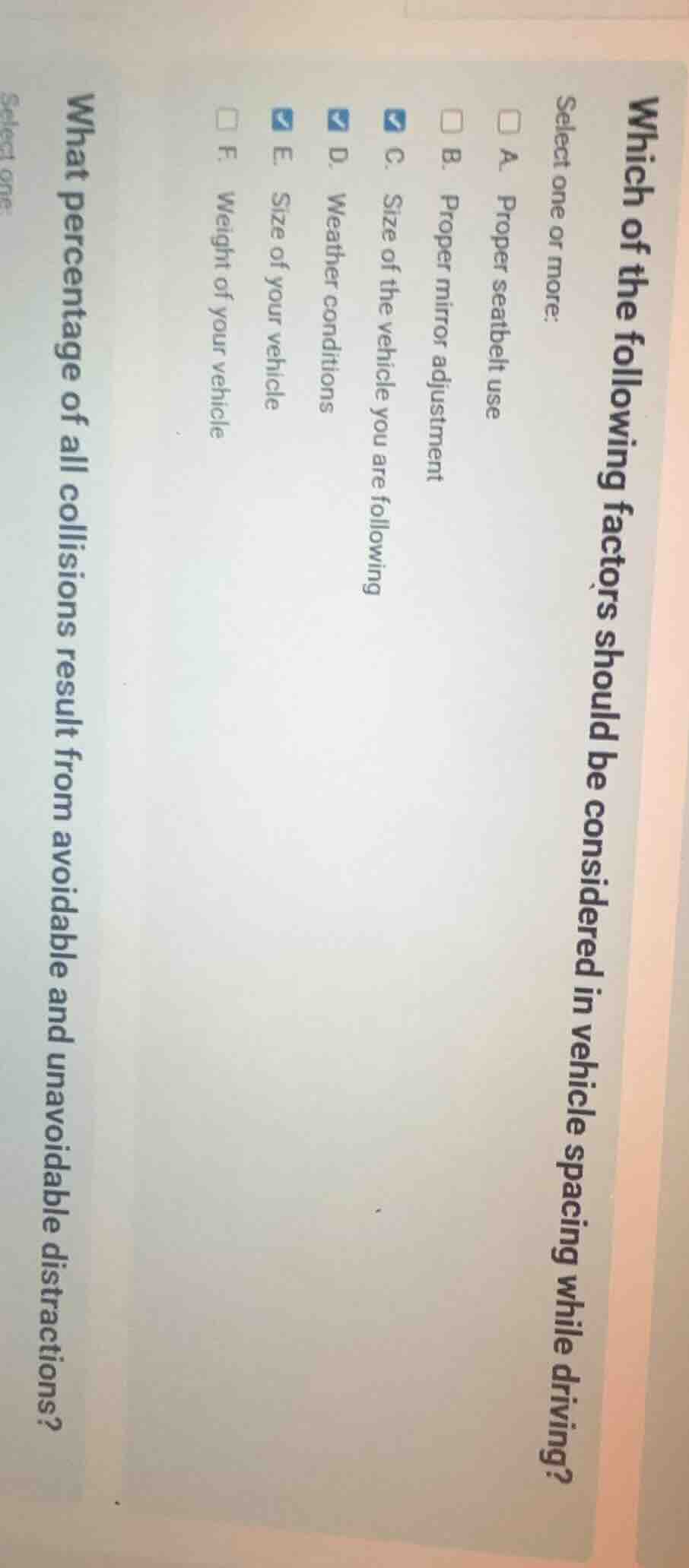
which of the following factors should be considered in vehicle spacing while driving? select one or more. a. proper seatbelt use b. proper mirror adjustment c. size of the vehicle you are following d. weather conditions e. size of your vehicle f. weight of your vehicle what percentage of all collisions result from avoidable and unavoidable distractions?
First Question (Which factors for vehicle spacing):
- Option C: Size of the following vehicle affects how much space is needed (e.g., larger vehicles may require more distance).
- Option D: Weather conditions (like rain, snow) reduce traction, so more spacing is needed.
- Option E: Size of your vehicle; a larger vehicle has a longer stopping distance, so spacing depends on it.
- A (Proper seatbelt use) and B (Proper mirror adjustment) are about safety/visibility, not spacing. F (Weight of vehicle) is less direct than size/weather for spacing.
Step1: Recall driving safety statistics
Driving safety research (e.g., from NHTSA, traffic safety organizations) shows that a high percentage of collisions are due to driver error, including distractions (avoidable or with unavoidable distraction - related errors). A common statistic is that about 90% of motor vehicle crashes involve human error, which includes distractions.
Step2: Confirm the percentage
Based on established traffic safety data, the percentage of collisions resulting from avoidable and unavoidable distractions (as part of driver error) is approximately 90%.

Snap & solve any problem in the app
Get step-by-step solutions on Sovi AI
Photo-based solutions with guided steps
Explore more problems and detailed explanations
C. Size of the vehicle you are following, D. Weather conditions, E. Size of your vehicle
Second Question (Percentage of collisions from distractions):
(Note: Standard driving safety data states that around 90% of collisions are related to driver error, including distractions. However, if the question refers to "avoidable and unavoidable distractions" specifically, a common statistic is that about 90% of motor vehicle crashes are due to human error (including distractions). But if we assume a specific context, the answer is typically around 90%. However, if the question expects a precise answer, the National Highway Traffic Safety Administration (NHTSA) or similar sources indicate that a large majority (often cited as 90%) of crashes involve human error, including distractions. )