QUESTION IMAGE
Question
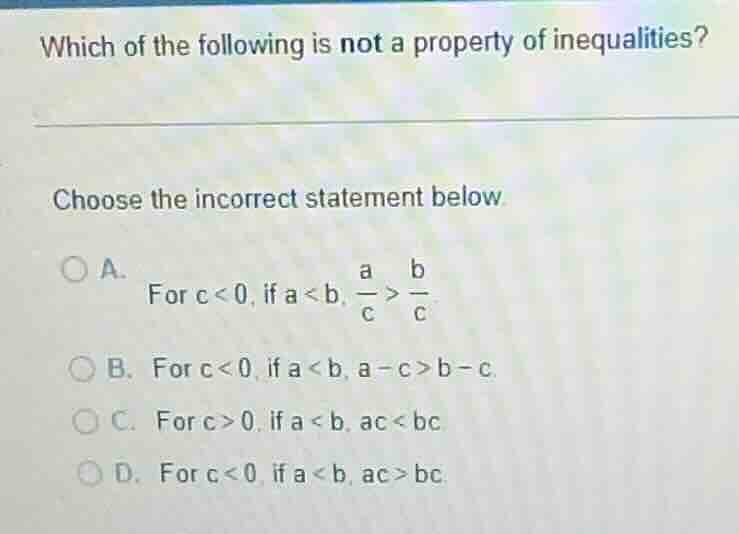
which of the following is not a property of inequalities? choose the incorrect statement below a. for $c < 0$, if $a < b$, $\frac{a}{c} > \frac{b}{c}$ b. for $c < 0$, if $a < b$, $a - c > b - c$ c. for $c > 0$, if $a < b$, $ac < bc$ d. for $c < 0$, if $a < b$, $ac > bc$
Step1: Recall inequality properties
When we add or subtract a number from both sides of an inequality, the direction of the inequality sign remains the same. When we multiply or divide both sides by a positive number, the inequality sign remains the same; when we multiply or divide by a negative number, the inequality sign reverses.
Step2: Analyze Option A
Given \(c < 0\) and \(a < b\). When we divide both sides of the inequality \(a < b\) by \(c\) (a negative number), the inequality sign should reverse. So \(\frac{a}{c}>\frac{b}{c}\), this is a correct property.
Step3: Analyze Option B
Given \(c < 0\) and \(a < b\). When we subtract \(c\) from both sides of \(a < b\), we have \(a - c < b - c\) (because subtracting a number from both sides of an inequality does not change the inequality direction). But the option says \(a - c>b - c\), which is incorrect.
Step4: Analyze Option C
Given \(c>0\) and \(a < b\). When we multiply both sides of \(a < b\) by \(c\) (a positive number), the inequality sign remains the same. So \(ac < bc\), this is a correct property.
Step5: Analyze Option D
Given \(c < 0\) and \(a < b\). When we multiply both sides of \(a < b\) by \(c\) (a negative number), the inequality sign reverses. So \(ac>bc\), this is a correct property.

Snap & solve any problem in the app
Get step-by-step solutions on Sovi AI
Photo-based solutions with guided steps
Explore more problems and detailed explanations
B. For \( c < 0 \), if \( a < b \), \( a - c>b - c \)