QUESTION IMAGE
Question
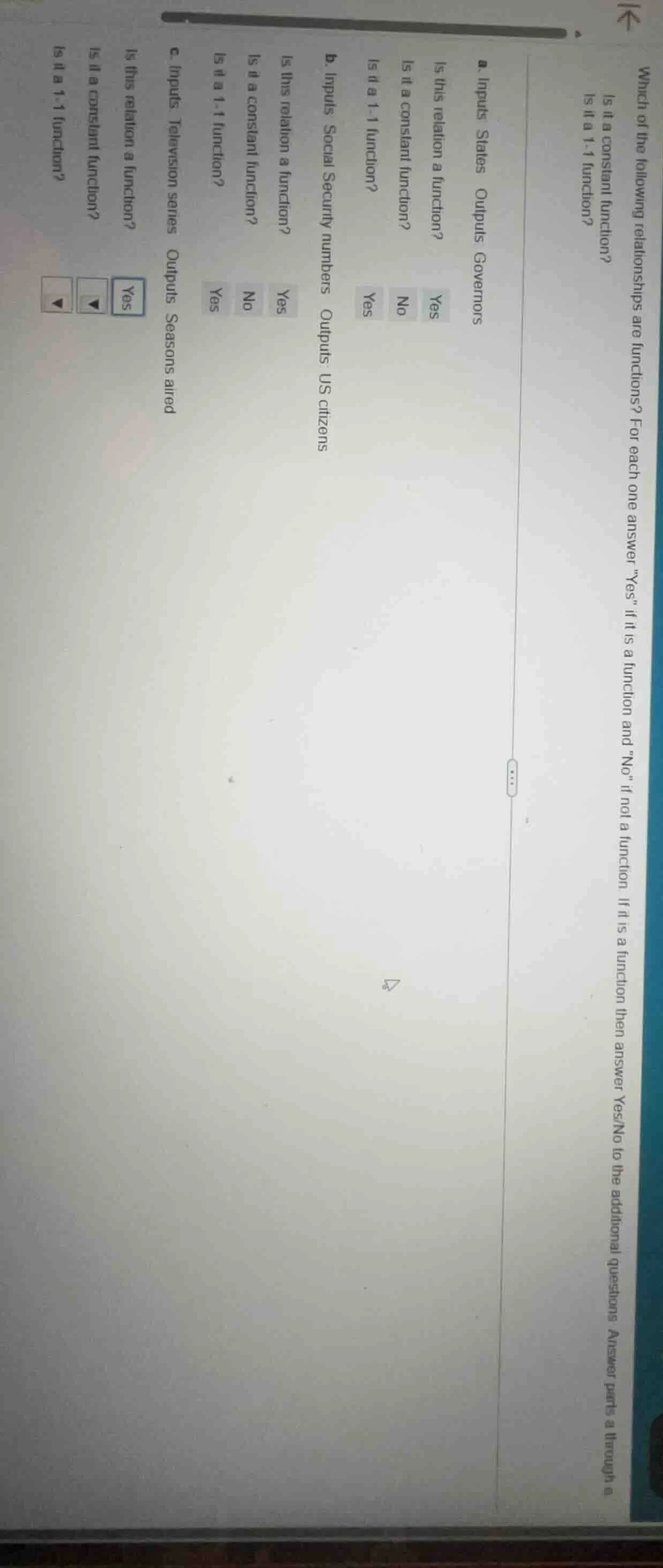
which of the following relationships are functions? for each one answer \yes\ if it is a function and
o\ if not a function. if it is a function then answer yes/no to the additional questions. answer parts a through c.
is it a constant function?
is it a 1-1 function?
a. inputs: states outputs: governors
is this relation a function?
is it a constant function?
is it a 1-1 function?
b. inputs: social security numbers outputs: us citizens
is this relation a function?
is it a constant function?
is it a 1-1 function?
c. inputs: television series outputs: seasons aired
is this relation a function?
is it a constant function?
is it a 1-1 function?
Part a: Inputs - States, Outputs - Governors
Is this relation a function?
A relation is a function if each input (state) has exactly one output (governor). Since each state has only one governor, this is a function. So answer: Yes.
Is it a constant function?
A constant function has the same output for all inputs. Different states have different governors, so it's not a constant function. Answer: No.
Is it a 1 - 1 function?
A 1 - 1 (one - to - one) function means that if \(f(x_1)=f(x_2)\), then \(x_1 = x_2\). If two states had the same governor, it wouldn't be 1 - 1, but in reality, each governor is for one state (in the context of this relation, assuming each state has a unique governor), so if we consider the relation from states to governors, and since each governor is associated with one state, it is 1 - 1. Wait, actually, the definition of a function from states to governors: each state (input) has one governor (output). For 1 - 1, we need that each output (governor) has at most one input (state). Since each governor is for one state, so yes, it is 1 - 1. Answer: Yes.
Part b: Inputs - Social Security numbers, Outputs - US citizens
Is this relation a function?
A relation from Social Security numbers (SSN) to US citizens: each SSN is assigned to exactly one US citizen (by definition, an SSN is unique to a person). So each input (SSN) has exactly one output (citizen), so it is a function. Answer: Yes.
Is it a constant function?
A constant function would have the same output (citizen) for all inputs (SSN). Since different SSNs are for different citizens, it's not a constant function. Answer: No.
Is it a 1 - 1 function?
A 1 - 1 function means that if \(f(x_1)=f(x_2)\), then \(x_1=x_2\). Since each SSN is unique to a citizen, if two SSNs had the same citizen, that would mean the same citizen has two SSNs, which is not the case. So if \(f(SSN_1)=f(SSN_2)\) (same citizen), then \(SSN_1 = SSN_2\). So it is 1 - 1. Answer: Yes.
Part c: Inputs - Television series, Outputs - Seasons aired
Is this relation a function?
A relation from television series to seasons aired: each television series has a certain number of seasons aired (assuming we are considering the number of seasons as the output). So each input (series) has exactly one output (number of seasons), so it is a function. Answer: Yes.
Is it a constant function?
A constant function has the same output for all inputs. Different television series have different numbers of seasons, so it's not a constant function. Answer: No.
Is it a 1 - 1 function?
A 1 - 1 function means that if \(f(x_1)=f(x_2)\), then \(x_1=x_2\). If two different television series had the same number of seasons, then it wouldn't be 1 - 1. Since there are multiple series with the same number of seasons (e.g., many series have 1 season, or 2 seasons etc.), so if \(f(series_1)=f(series_2)\) (same number of seasons), \(series_1\) is not necessarily equal to \(series_2\). So it is not 1 - 1. Answer: No.
Final Answers (summarized for each part):
Part a:
- Is this relation a function? \(\boldsymbol{Yes}\)
- Is it a constant function? \(\boldsymbol{No}\)
- Is it a 1 - 1 function? \(\boldsymbol{Yes}\)
Part b:
- Is this relation a function? \(\boldsymbol{Yes}\)
- Is it a constant function? \(\boldsymbol{No}\)
- Is it a 1 - 1 function? \(\boldsymbol{Yes}\)
Part c:
- Is this relation a function? \(\boldsymbol{Yes}\)
- Is it a constant function? \(\boldsymbol{No}\)
- Is it a 1 - 1 function? \(\boldsymbol{No}\)

Snap & solve any problem in the app
Get step-by-step solutions on Sovi AI
Photo-based solutions with guided steps
Explore more problems and detailed explanations
Part a: Inputs - States, Outputs - Governors
Is this relation a function?
A relation is a function if each input (state) has exactly one output (governor). Since each state has only one governor, this is a function. So answer: Yes.
Is it a constant function?
A constant function has the same output for all inputs. Different states have different governors, so it's not a constant function. Answer: No.
Is it a 1 - 1 function?
A 1 - 1 (one - to - one) function means that if \(f(x_1)=f(x_2)\), then \(x_1 = x_2\). If two states had the same governor, it wouldn't be 1 - 1, but in reality, each governor is for one state (in the context of this relation, assuming each state has a unique governor), so if we consider the relation from states to governors, and since each governor is associated with one state, it is 1 - 1. Wait, actually, the definition of a function from states to governors: each state (input) has one governor (output). For 1 - 1, we need that each output (governor) has at most one input (state). Since each governor is for one state, so yes, it is 1 - 1. Answer: Yes.
Part b: Inputs - Social Security numbers, Outputs - US citizens
Is this relation a function?
A relation from Social Security numbers (SSN) to US citizens: each SSN is assigned to exactly one US citizen (by definition, an SSN is unique to a person). So each input (SSN) has exactly one output (citizen), so it is a function. Answer: Yes.
Is it a constant function?
A constant function would have the same output (citizen) for all inputs (SSN). Since different SSNs are for different citizens, it's not a constant function. Answer: No.
Is it a 1 - 1 function?
A 1 - 1 function means that if \(f(x_1)=f(x_2)\), then \(x_1=x_2\). Since each SSN is unique to a citizen, if two SSNs had the same citizen, that would mean the same citizen has two SSNs, which is not the case. So if \(f(SSN_1)=f(SSN_2)\) (same citizen), then \(SSN_1 = SSN_2\). So it is 1 - 1. Answer: Yes.
Part c: Inputs - Television series, Outputs - Seasons aired
Is this relation a function?
A relation from television series to seasons aired: each television series has a certain number of seasons aired (assuming we are considering the number of seasons as the output). So each input (series) has exactly one output (number of seasons), so it is a function. Answer: Yes.
Is it a constant function?
A constant function has the same output for all inputs. Different television series have different numbers of seasons, so it's not a constant function. Answer: No.
Is it a 1 - 1 function?
A 1 - 1 function means that if \(f(x_1)=f(x_2)\), then \(x_1=x_2\). If two different television series had the same number of seasons, then it wouldn't be 1 - 1. Since there are multiple series with the same number of seasons (e.g., many series have 1 season, or 2 seasons etc.), so if \(f(series_1)=f(series_2)\) (same number of seasons), \(series_1\) is not necessarily equal to \(series_2\). So it is not 1 - 1. Answer: No.
Final Answers (summarized for each part):
Part a:
- Is this relation a function? \(\boldsymbol{Yes}\)
- Is it a constant function? \(\boldsymbol{No}\)
- Is it a 1 - 1 function? \(\boldsymbol{Yes}\)
Part b:
- Is this relation a function? \(\boldsymbol{Yes}\)
- Is it a constant function? \(\boldsymbol{No}\)
- Is it a 1 - 1 function? \(\boldsymbol{Yes}\)
Part c:
- Is this relation a function? \(\boldsymbol{Yes}\)
- Is it a constant function? \(\boldsymbol{No}\)
- Is it a 1 - 1 function? \(\boldsymbol{No}\)