QUESTION IMAGE
Question
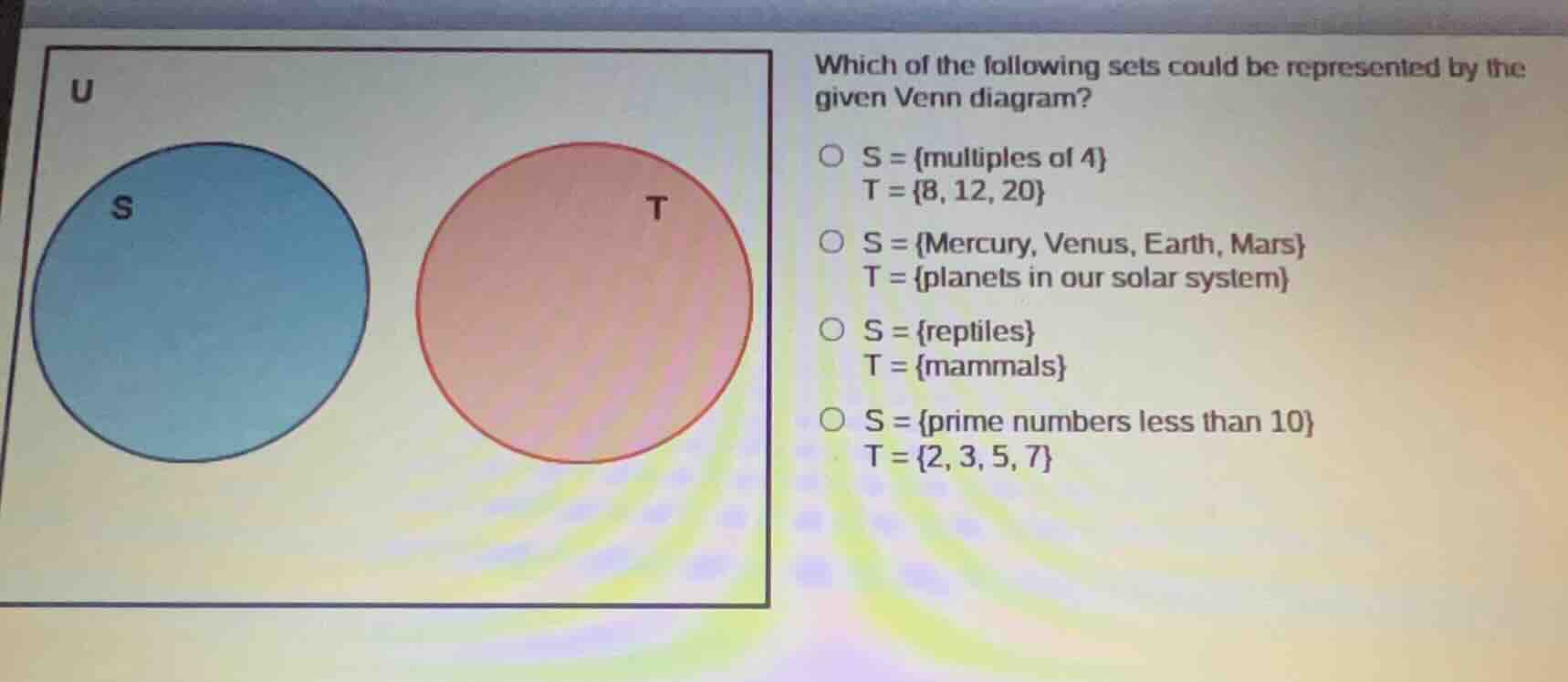
which of the following sets could be represented by the given venn diagram? s = {multiples of 4} t = {8, 12, 20} s = {mercury, venus, earth, mars} t = {planets in our solar system} s = {reptiles} t = {mammals} s = {prime numbers less than 10} t = {2, 3, 5, 7}
Brief Explanations
- Analyze Option 1: \( S = \{ \text{multiples of 4} \} \), \( T = \{8, 12, 20\} \). Since 8, 12, 20 are multiples of 4, \( T \) should be a subset of \( S \), but the Venn diagram shows disjoint sets, so this is incorrect.
- Analyze Option 2: \( S = \{ \text{Mercury, Venus, Earth, Mars} \} \), \( T = \{ \text{planets in our solar system} \} \). The inner planets (S) are a subset of all planets (T), but the diagram shows disjoint sets, so this is incorrect.
- Analyze Option 3: \( S = \{ \text{reptiles} \} \), \( T = \{ \text{mammals} \} \). Reptiles and mammals are disjoint sets (no overlap), which matches the Venn diagram (two separate circles with no intersection).
- Analyze Option 4: \( S = \{ \text{prime numbers less than 10} \} \), \( T = \{2, 3, 5, 7\} \). Here, \( T \) is equal to \( S \) (since prime numbers less than 10 are 2, 3, 5, 7), so they should be the same set, not disjoint, so this is incorrect.

Snap & solve any problem in the app
Get step-by-step solutions on Sovi AI
Photo-based solutions with guided steps
Explore more problems and detailed explanations
C. \( S = \{ \text{reptiles} \} \), \( T = \{ \text{mammals} \} \)