QUESTION IMAGE
Question
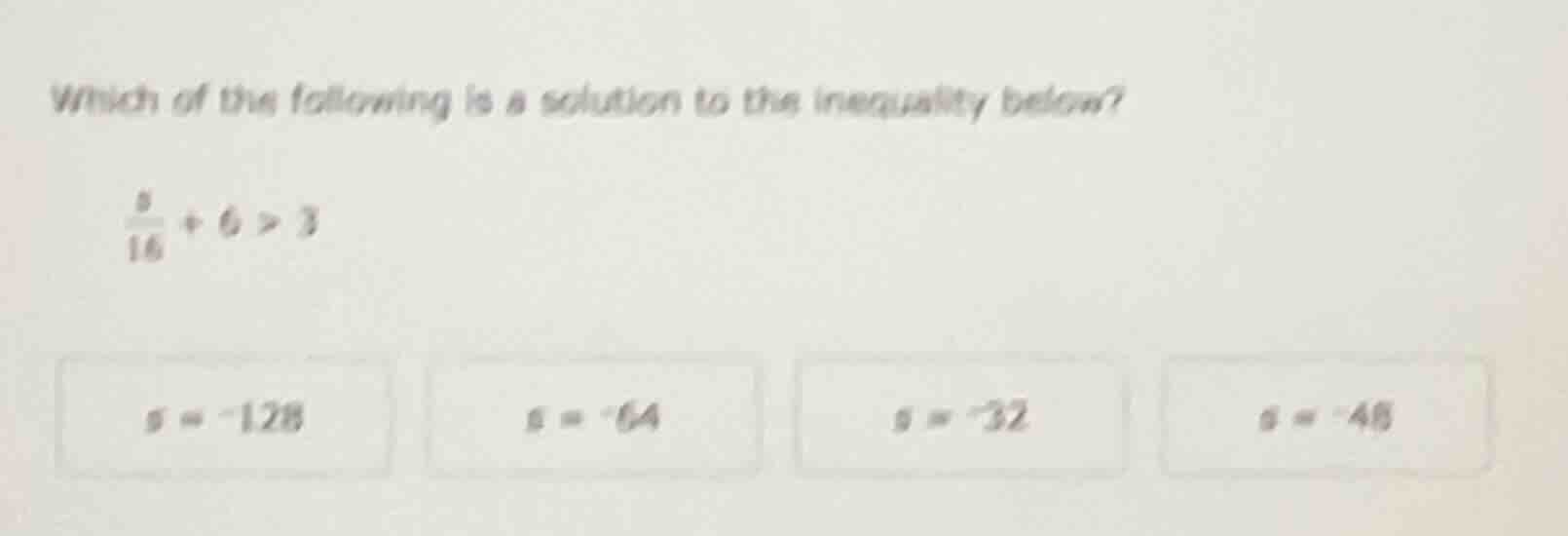
which of the following is a solution to the inequality below?
\\(\frac{s}{16} + 6 > 3\\)
\\(s = -128\\) \\(s = -64\\) \\(s = -32\\) \\(s = -48\\)
Step1: Solve the inequality for \( s \)
Subtract 6 from both sides of the inequality \(\frac{s}{16}+6 > 3\):
\(\frac{s}{16}+6 - 6>3 - 6\)
\(\frac{s}{16}>- 3\)
Multiply both sides by 16:
\(s>-3\times16\)
\(s > - 48\)
Step2: Check each option
- For \(s=-128\): \(-128<-48\), so it is not a solution.
- For \(s = - 64\): \(-64<-48\), so it is not a solution.
- For \(s=-32\): \(-32>-48\), so it is a solution.
- For \(s=-48\): \(-48\) is not greater than \(-48\) (it is equal), so it is not a solution.

Snap & solve any problem in the app
Get step-by-step solutions on Sovi AI
Photo-based solutions with guided steps
Explore more problems and detailed explanations
\(s=-32\) (the option with \(s = - 32\))