QUESTION IMAGE
Question
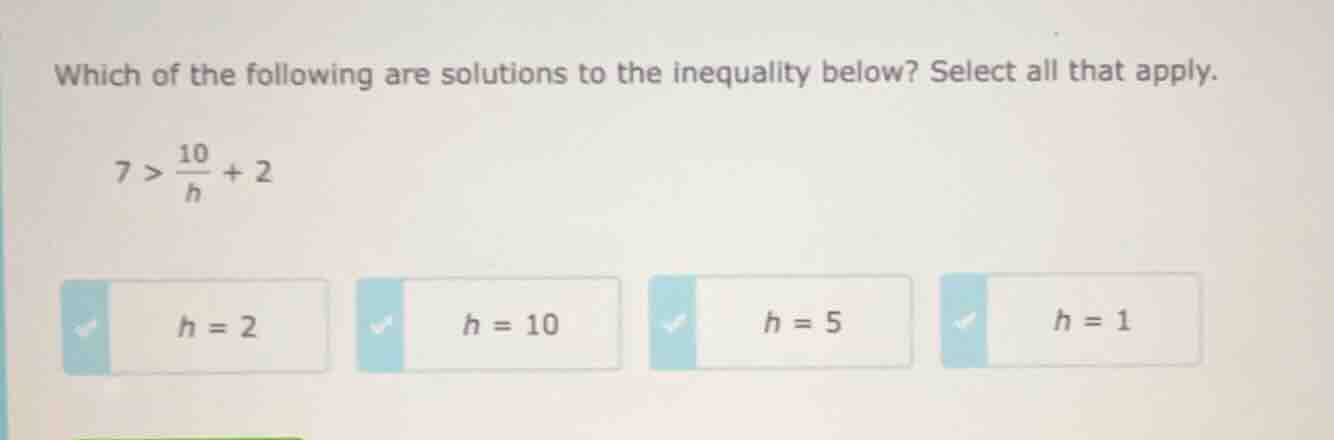
which of the following are solutions to the inequality below? select all that apply.
$7 > \frac{10}{h} + 2$
$h = 2$
$h = 10$
$h = 5$
$h = 1$
Step1: Solve the inequality for \( h \)
First, subtract 2 from both sides of the inequality \( 7 > \frac{10}{h}+2 \):
\( 7 - 2 > \frac{10}{h}+2 - 2 \)
\( 5 > \frac{10}{h} \)
Then, consider two cases for \( h \) (positive and negative, but since \( h \) is in the denominator and we have positive values in the options, we assume \( h>0 \)). Multiply both sides by \( h \) (since \( h>0 \), the inequality sign remains the same):
\( 5h > 10 \)
Divide both sides by 5:
\( h > 2 \) (Wait, no, let's correct. Wait, when we have \( 5 > \frac{10}{h} \) and \( h>0 \), we can rewrite it as \( 5h > 10 \) (multiplying both sides by \( h \), which is positive, so inequality direction doesn't change), then \( h > 2 \)? Wait, no, let's do it again. Wait, \( 5 > \frac{10}{h} \) can be rewritten as \( \frac{10}{h}<5 \). For \( h>0 \), multiply both sides by \( h \): \( 10 < 5h \), then \( 5h>10 \), so \( h > 2 \). But wait, let's test the values:
Wait, maybe I made a mistake. Let's test each option:
- For \( h = 2 \): Substitute into \( \frac{10}{h}+2 \), we get \( \frac{10}{2}+2 = 5 + 2 = 7 \). The inequality is \( 7 > 7 \), which is false. So \( h = 2 \) is not a solution.
- For \( h = 10 \): \( \frac{10}{10}+2 = 1 + 2 = 3 \). \( 7 > 3 \), which is true.
- For \( h = 5 \): \( \frac{10}{5}+2 = 2 + 2 = 4 \). \( 7 > 4 \), which is true.
- For \( h = 1 \): \( \frac{10}{1}+2 = 10 + 2 = 12 \). \( 7 > 12 \), which is false.
Wait, so my earlier solving was wrong. Let's solve the inequality correctly.
Starting over: \( 7 > \frac{10}{h}+2 \)
Subtract 2: \( 5 > \frac{10}{h} \)
Now, we have two cases:
Case 1: \( h > 0 \). Then we can multiply both sides by \( h \) (positive, so inequality direction remains): \( 5h > 10 \) => \( h > 2 \)
Case 2: \( h < 0 \). Then multiplying both sides by \( h \) (negative, so inequality direction reverses): \( 5h < 10 \) => \( h < 2 \), but since \( h < 0 \), this is always true for \( h < 0 \). But in our options, \( h \) is positive (1,2,5,10), so we consider \( h > 0 \) case.
So for \( h > 0 \), the solution is \( h > 2 \) (from \( 5h > 10 \) => \( h > 2 \)). Wait, but when \( h = 2 \), \( \frac{10}{2}+2 = 7 \), and \( 7 > 7 \) is false. When \( h = 5 \), \( \frac{10}{5}+2 = 4 \), \( 7 > 4 \) is true. When \( h = 10 \), \( \frac{10}{10}+2 = 3 \), \( 7 > 3 \) is true. When \( h = 1 \), \( \frac{10}{1}+2 = 12 \), \( 7 > 12 \) is false. So the correct solutions are \( h = 5 \) and \( h = 10 \). The original check marks were wrong. Let's correct:
Step1: Test \( h = 2 \)
Substitute \( h = 2 \) into \( \frac{10}{h}+2 \): \( \frac{10}{2}+2 = 5 + 2 = 7 \). Inequality \( 7 > 7 \) is false. So \( h = 2 \) is not a solution.
Step2: Test \( h = 10 \)
Substitute \( h = 10 \): \( \frac{10}{10}+2 = 1 + 2 = 3 \). \( 7 > 3 \) is true. So \( h = 10 \) is a solution.
Step3: Test \( h = 5 \)
Substitute \( h = 5 \): \( \frac{10}{5}+2 = 2 + 2 = 4 \). \( 7 > 4 \) is true. So \( h = 5 \) is a solution.
Step4: Test \( h = 1 \)
Substitute \( h = 1 \): \( \frac{10}{1}+2 = 10 + 2 = 12 \). \( 7 > 12 \) is false. So \( h = 1 \) is not a solution.

Snap & solve any problem in the app
Get step-by-step solutions on Sovi AI
Photo-based solutions with guided steps
Explore more problems and detailed explanations
The solutions are \( h = 5 \) and \( h = 10 \), so the correct options are:
B. \( h = 10 \)
C. \( h = 5 \)