QUESTION IMAGE
Question
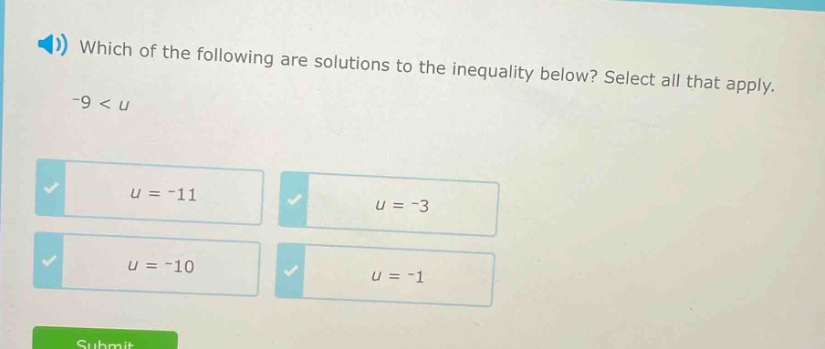
which of the following are solutions to the inequality below? select all that apply.
-9 < u
u = -11
u = -3
u = -10
u = -1
To determine which values of \( u \) satisfy the inequality \( -9 < u \), we check each given value:
For \( u = -11 \):
We compare \( -9 \) and \( -11 \). On the number line, \( -11 \) is to the left of \( -9 \), so \( -9 < -11 \) is false. Thus, \( u = -11 \) is not a solution.
For \( u = -3 \):
We compare \( -9 \) and \( -3 \). On the number line, \( -3 \) is to the right of \( -9 \), so \( -9 < -3 \) is true. Thus, \( u = -3 \) is a solution.
For \( u = -10 \):
We compare \( -9 \) and \( -10 \). On the number line, \( -10 \) is to the left of \( -9 \), so \( -9 < -10 \) is false. Thus, \( u = -10 \) is not a solution.
For \( u = -1 \):
We compare \( -9 \) and \( -1 \). On the number line, \( -1 \) is to the right of \( -9 \), so \( -9 < -1 \) is true. Thus, \( u = -1 \) is a solution.
So the correct solutions are \( u = -3 \) and \( u = -1 \).

Snap & solve any problem in the app
Get step-by-step solutions on Sovi AI
Photo-based solutions with guided steps
Explore more problems and detailed explanations
B. \( u = -3 \)
D. \( u = -1 \)
(Note: Assuming the options are labeled as A: \( u = -11 \), B: \( u = -3 \), C: \( u = -10 \), D: \( u = -1 \))