QUESTION IMAGE
Question
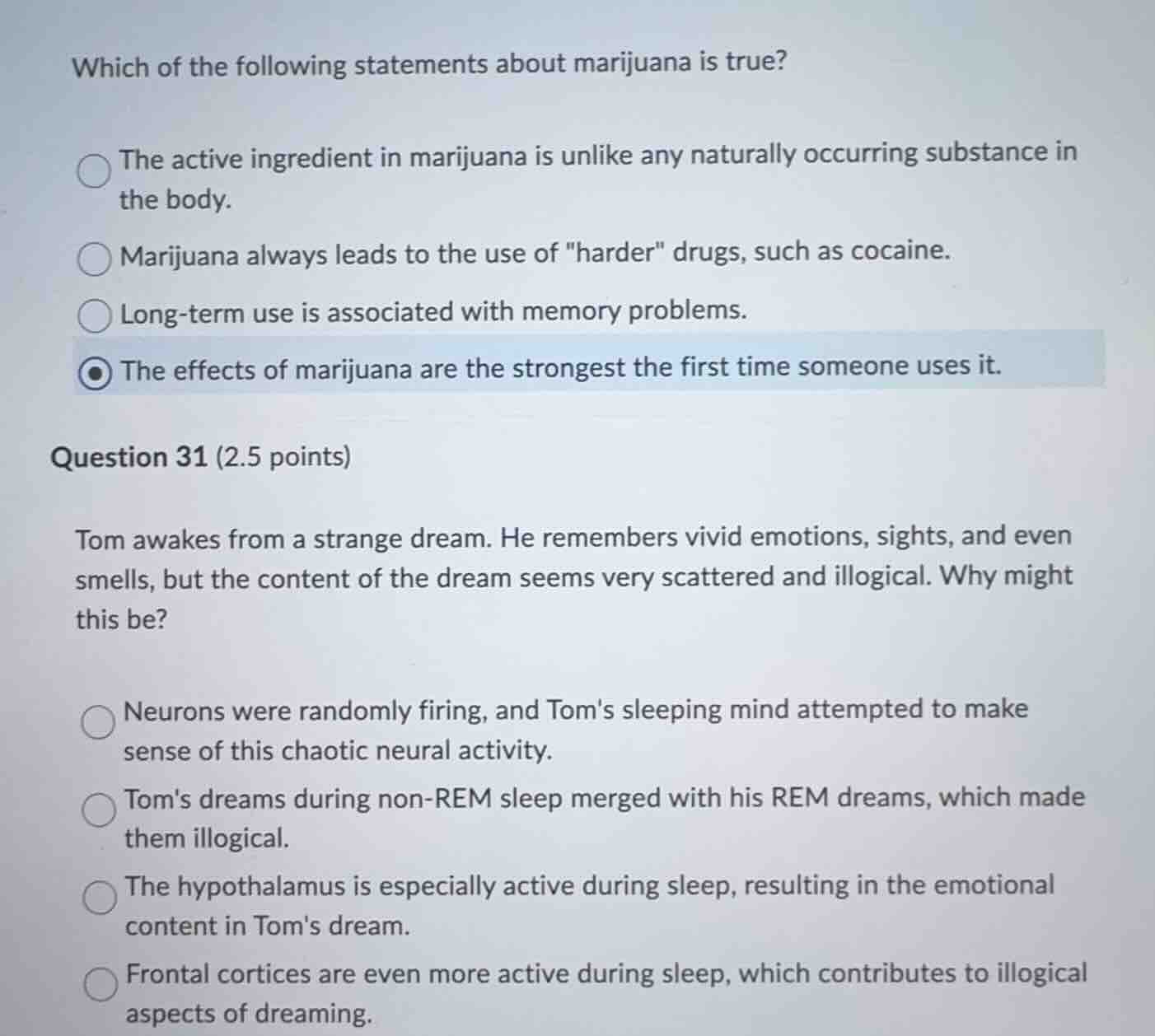
which of the following statements about marijuana is true?
the active ingredient in marijuana is unlike any naturally occurring substance in the body.
marijuana always leads to the use of \harder\ drugs, such as cocaine.
long - term use is associated with memory problems.
the effects of marijuana are the strongest the first time someone uses it.
question 31 (2.5 points)
tom awakes from a strange dream. he remembers vivid emotions, sights, and even smells, but the content of the dream seems very scattered and illogical. why might this be?
neurons were randomly firing, and toms sleeping mind attempted to make sense of this chaotic neural activity.
toms dreams during non - rem sleep merged with his rem dreams, which made them illogical.
the hypothalamus is especially active during sleep, resulting in the emotional content in toms dream.
frontal cortices are even more active during sleep, which contributes to illogical aspects of dreaming.
First Question (about marijuana):
- For the first option: The active ingredient in marijuana (THC) has analogs in the body's endocannabinoid system, so this is false.
- Second option: Marijuana use does not always lead to harder drugs (the "gateway drug" theory is not a certainty), so false.
- Third option: Long - term marijuana use is associated with memory problems due to its impact on the brain's hippocampus and other regions, so this is true.
- Fourth option: The effects of marijuana are not strongest the first time; tolerance builds over time but initial use has a different kind of impact, and generally, the idea that it's strongest first is false.
- First option: The activation - synthesis theory of dreaming suggests that dreams are the brain's attempt to make sense of random neural firing during REM sleep. This matches Tom's scattered and illogical dream content.
- Second option: Non - REM sleep dreams are usually less vivid, and there's no strong evidence for merging with REM dreams to cause illogic.
- Third option: The hypothalamus is more related to functions like sleep - wake cycles and hormone regulation, not dream content.
- Fourth option: Frontal cortices are less active during sleep, not more, and reduced frontal cortex activity is related to illogical dreams, not increased activity.

Snap & solve any problem in the app
Get step-by-step solutions on Sovi AI
Photo-based solutions with guided steps
Explore more problems and detailed explanations
Long - term use is associated with memory problems.