QUESTION IMAGE
Question
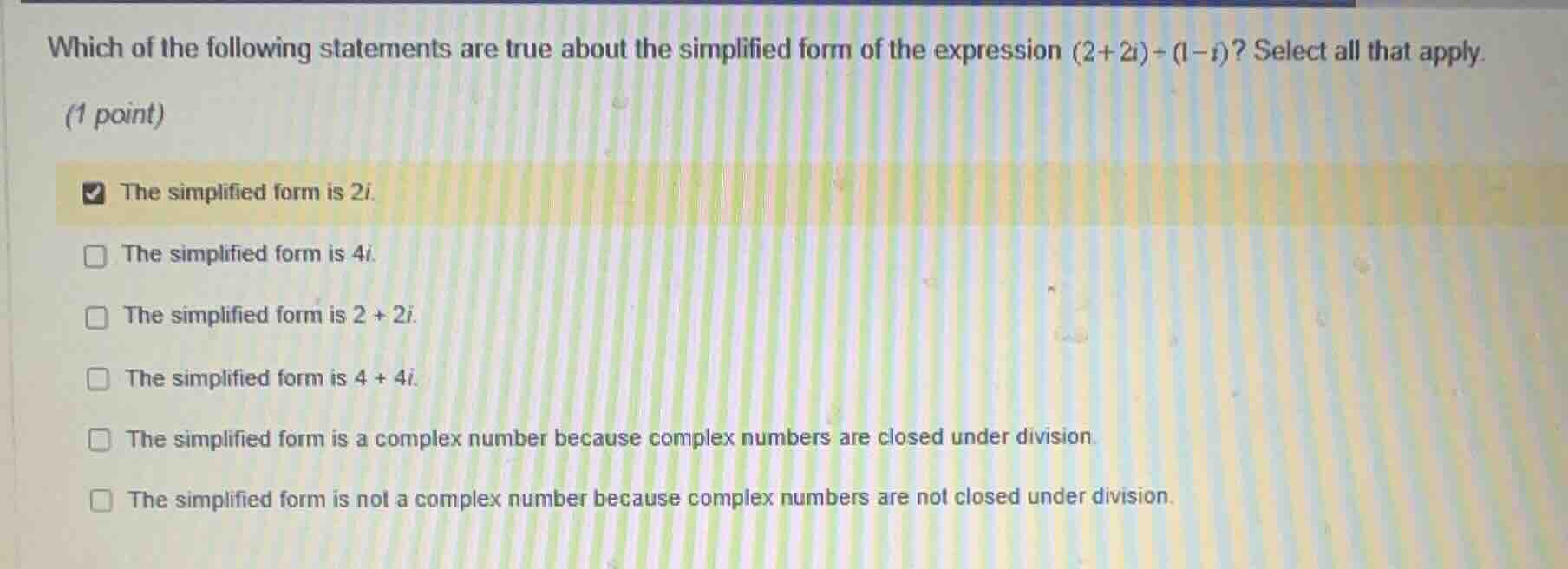
which of the following statements are true about the simplified form of the expression (2+2i)÷(1−i)? select all that apply.
(1 point)
- the simplified form is 2i.
- the simplified form is 4i.
- the simplified form is 2 + 2i.
- the simplified form is 4 + 4i.
- the simplified form is a complex number because complex numbers are closed under division.
- the simplified form is not a complex number because complex numbers are not closed under division.
Step1: Multiply by conjugate of denominator
Multiply numerator and denominator by $1+i$:
$\frac{(2+2i)(1+i)}{(1-i)(1+i)}$
Step2: Expand numerator and denominator
Numerator: $(2)(1)+(2)(i)+(2i)(1)+(2i)(i) = 2+2i+2i+2i^2$
Denominator: $1^2 - i^2$
Step3: Simplify using $i^2=-1$
Numerator: $2+4i+2(-1) = 2+4i-2 = 4i$
Denominator: $1 - (-1) = 2$
Step4: Divide to get simplified form
$\frac{4i}{2} = 2i$
Step5: Verify closure property
Complex numbers are closed under division (excluding division by 0), so the result is a complex number.

Snap & solve any problem in the app
Get step-by-step solutions on Sovi AI
Photo-based solutions with guided steps
Explore more problems and detailed explanations
- The simplified form is $2i$.
- The simplified form is a complex number because complex numbers are closed under division.