QUESTION IMAGE
Question
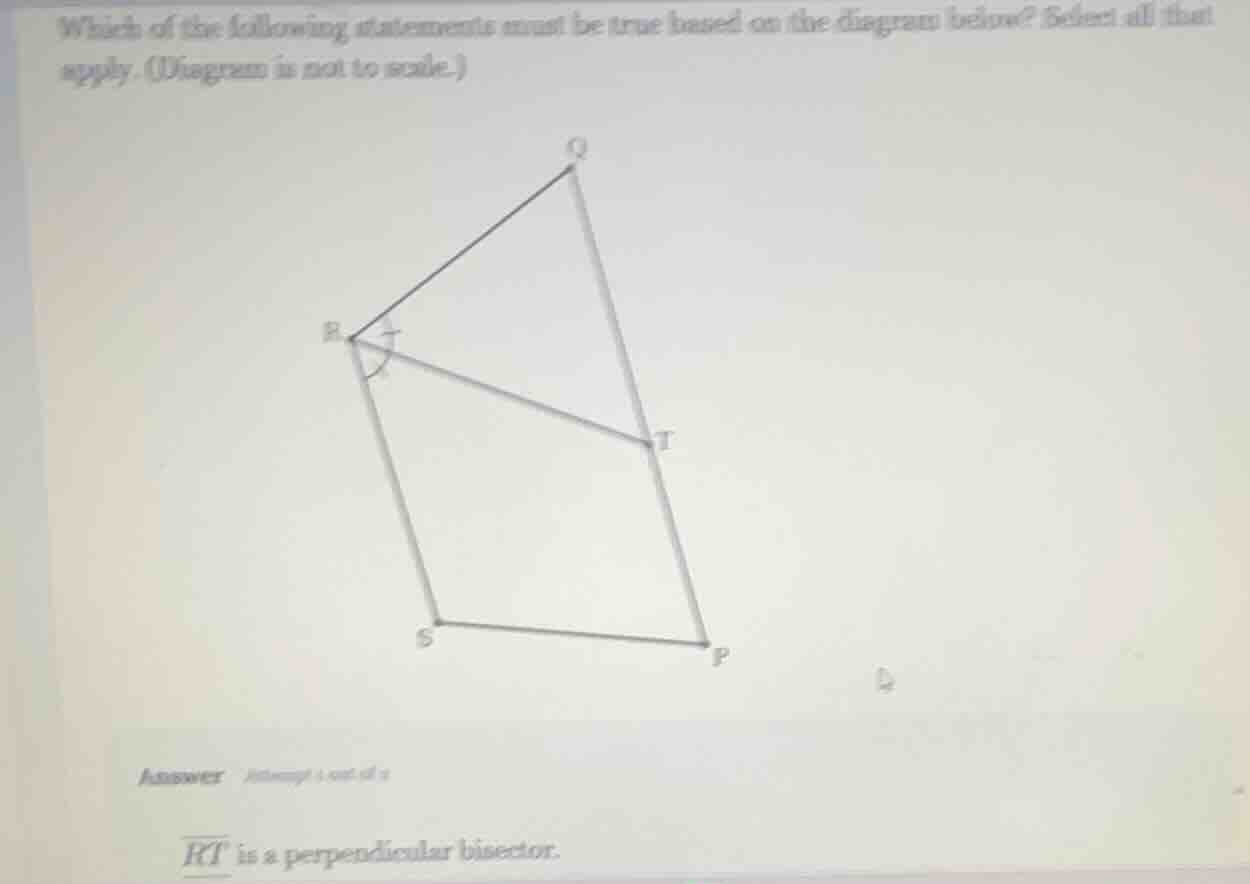
which of the following statements must be true based on the diagram below? select all that apply. (diagram is not to scale.)
answer attempt 1 out of 2
\\(overline{rt}\\) is a perpendicular bisector.
Response
To determine if \(\overline{RT}\) is a perpendicular bisector, we analyze the diagram:
- A perpendicular bisector of a segment must:
- Bisect the segment (divide it into two equal parts).
- Be perpendicular to the segment (form a \(90^\circ\) angle with it).
- From the diagram, \(\overline{RT}\) splits \(\overline{QP}\) at \(T\), but there is no indication (e.g., right - angle symbol, equal - length markings for the bisected segment) that \(\overline{RT}\) is perpendicular to \(\overline{QP}\) or that it bisects \(\overline{QP}\) (or any other segment) in the required way for a perpendicular bisector. The markings at \(R\) only show angle - bisecting, not perpendicularity or bisecting of a segment by \(\overline{RT}\).
So, the statement “\(\overline{RT}\) is a perpendicular bisector” is false.

Snap & solve any problem in the app
Get step-by-step solutions on Sovi AI
Photo-based solutions with guided steps
Explore more problems and detailed explanations
To determine if \(\overline{RT}\) is a perpendicular bisector, we analyze the diagram:
- A perpendicular bisector of a segment must:
- Bisect the segment (divide it into two equal parts).
- Be perpendicular to the segment (form a \(90^\circ\) angle with it).
- From the diagram, \(\overline{RT}\) splits \(\overline{QP}\) at \(T\), but there is no indication (e.g., right - angle symbol, equal - length markings for the bisected segment) that \(\overline{RT}\) is perpendicular to \(\overline{QP}\) or that it bisects \(\overline{QP}\) (or any other segment) in the required way for a perpendicular bisector. The markings at \(R\) only show angle - bisecting, not perpendicularity or bisecting of a segment by \(\overline{RT}\).
So, the statement “\(\overline{RT}\) is a perpendicular bisector” is false.