QUESTION IMAGE
Question
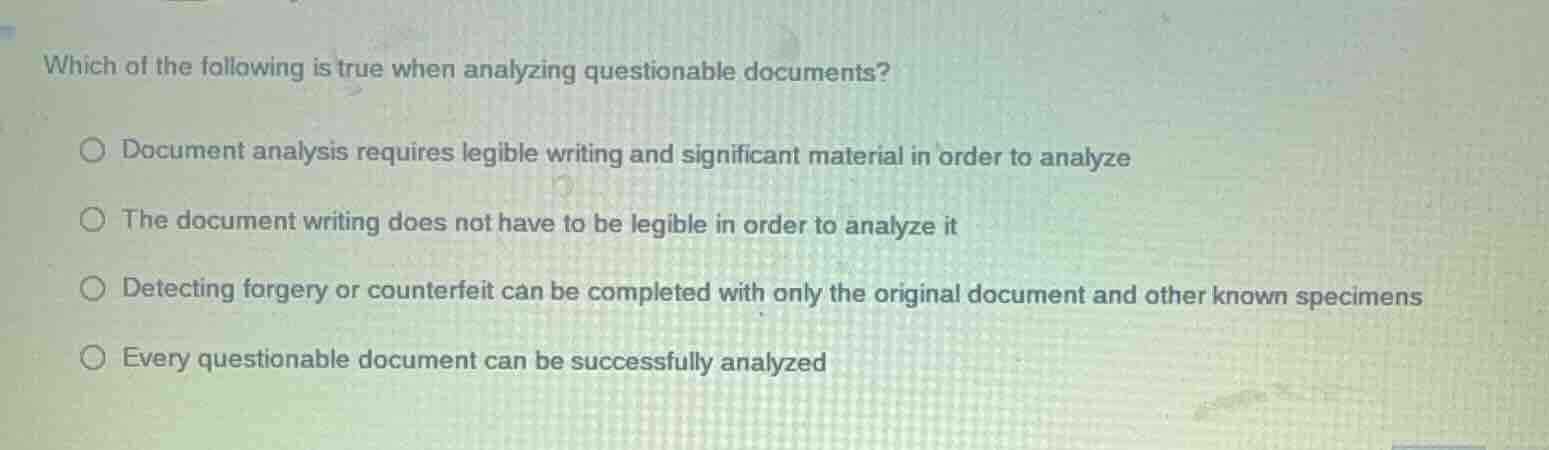
which of the following is true when analyzing questionable documents?
- document analysis requires legible writing and significant material in order to analyze
- the document writing does not have to be legible in order to analyze it
- detecting forgery or counterfeit can be completed with only the original document and other known specimens
- every questionable document can be successfully analyzed
Brief Explanations
- For the first option: Document analysis in forensic or document examination doesn't strictly require legible writing or a large amount of material; even partial or unclear documents can be analyzed with techniques like handwriting analysis, ink analysis, etc. So this is false.
- For the second option: Document analysis (e.g., forensic document examination) can be done even if writing is not legible. Analysts use methods like examining paper, ink, watermarks, or using technological tools (like infrared, microscopy) to study the document's components, so this is true.
- For the third option: Detecting forgery often needs more than just the original and known specimens. It may require analyzing the document's creation process, materials, and comparing with various samples, tools, or historical data. So this is false.
- For the fourth option: Not every questionable document can be successfully analyzed. Factors like document degradation, lack of comparative samples, or limitations in analytical techniques can hinder successful analysis. So this is false.

Snap & solve any problem in the app
Get step-by-step solutions on Sovi AI
Photo-based solutions with guided steps
Explore more problems and detailed explanations
B. The document writing does not have to be legible in order to analyze it