QUESTION IMAGE
Question
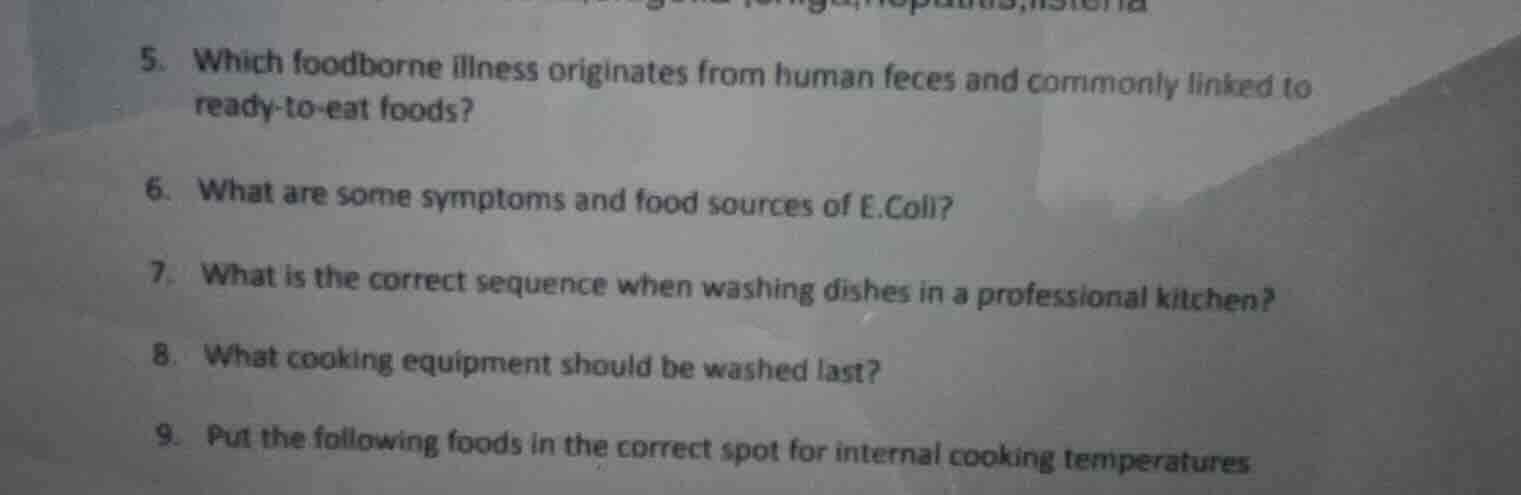
- which foodborne illness originates from human feces and commonly linked to ready - to - eat foods?
- what are some symptoms and food sources of e.coli?
- what is the correct sequence when washing dishes in a professional kitchen?
- what cooking equipment should be washed last?
- put the following foods in the correct spot for internal cooking temperatures
Response
Question 5
Brief Explanations
The foodborne illness that originates from human feces and is commonly linked to ready - to - eat foods is Norovirus (also known as Norwalk virus). It is highly contagious and can be transmitted through contaminated food, especially ready - to - eat foods that are handled by infected individuals without proper handwashing. Another possible answer could be Hepatitis A, but Norovirus is more commonly associated with ready - to - eat foods in this context.
Brief Explanations
- Symptoms of E. Coli infection:
- Gastrointestinal symptoms are common, including diarrhea (which can be bloody in cases of Shiga - toxin - producing E. coli like E. coli O157:H7), abdominal cramps, nausea, and sometimes vomiting. Fever may also be present, although it is usually mild.
- Food sources of E. Coli:
- Undercooked or raw ground beef is a well - known source, as the bacteria can be present in the intestinal tract of cattle and can contaminate the meat during processing.
- Raw milk and dairy products made from raw milk can also harbor E. coli.
- Fresh produce such as spinach, lettuce, and sprouts can be contaminated through contact with contaminated water (for example, water used for irrigation that has been contaminated with fecal matter) or during handling.
Brief Explanations
In a professional kitchen, the correct sequence for washing dishes is usually:
- Scrape/Pre - rinse: Remove any large food particles from the dishes. This can be done by scraping leftover food into the trash or using a pre - rinse to get rid of loose debris.
- Wash: Use hot, soapy water to wash the dishes. This step helps to remove grease, food residue, and bacteria.
- Rinse: Rinse the dishes thoroughly with hot water to remove the soap and any remaining food particles.
- Sanitize: Sanitize the dishes using a chemical sanitizer (like a chlorine - based sanitizer) or by using hot water (at least 171°F or 77°C for a certain amount of time, usually 30 seconds) to kill any remaining bacteria.
- Air - dry or towel - dry (with a clean, sanitized towel): Allowing dishes to air - dry is often preferred in professional kitchens as it reduces the risk of cross - contamination from towels, but if towel - drying, the towel must be clean and sanitized.

Snap & solve any problem in the app
Get step-by-step solutions on Sovi AI
Photo-based solutions with guided steps
Explore more problems and detailed explanations
Norovirus (or Norwalk virus)