QUESTION IMAGE
Question
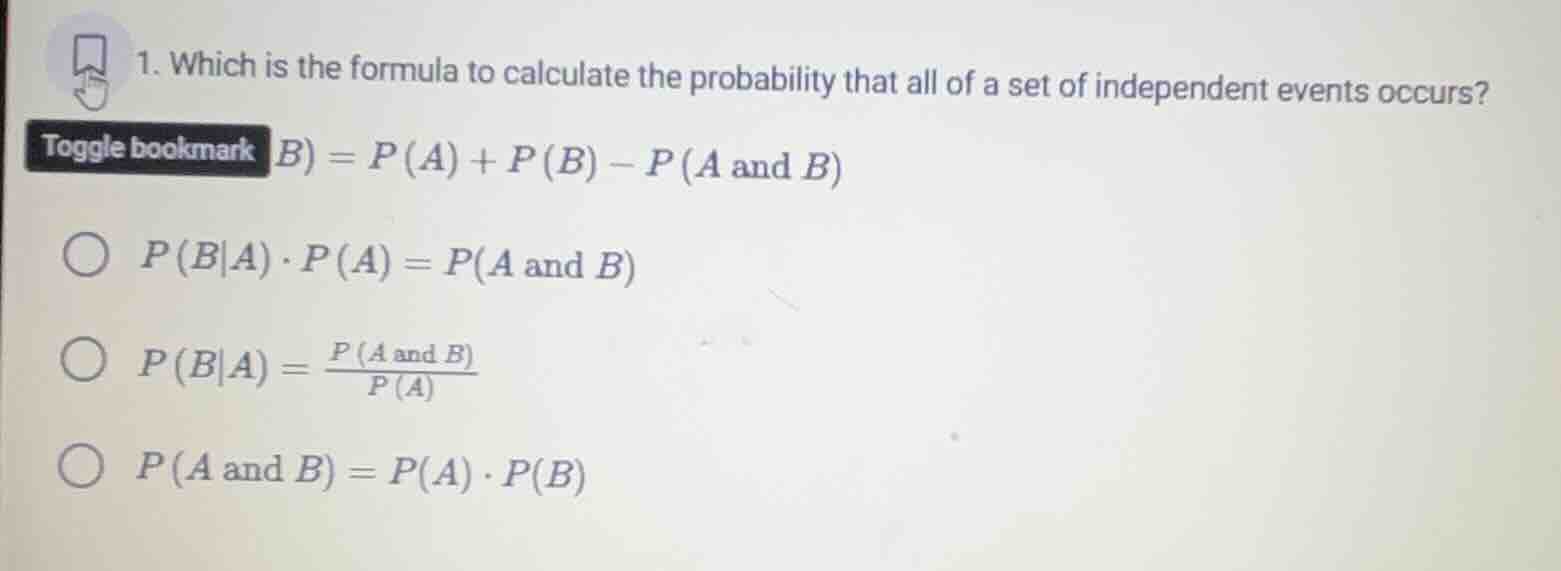
- which is the formula to calculate the probability that all of a set of independent events occurs?
$b) = p(a) + p(b) - p(a\text{ and }b)$
$p(b|a) \cdot p(a) = p(a\text{ and }b)$
$p(b|a) = \frac{p(a\text{ and }b)}{p(a)}$
$p(a\text{ and }b) = p(a) \cdot p(b)$
Brief Explanations
- The first formula is the general addition rule for any two events, not for independent events all occurring.
- The second is the general multiplication rule for conditional probability, not specific to independent events.
- The third is the formula for conditional probability, which does not apply to independent events in this context.
- The fourth formula is the multiplication rule for independent events, which calculates the probability that both independent events A and B occur, and extends to any set of independent events by multiplying all their individual probabilities.

Snap & solve any problem in the app
Get step-by-step solutions on Sovi AI
Photo-based solutions with guided steps
Explore more problems and detailed explanations
$\boldsymbol{P(A \text{ and } B) = P(A) \cdot P(B)}$