QUESTION IMAGE
Question
which is the graph of the linear inequality $2x - 3y < 12$?
Step1: Rewrite the inequality
First, rewrite the inequality \(2x - 3y < 12\) in slope - intercept form (\(y=mx + b\)) to make it easier to graph.
Subtract \(2x\) from both sides: \(-3y<-2x + 12\)
Divide each term by \(- 3\). Remember that when we divide or multiply an inequality by a negative number, the direction of the inequality sign changes. So we get \(y>\frac{2}{3}x - 4\)
Step2: Analyze the boundary line
The boundary line for the inequality \(y=\frac{2}{3}x - 4\) has a slope of \(\frac{2}{3}\) and a \(y\) - intercept of \(-4\). Since the inequality is \(y>\frac{2}{3}x - 4\) (not \(y\geq\frac{2}{3}x - 4\)), the boundary line should be a dashed line.
Step3: Determine the shaded region
To determine which side of the line to shade, we can test a point that is not on the line. A common test point is the origin \((0,0)\).
Substitute \(x = 0\) and \(y = 0\) into the inequality \(y>\frac{2}{3}x - 4\):
\(0>\frac{2}{3}(0)-4\)
\(0> - 4\), which is true. So we shade the region that contains the origin \((0,0)\) relative to the line \(y=\frac{2}{3}x - 4\)
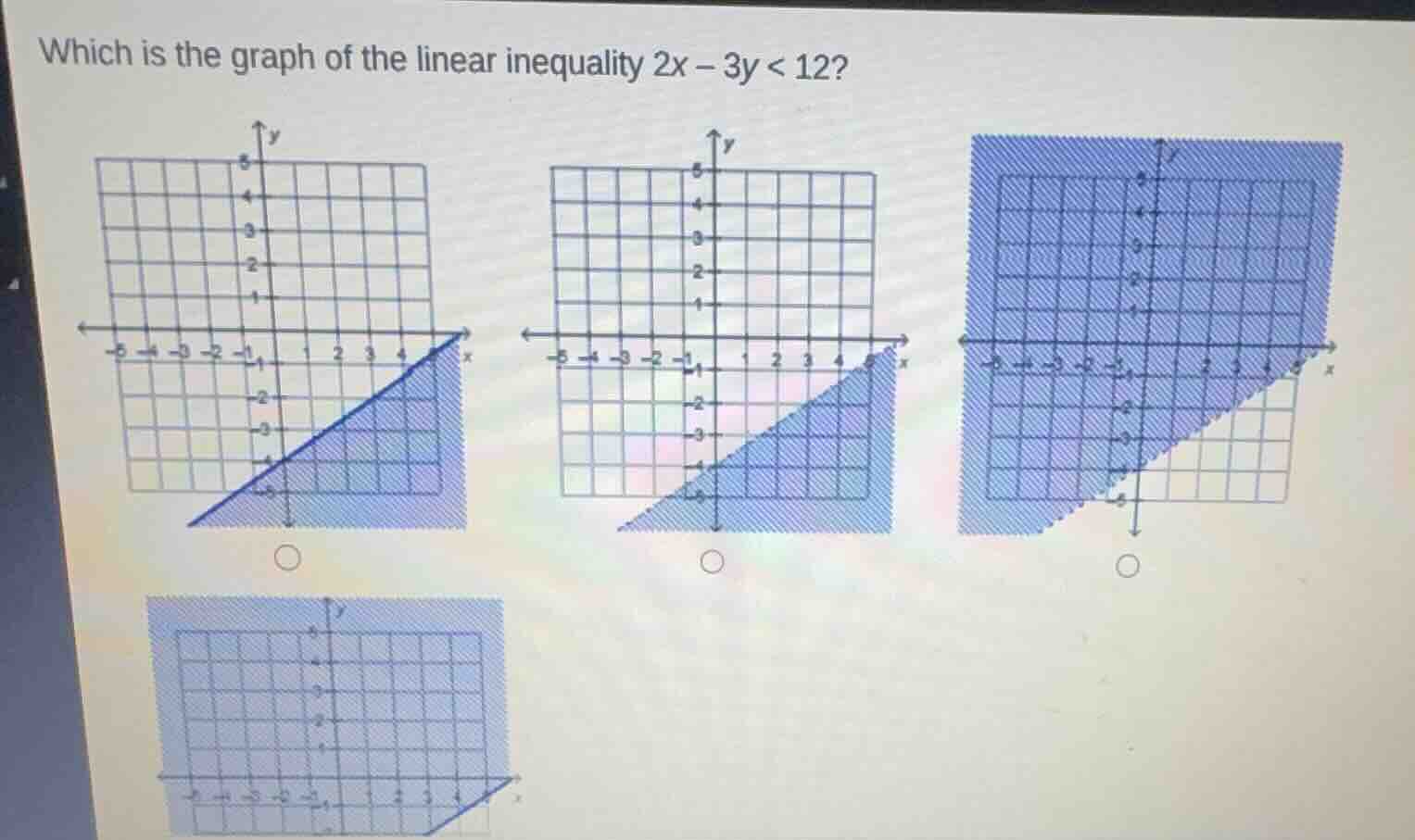
Now, let's analyze the graphs:
- The first graph: Check the boundary line (should be dashed? Wait, no, wait. Wait, our inequality is \(2x-3y < 12\), the boundary line \(2x - 3y=12\) or \(y=\frac{2}{3}x - 4\). Let's check the \(y\) - intercept. The \(y\) - intercept of \(y=\frac{2}{3}x - 4\) is \(-4\). The first graph has a line with \(y\) - intercept \(- 4\)? Wait, no, the first graph's line seems to have a different \(y\) - intercept. Wait, maybe I made a mistake. Wait, let's re - express the original inequality again.
Wait, \(2x-3y<12\), when \(x = 0\), \(-3y<12\), so \(y>- 4\). When \(y = 0\), \(2x<12\), so \(x < 6\).
The line \(2x-3y = 12\) can be written as \(y=\frac{2}{3}x-4\). So the \(y\) - intercept is \(-4\), and \(x\) - intercept is \(6\) (when \(y = 0\), \(2x=12\), \(x = 6\)).
Now, the inequality is \(2x-3y<12\), which is equivalent to \(y>\frac{2}{3}x - 4\). So the boundary line is dashed (since the inequality is strict, \(<\) or \(>\)), and we shade above the line (because \(y>\) the line).
Looking at the graphs, the third graph (the one with the blue region that includes the origin and is above the line with \(x\) - intercept \(6\) and \(y\) - intercept \(-4\)) should be the correct one. Wait, let's check the test point \((0,0)\) in the original inequality \(2x-3y<12\): \(2(0)-3(0)=0<12\), which is true. So the region containing \((0,0)\) should be shaded.
The line \(2x - 3y=12\) passes through \((6,0)\) and \((0,-4)\). So the graph with a dashed line (or maybe in the given graphs, the line is solid? Wait, no, the inequality is \(2x - 3y<12\), so the boundary line should be dashed. But looking at the given graphs, maybe the first graph has a solid line? Wait, no, maybe the problem's graphs have solid lines, but in theory, it should be dashed. But among the given options, the third graph (the one with the blue region that is above the line \(y=\frac{2}{3}x - 4\) and includes the origin) is the correct one.

Snap & solve any problem in the app
Get step-by-step solutions on Sovi AI
Photo-based solutions with guided steps
Explore more problems and detailed explanations
The third graph (the one with the blue region that is above the line with \(x\) - intercept \(6\) and \(y\) - intercept \(-4\) and includes the origin \((0,0)\) in the shaded region)