QUESTION IMAGE
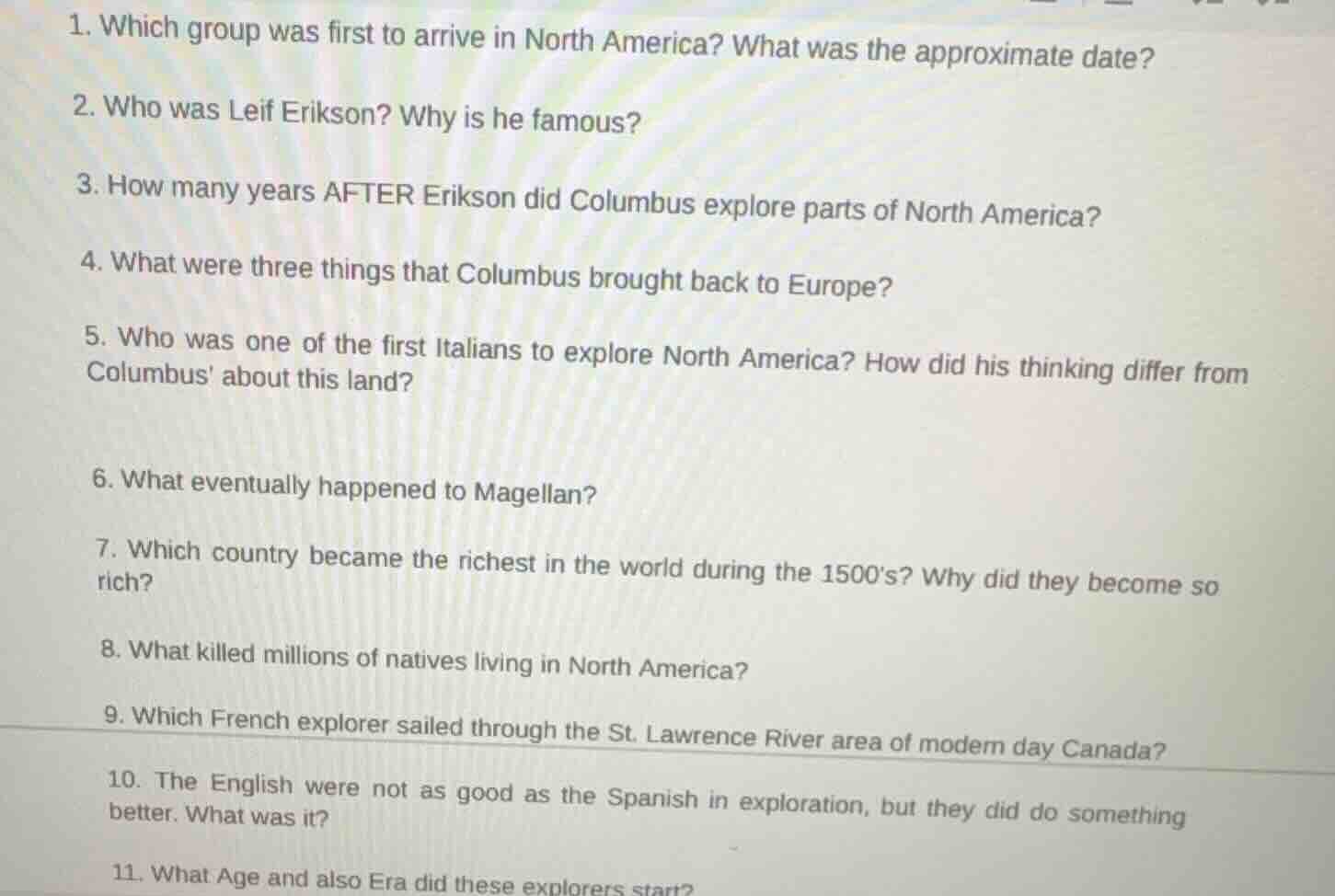
Question
- which group was first to arrive in north america? what was the approximate date?
- who was leif erikson? why is he famous?
- how many years after erikson did columbus explore parts of north america?
- what were three things that columbus brought back to europe?
- who was one of the first italians to explore north america? how did his thinking differ from columbus about this land?
- what eventually happened to magellan?
- which country became the richest in the world during the 1500s? why did they become so rich?
- what killed millions of natives living in north america?
- which french explorer sailed through the st. lawrence river area of modern day canada?
- the english were not as good as the spanish in exploration, but they did do something better. what was it?
- what age and also era did these explorers start?
Brief Explanations
- The first confirmed group to reach North America were the Paleo-Indians, who migrated via the Bering Land Bridge during the last Ice Age.
- Leif Erikson was a Norse Viking explorer; he led the first confirmed European expedition to reach North America (excluding Greenland).
- Calculate the difference between Columbus' 1492 voyage and Erikson's c. 1000 CE voyage.
- Columbus returned to Europe with goods native to the Americas that were unknown there at the time.
- Amerigo Vespucci was an early Italian explorer; he recognized the lands were a new continent, not Asia.
- Magellan led the first circumnavigation of the globe but did not complete the journey.
- Spain gained massive wealth from its American colonies in the 1500s through resource extraction and trade.
- European-introduced diseases to which Native Americans had no immunity caused the largest number of deaths.
- Jacques Cartier was the French explorer who explored and sailed the St. Lawrence River in present-day Canada.
- While Spanish focused on extracting resources, the English prioritized establishing permanent, self-sustaining settlements.
- These explorers were part of the Age of Discovery, which falls within the Early Modern Era.

Snap & solve any problem in the app
Get step-by-step solutions on Sovi AI
Photo-based solutions with guided steps
Explore more problems and detailed explanations
- The Paleo-Indians, approximately 20,000-15,000 BCE.
- Leif Erikson was a Norse Viking explorer; he is famous for leading the first confirmed European expedition to reach North America (around 1000 CE, establishing a short-lived settlement at L'Anse aux Meadows in modern Canada).
- Approximately 492 years (1492 - 1000 = 492).
- Examples include maize (corn), potatoes, and tobacco.
- Amerigo Vespucci; unlike Columbus, who believed he had reached Asia, Vespucci concluded the lands were a previously unknown continent (later named America in his honor).
- Magellan was killed in 1521 during a battle with indigenous peoples in the Philippines. His crew completed the first circumnavigation of the globe without him.
- Spain; they became rich by extracting vast amounts of gold and silver from their American colonies, as well as profiting from the trade of new crops and other resources from the Americas.
- European-introduced diseases such as smallpox, measles, and influenza (to which Native Americans had no natural immunity).
- Jacques Cartier.
- They established permanent, successful settlements in North America (such as Jamestown, 1607, and Plymouth, 1620) that grew into long-term colonies, rather than just extracting resources temporarily.
- These explorers started during the Age of Discovery (also called the Age of Exploration), which is part of the Early Modern Era (roughly starting in the late 15th century).