QUESTION IMAGE
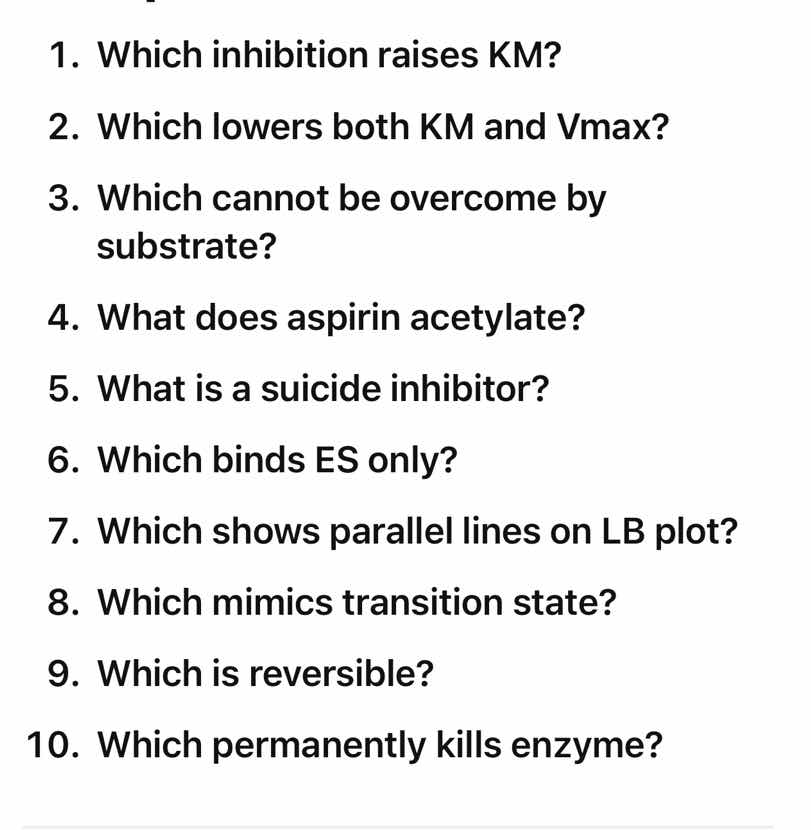
Question
- which inhibition raises km?
- which lowers both km and vmax?
- which cannot be overcome by substrate?
- what does aspirin acetylate?
- what is a suicide inhibitor?
- which binds es only?
- which shows parallel lines on lb plot?
- which mimics transition state?
- which is reversible?
- which permanently kills enzyme?
Brief Explanations
- Competitive inhibitors compete with substrate for the enzyme's active site, reducing enzyme affinity for substrate, which increases \(K_M\).
- Uncompetitive inhibitors bind only to the enzyme-substrate (ES) complex, reducing both the effective enzyme concentration for catalysis (lowering \(V_{max}\)) and the apparent substrate affinity (lowering \(K_M\)).
- Non-competitive inhibitors bind to an allosteric site on the enzyme (or ES complex), and their effect is independent of substrate concentration, so increasing substrate cannot overcome this inhibition.
- Aspirin is an irreversible inhibitor that acetylates the serine residue in the active site of cyclooxygenase (COX) enzymes.
- A suicide inhibitor is a type of irreversible inhibitor that is converted to a reactive intermediate by the enzyme itself, which then covalently modifies and inactivates the enzyme.
- Uncompetitive inhibitors exclusively bind to the enzyme-substrate (ES) complex, not the free enzyme.
- Uncompetitive inhibition produces parallel lines on a Lineweaver-Burk (LB) plot, as it changes both \(K_M\) and \(V_{max}\) proportionally.
- Transition state analogs are molecules that structurally resemble the high-energy transition state of an enzyme-catalyzed reaction, binding tightly to the enzyme's active site.
- Competitive, non-competitive (pure), and uncompetitive inhibitors are all reversible, as they bind non-covalently to the enzyme/ES complex and can be displaced or removed.
- Irreversible (including suicide) inhibitors form covalent bonds with the enzyme, permanently modifying and inactivating it.

Snap & solve any problem in the app
Get step-by-step solutions on Sovi AI
Photo-based solutions with guided steps
Explore more problems and detailed explanations
- Competitive inhibition
- Uncompetitive inhibition
- Non-competitive inhibition
- The serine residue in the active site of COX enzymes
- An irreversible inhibitor that is activated by the enzyme it targets, then covalently inactivates the enzyme
- Uncompetitive inhibitor
- Uncompetitive inhibition
- Transition state analog
- Competitive, non-competitive, and uncompetitive inhibition
- Irreversible (suicide) inhibitor