QUESTION IMAGE
Question
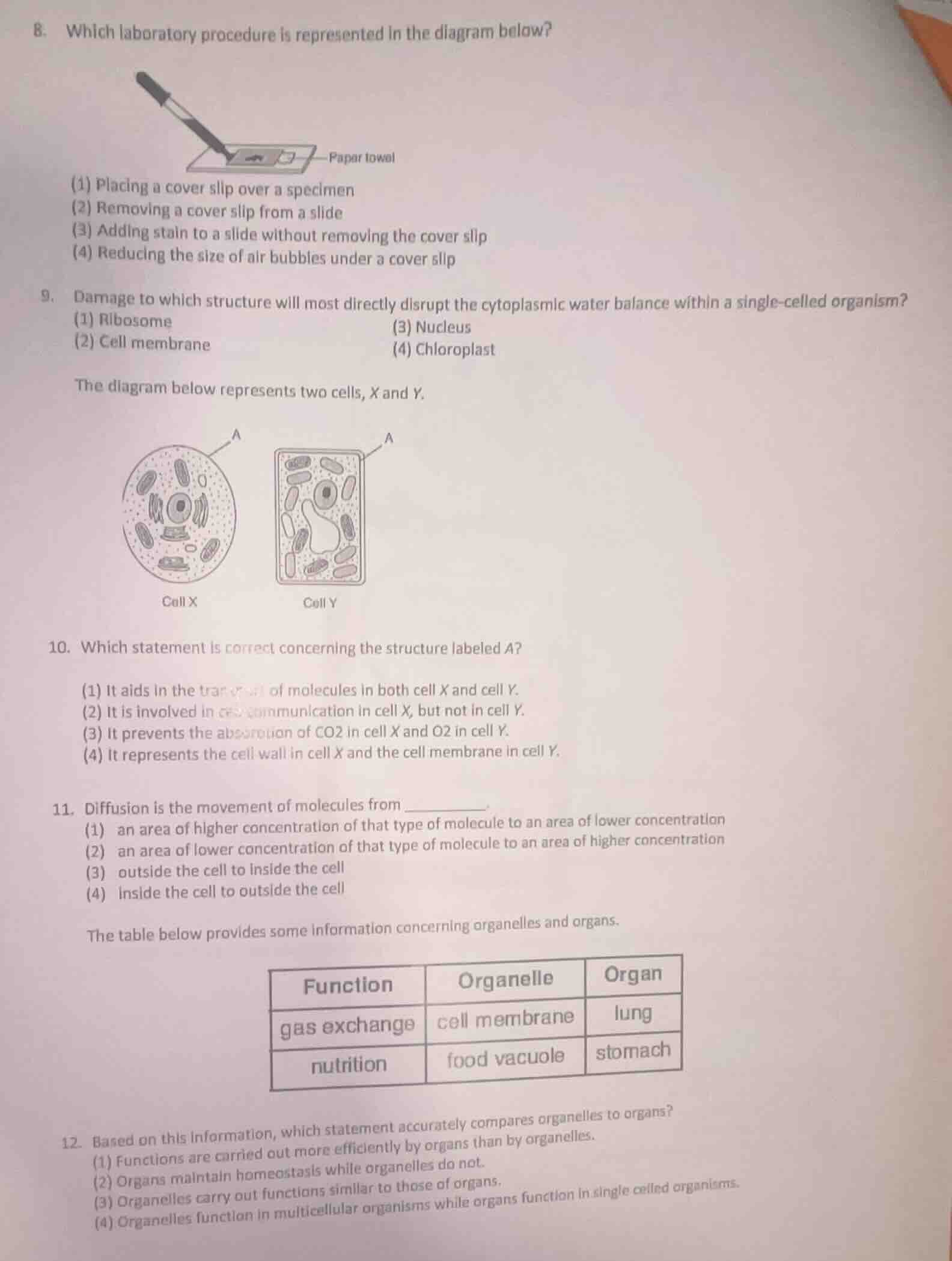
- which laboratory procedure is represented in the diagram below? (1) placing a cover slip over a specimen (2) removing a cover slip from a slide (3) adding stain to a slide without removing the cover slip (4) reducing the size of air bubbles under a cover slip 9. damage to which structure will most directly disrupt the cytoplasmic water balance within a single - celled organism? (1) ribosome (3) nucleus (2) cell membrane (4) chloroplast the diagram below represents two cells, x and y. 10. which statement is correct concerning the structure labeled a? (1) it aids in the transport of molecules in both cell x and cell y. (2) it is involved in cell communication in cell x, but not in cell y. (3) it prevents the absorption of co2 in cell x and o2 in cell y. (4) it represents the cell wall in cell x and the cell membrane in cell y. 11. diffusion is the movement of molecules from ______. (1) an area of higher concentration of that type of molecule to an area of lower concentration (2) an area of lower concentration of that type of molecule to an area of higher concentration (3) outside the cell to inside the cell (4) inside the cell to outside the cell the table below provides some information concerning organelles and organs. | function | organelle | organ | | --- | --- | --- | | gas exchange | cell membrane | lung | | nutrition | food vacuole | stomach | 12. based on this information, which statement accurately compares organelles to organs? (1) functions are carried out more efficiently by organs than by organelles. (2) organs maintain homeostasis while organelles do not. (3) organelles carry out functions similar to those of organs. (4) organelles function in multicellular organisms while organs function in single - celled organisms.
Question 8:
The diagram shows adding liquid to one edge of a coverslip while drawing it under with a paper towel on the opposite edge. This is the "wicking" method to add stain without removing the coverslip.
Question 9:
The cell membrane regulates the movement of water and substances in/out of the cell, directly controlling cytoplasmic water balance. Other structures have unrelated functions: ribosomes make proteins, nucleus controls genetics, chloroplasts do photosynthesis.
Question 10:
Structure A is the cell membrane in both cells (Cell X is animal, Cell Y is plant; the outermost layer of the animal cell is the membrane, and the membrane lies just inside the plant cell wall, which is not labeled here). The cell membrane aids in molecule transport for both cell types.
Question 11:
Diffusion is defined as the passive movement of molecules from a region of higher concentration to a region of lower concentration, down their concentration gradient.
Question 12:
The table shows organelles (cell membrane, food vacuole) and organs (lung, stomach) perform similar core functions: gas exchange and nutrition, respectively. The other options are incorrect: efficiency is not stated, organelles do maintain homeostasis, and organelles function in single-celled organisms while organs are multicellular.

Snap & solve any problem in the app
Get step-by-step solutions on Sovi AI
Photo-based solutions with guided steps
Explore more problems and detailed explanations
- (3) Adding stain to a slide without removing the cover slip
- (2) Cell membrane
- (1) It aids in the transport of molecules in both cell X and cell Y.
- (1) an area of higher concentration of that type of molecule to an area of lower concentration
- (3) Organelles carry out functions similar to those of organs.