QUESTION IMAGE
Question
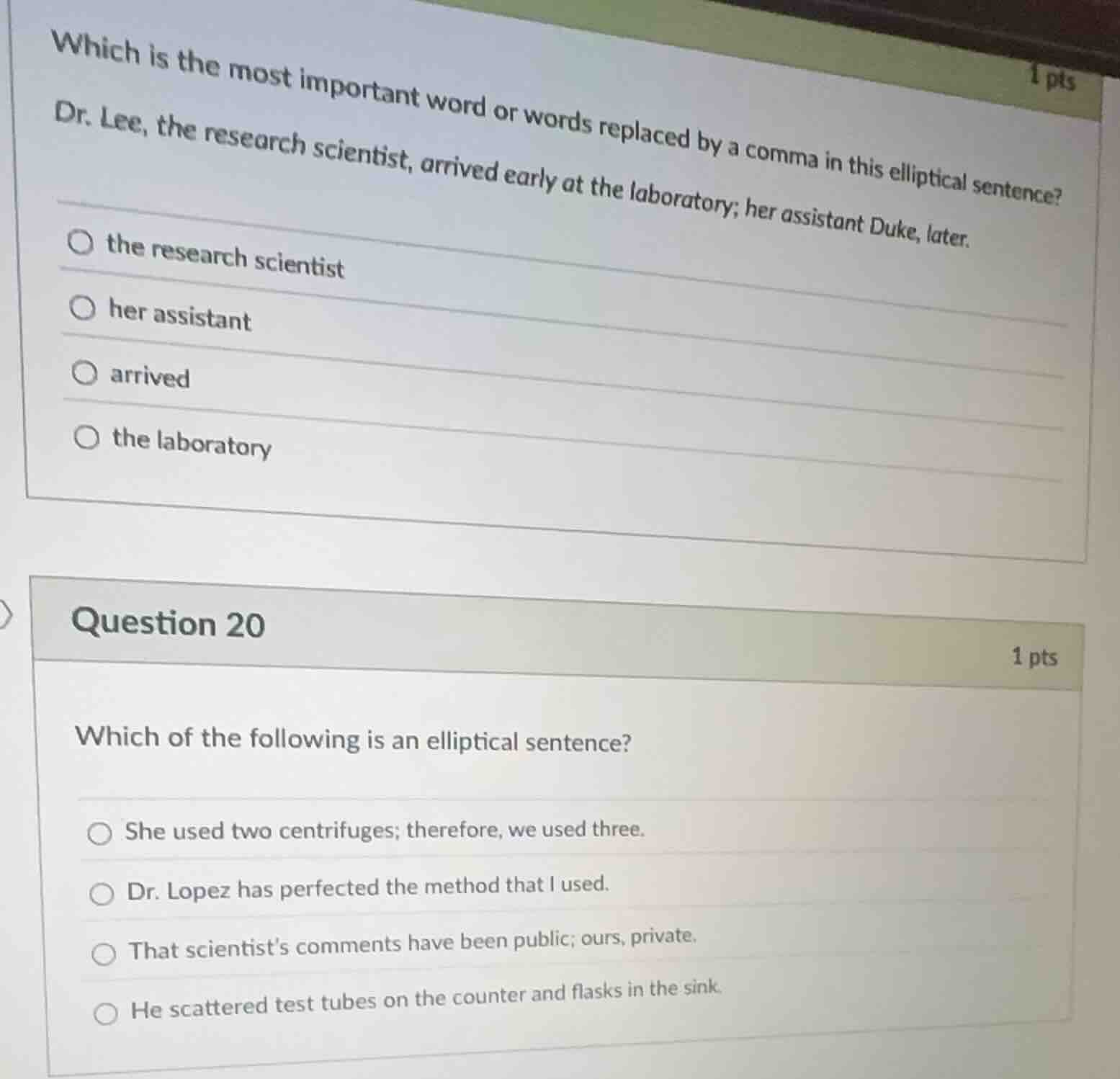
which is the most important word or words replaced by a comma in this elliptical sentence? dr. lee, the research scientist, arrived early at the laboratory; her assistant duke, later. the research scientist her assistant arrived the laboratory question 20 which of the following is an elliptical sentence? she used two centrifuges; therefore, we used three. dr. lopez has perfected the method that i used. that scientists comments have been public; ours, private. he scattered test tubes on the counter and flasks in the sink.
First Question (about elliptical sentence word replacement)
To determine the word replaced by a comma, we analyze the elliptical structure. The first clause is "Dr. Lee, the research scientist, arrived early at the laboratory" and the second is "her assistant Duke, later." The elliptical part implies parallelism, so we check what's omitted. The structure suggests "her assistant Duke" corresponds to "Dr. Lee, the research scientist", and the omitted verb/adverb part? Wait, no—actually, the comma - replaced word should be the one that's parallel. Wait, the first sentence has "Dr. Lee, the research scientist, arrived...", the second "her assistant Duke, later." The "later" implies the verb "arrived" is omitted, but no—wait, the question is which word is replaced by the comma. Wait, the options: "the research scientist" is an appositive for Dr. Lee. In the second clause, "her assistant Duke" is an appositive for... Wait, no, the elliptical sentence here: the full form would be "Dr. Lee, the research scientist, arrived early at the laboratory; her assistant Duke arrived later." So the word replaced by the comma (in the second clause) would be the parallel element. Wait, the first clause has "the research scientist" as an appositive, the second clause "her assistant" is part of the appositive? No, wait the options: the first option is "the research scientist", the second "her assistant". Wait, no—let's re - examine. The first sentence: "Dr. Lee, the research scientist, arrived...", the second: "her assistant Duke, later." The "later" is an adverb, and the verb "arrived" is omitted. But the question is which word is replaced by the comma. Wait, maybe the parallel structure: "Dr. Lee (the research scientist) arrived...; her assistant Duke (her assistant? No) Wait, no. Wait, the correct approach: in an elliptical sentence with a semicolon, we look for parallelism. The first clause: subject (Dr. Lee) + appositive (the research scientist) + verb (arrived) + adverb (early) + prepositional phrase (at the laboratory). The second clause: subject (her assistant Duke) + adverb (later) + (omitted verb "arrived"). But the comma - replaced word: the appositive in the first is "the research scientist", in the second, what's parallel? Wait, no, the question is which word is replaced by the comma. Wait, the options: "the research scientist"—in the first clause, it's set off by commas as an appositive. In the second clause, "her assistant Duke" is set off? No, the comma in the second clause is before "later". Wait, maybe I'm overcomplicating. The correct answer is "her assistant"? No, wait the first option: "the research scientist"—in the first sentence, it's an appositive, in the second sentence, the parallel appositive - like structure would be... Wait, no, let's think again. The sentence is "Dr. Lee, the research scientist, arrived early at the laboratory; her assistant Duke, later." The full sentence would be "Dr. Lee, the research scientist, arrived early at the laboratory; her assistant Duke arrived later." So the word replaced by the comma (in the second clause) is "arrived"? No, "arrived" is a verb. Wait, the options don't have "arrived" as the correct answer? Wait, the options are "the research scientist", "her assistant", "arrived", "the laboratory". Wait, maybe the parallel element is the appositive. The first appositive is "the research scientist" for Dr. Lee, the second appositive - like element? No, "her assistant" is part of the subject. Wait, I think I made a mistake. Let's look at the options again. The correct answer is "her assistant"? No, wait the first option: "the research scientist"—in the fir…
An elliptical sentence is a sentence where part of the structure is omitted (usually due to parallelism or context) but can be inferred. Let's analyze each option:
- Option 1: "She used two centrifuges; therefore, we used three." This is a compound sentence with a conjunctive adverb, no omission.
- Option 2: "Dr. Lopez has perfected the method that I used." This is a complex sentence with a relative clause, no omission.
- Option 3: "That scientist's comments have been public; ours, private." The full form would be "That scientist's comments have been public; ours have been private." Here, "have been" is omitted from the second clause, so it's an elliptical sentence.
- Option 4: "He scattered test tubes on the counter and flasks in the sink." This is a simple sentence with a compound object, no omission.

Snap & solve any problem in the app
Get step-by-step solutions on Sovi AI
Photo-based solutions with guided steps
Explore more problems and detailed explanations
B. her assistant