QUESTION IMAGE
Question
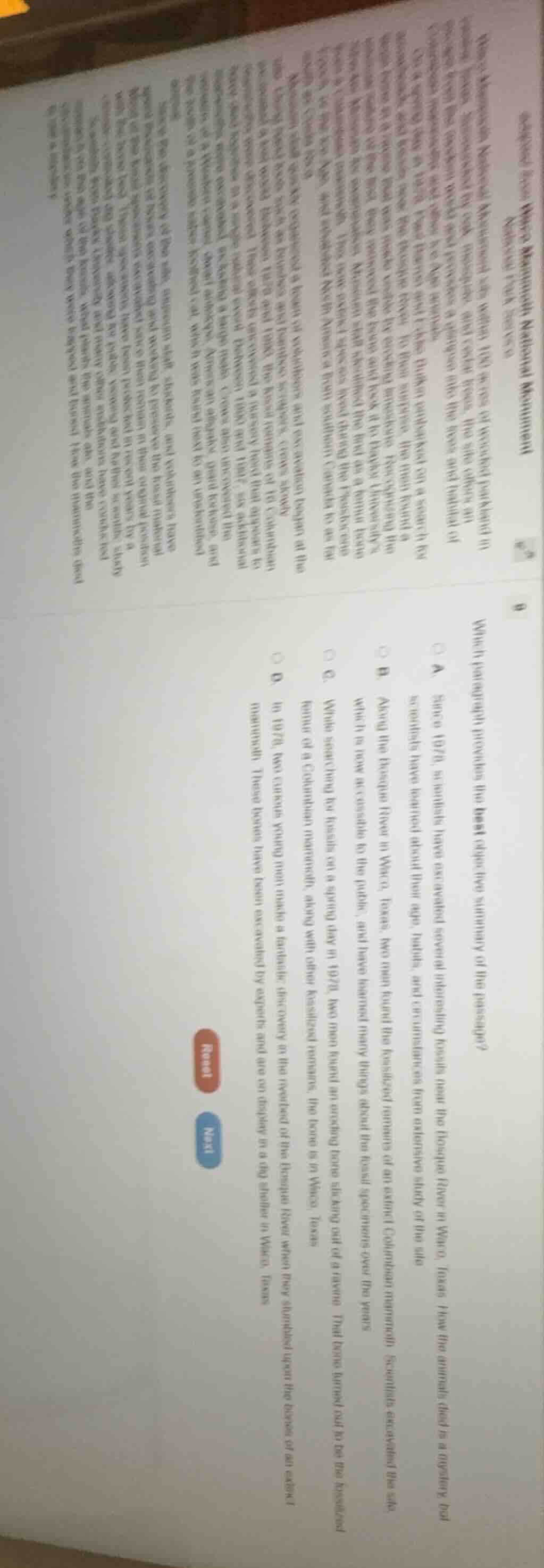
which paragraph provides the best clue for summary of the passage? a. since 1971, scientists have uncovered several interesting fossils near the hesperian river in waco, texas. how the animals died is a mystery but scientists have learned about their age, habits, and environments from extensive study of the site. b. along the hesperian river in waco, texas, two men found the fossilized remains of an extinct columbian mammoth. fossils are extracted from the site, which is now accessible to the public, and have taught many things about the fossil specimens over the years. c. while searching for fossils on a spring day in 1971, two men found an amazing bone sticking out of a ravine. that bone turned out to be the fossilized tusk of a columbian mammoth, along with other fossilized remains. the bone is in waco, texas. d. in 1971, two curious young men made a fantastic discovery in the riverbed of the hesperian river when they stumbled upon the tusk of an extinct mammoth. these bones have been uncovered by experts and are on display in a city shelter in waco, texas.
To determine the best summary, we analyze each option:
- Option A: Focuses on studies since 1971 but the passage covers more than just post - 1971 studies (like the initial discovery).
- Option B: Mentions finding fossilized remains and learning about them, but the passage also includes the discovery process and the display of the bones.
- Option C: Only talks about a specific discovery in 1971, not the overall passage.
- Option D: Covers the discovery of the mammoth bones in 1971, the study of them, and their current display, which aligns with the overall content of the passage.

Snap & solve any problem in the app
Get step-by-step solutions on Sovi AI
Photo-based solutions with guided steps
Explore more problems and detailed explanations
D. In 1971, two curious young men made a fantastic discovery in the riverbed of the Hesperian River when they stumbled upon the bones of an extinct mammoth. These bones have been evaluated by experts and are on display in a city museum in Waco, Texas.