QUESTION IMAGE
Question
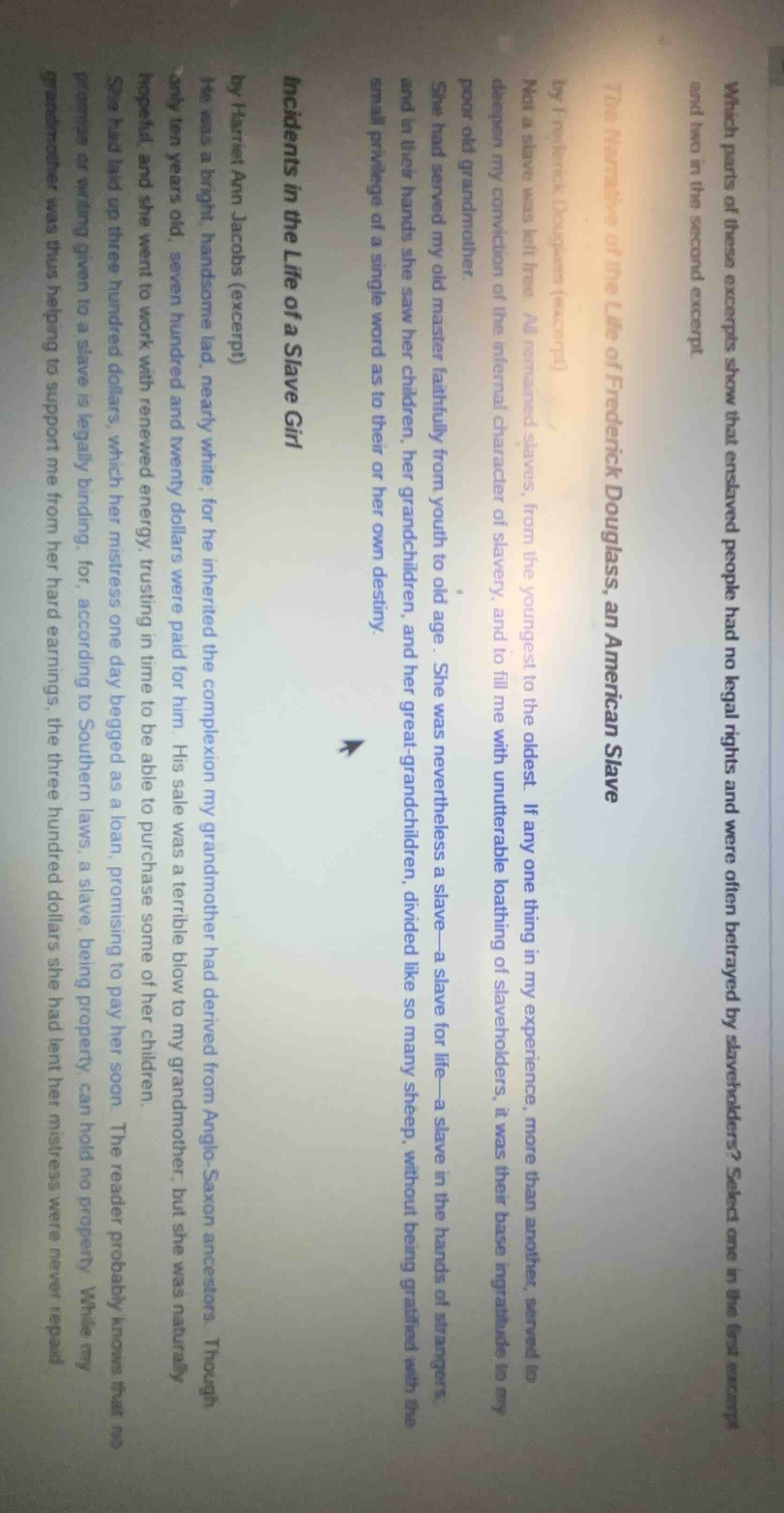
which parts of these excerpts show that enslaved people had no legal rights and were often betrayed by slaveholders? select one in the first excerpt and two in the second excerpt.
the narrative of the life of frederick douglass, an american slave
by frederick douglass (excerpt)
not a slave was left free. all remained slaves, from the youngest to the oldest. if any one thing in my experience, more than another, served to deepen my conviction of the infernal character of slavery, and to fill me with unutterable loathing of slaveholders, it was their base ingratitude to my poor old grandmother.
she had served my old master faithfully from youth to old age. she was nevertheless a slave—a slave for life—a slave in the hands of strangers, and in their hands she saw her children, her grandchildren, and her great - grandchildren, divided like so many sheep, without being gratified with one small privilege of a single word as to their or her own destiny.
incidents in the life of a slave girl
by harriet ann jacobs (excerpt)
he was a bright, handsome lad, nearly white; for he inherited the complexion my grandmother had derived from anglo - saxon ancestors. though only ten years old, seven hundred and twenty dollars were paid for him. his sale was a terrible blow to my grandmother, but she was naturally hopeful, and she went to work with renewed energy, trusting in time to be able to purchase some of her children.
she had laid up three hundred dollars, which her mistress one day begged as a loan, promising to pay her soon. the reader probably knows that no promise or writing given to a slave is legally binding, for, according to southern laws, a slave, being property, can hold no property. while my grandmother was thus helping to support me from her hard earnings, the three hundred dollars she had lent her mistress were never repaid.
To determine which part of the first excerpt (from The Narrative of the Life of Frederick Douglass, an American Slave) shows enslaved people had no legal rights and were betrayed, we analyze the text:
- The relevant part is: "Not a slave was left free. All remained slaves, from the youngest to the oldest. If any one thing in my experience, more than another, served to deepen my conviction of the infernal character of slavery, and to fill me with unutterable loathing of slaveholders, it was their base ingratitude to my poor old grandmother. She had served my old master faithfully from youth to old age. She was nevertheless a slave—a slave for life—a slave in the hands of strangers; and in their hands she saw her children, her grandchildren, and her great - grandchildren, divided like so many sheep, without being gratified with the small privilege of a single word as to their or her own destiny."
This part shows that despite the grandmother's lifelong faithful service, she remained a slave with no control over her own destiny or that of her family. She was a slave "for life" and her family was divided like property, indicating she had no legal rights (as she couldn't even have a say in her family's fate) and was betrayed by the slaveholders who showed "base ingratitude" after her faithful service.
For the second excerpt (from Incidents in the Life of a Slave Girl), the relevant part is: "She had laid up three hundred dollars, which her mistress one day begged as a loan, promising to pay her soon. The reader probably knows that no promise or writing given to a slave is legally binding; for, according to Southern laws, a slave, being property, can hold no property. While my grandmother was thus helping to support me from her hard earnings, the three hundred dollars she had lent her mistress were never repaid."
Here, the grandmother, a slave, had no legal right to her own earnings (as per Southern laws, a slave "can hold no property"). Her mistress took her money as a "loan" but never repaid it, showing that the grandmother had no legal rights to enforce the repayment and was betrayed by her mistress who took advantage of her slave status.

Snap & solve any problem in the app
Get step-by-step solutions on Sovi AI
Photo-based solutions with guided steps
Explore more problems and detailed explanations
- From the first excerpt (The Narrative of the Life of Frederick Douglass, an American Slave): "She had served my old master faithfully from youth to old age. She was nevertheless a slave—a slave for life—a slave in the hands of strangers; and in their hands she saw her children, her grandchildren, and her great - grandchildren, divided like so many sheep, without being gratified with the small privilege of a single word as to their or her own destiny."
- From the second excerpt (Incidents in the Life of a Slave Girl): "She had laid up three hundred dollars, which her mistress one day begged as a loan, promising to pay her soon. The reader probably knows that no promise or writing given to a slave is legally binding; for, according to Southern laws, a slave, being property, can hold no property. While my grandmother was thus helping to support me from her hard earnings, the three hundred dollars she had lent her mistress were never repaid."