QUESTION IMAGE
Question
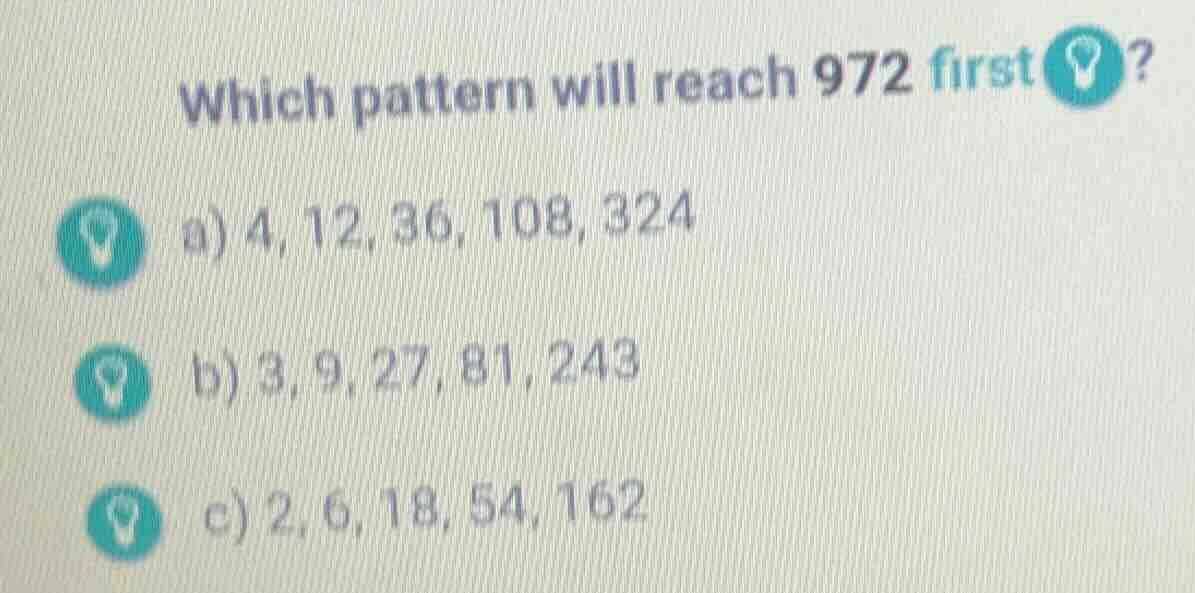
which pattern will reach 972 first?
a) 4, 12, 36, 108, 324
b) 3, 9, 27, 81, 243
c) 2, 6, 18, 54, 162
Step1: Identify the pattern of each sequence
For sequence a: Check the ratio between consecutive terms. $12\div4 = 3$, $36\div12 = 3$, $108\div36 = 3$, $324\div108 = 3$. So it's a geometric sequence with common ratio $r = 3$. The next term after 324 would be $324\times3 = 972$. Let's check the number of terms taken to reach 972. The given terms are 4 (term 1), 12 (term 2), 36 (term 3), 108 (term 4), 324 (term 5). The next term (term 6) is 972.
For sequence b: Check the ratio between consecutive terms. $9\div3 = 3$, $27\div9 = 3$, $81\div27 = 3$, $243\div81 = 3$. So it's a geometric sequence with common ratio $r = 3$. The next term after 243 would be $243\times3 = 729$, and then the term after 729 would be $729\times3 = 2187$. So 972 is not in this sequence's next few terms as the terms are 3 (term 1), 9 (term 2), 27 (term 3), 81 (term 4), 243 (term 5), 729 (term 6), 2187 (term 7). So it doesn't reach 972 at term 6.
For sequence c: Check the ratio between consecutive terms. $6\div2 = 3$, $18\div6 = 3$, $54\div18 = 3$, $162\div54 = 3$. So it's a geometric sequence with common ratio $r = 3$. The next term after 162 would be $162\times3 = 486$, and then the term after 486 would be $486\times3 = 1458$. So 972 is not in this sequence's next few terms as the terms are 2 (term 1), 6 (term 2), 18 (term 3), 54 (term 4), 162 (term 5), 486 (term 6), 1458 (term 7). So it doesn't reach 972 at term 6.
Step2: Compare the number of terms to reach 972
Sequence a reaches 972 at term 6. Sequence b and c do not reach 972 at term 6 (sequence b reaches 729 at term 6, sequence c reaches 486 at term 6). So sequence a reaches 972 first.

Snap & solve any problem in the app
Get step-by-step solutions on Sovi AI
Photo-based solutions with guided steps
Explore more problems and detailed explanations
a) 4, 12, 36, 108, 324