QUESTION IMAGE
Question
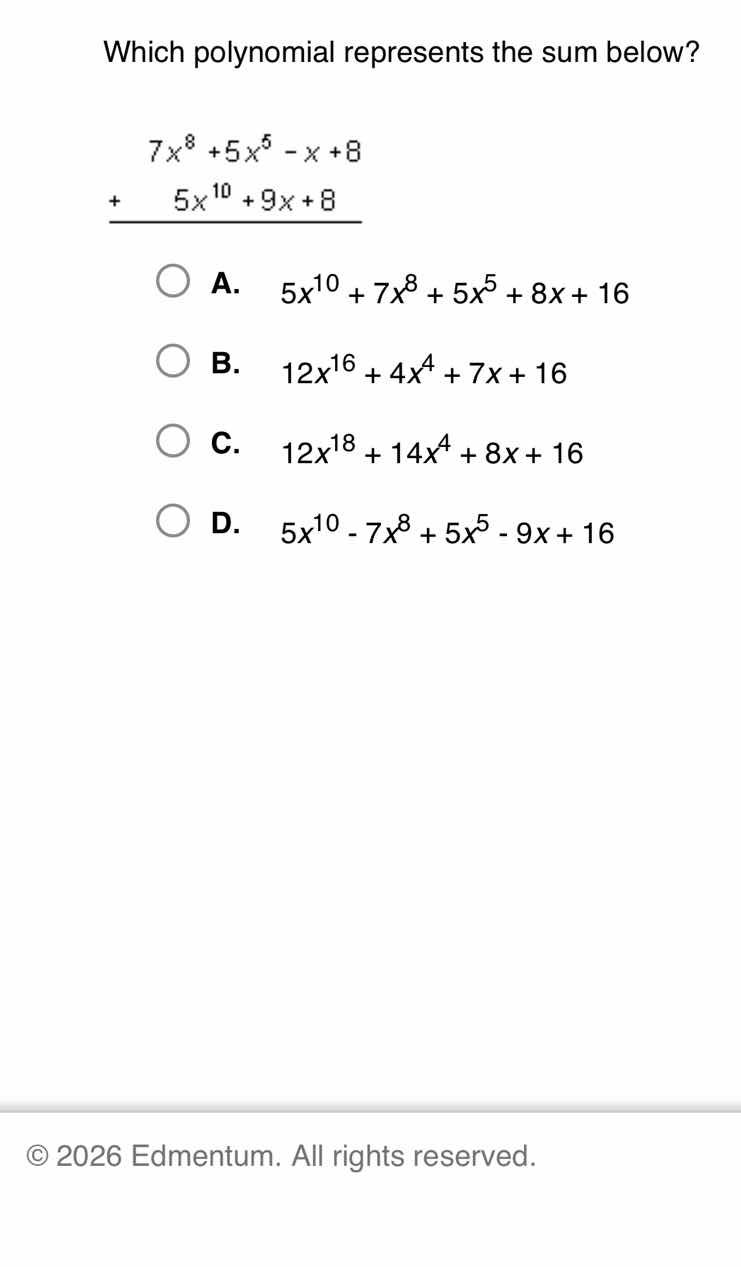
which polynomial represents the sum below?
$7x^8 + 5x^5 - x + 8$
$\underline{+ \\ \\ \\ \\ 5x^{10} + 9x + 8}$
\bigcirc a. $5x^{10} + 7x^8 + 5x^5 + 8x + 16$
\bigcirc b. $12x^{16} + 4x^4 + 7x + 16$
\bigcirc c. $12x^{18} + 14x^4 + 8x + 16$
\bigcirc d. $5x^{10} - 7x^8 + 5x^5 - 9x + 16$
© 2026 edmentum. all rights reserved.
Step1: Combine like terms for \(x^{10}\)
The term with \(x^{10}\) is \(5x^{10}\) (only in the second polynomial), so we keep it as \(5x^{10}\).
Step2: Combine like terms for \(x^{8}\)
The term with \(x^{8}\) is \(7x^{8}\) (only in the first polynomial), so we keep it as \(7x^{8}\).
Step3: Combine like terms for \(x^{5}\)
The term with \(x^{5}\) is \(5x^{5}\) (only in the first polynomial), so we keep it as \(5x^{5}\).
Step4: Combine like terms for \(x\)
The terms with \(x\) are \(-x\) (from the first polynomial) and \(9x\) (from the second polynomial). Combining them: \(-x + 9x = 8x\).
Step5: Combine like terms for constants
The constant terms are \(8\) (from the first polynomial) and \(8\) (from the second polynomial). Combining them: \(8 + 8 = 16\).
Putting all the combined terms together, we get \(5x^{10}+7x^{8}+5x^{5}+8x + 16\).

Snap & solve any problem in the app
Get step-by-step solutions on Sovi AI
Photo-based solutions with guided steps
Explore more problems and detailed explanations
A. \(5x^{10}+7x^{8}+5x^{5}+8x + 16\)