QUESTION IMAGE
Question
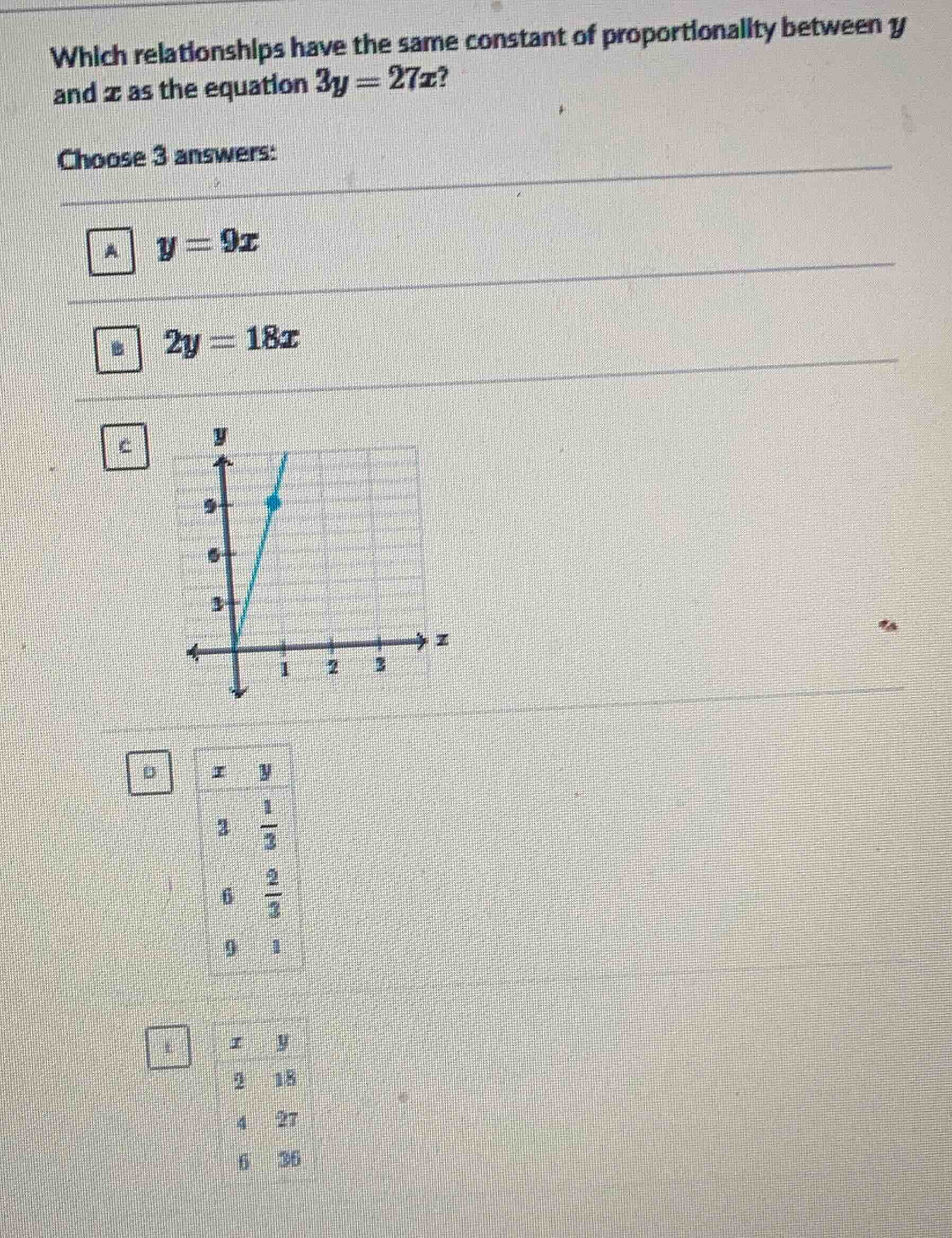
which relationships have the same constant of proportionality between y and x as the equation 3y = 27x? choose 3 answers: a y = 9x b 2y = 18x c a graph d a table with x and y values: x=3, y=1/3; x=6, y=2/3; x=9, y=1 e a table with x and y values: x=2, y=18; x=4, y=27; x=6, y=36
Step1: Find the constant of proportionality for the given equation.
The equation is \(3y = 27x\). To find the constant of proportionality (let's call it \(k\)) in the form \(y = kx\), we solve for \(y\). Divide both sides of the equation by 3:
\(y=\frac{27}{3}x = 9x\). So the constant of proportionality \(k = 9\).
Step2: Analyze Option A.
Option A is \(y = 9x\). Here, the constant of proportionality is 9, which matches the constant from the given equation. So Option A is correct.
Step3: Analyze Option B.
Option B is \(2y = 18x\). Solve for \(y\) by dividing both sides by 2:
\(y=\frac{18}{2}x=9x\). The constant of proportionality is 9, which matches. So Option B is correct.
Step4: Analyze Option C (Graph).
From the graph, we can see a point \((1, 9)\) (since when \(x = 1\), \(y = 9\)). Using the formula for constant of proportionality \(k=\frac{y}{x}\), when \(x = 1\) and \(y = 9\), \(k=\frac{9}{1}=9\). So the constant of proportionality is 9, which matches. So Option C is correct.
Step5: Analyze Option D (Table).
For the table in Option D, we calculate \(k=\frac{y}{x}\) for each row.
- When \(x = 3\), \(y=\frac{1}{3}\), so \(k=\frac{\frac{1}{3}}{3}=\frac{1}{9}\).
- When \(x = 6\), \(y=\frac{2}{3}\), so \(k=\frac{\frac{2}{3}}{6}=\frac{1}{9}\).
- When \(x = 9\), \(y = 1\), so \(k=\frac{1}{9}\). The constant of proportionality is \(\frac{1}{9}\), which does not match 9. So Option D is incorrect.
Step6: Analyze Option E (Table).
For the table in Option E, calculate \(k=\frac{y}{x}\) for each row.
- When \(x = 2\), \(y = 18\), so \(k=\frac{18}{2}=9\).
- When \(x = 4\), \(y = 27\), so \(k=\frac{27}{4}=6.75\) (wait, this is a mistake? Wait, no, wait the table: Wait, the table in E: x=2, y=18; x=4, y=27? Wait, no, maybe I misread. Wait, no, let's recalculate. Wait, if \(x = 2\), \(y = 18\), then \(k=\frac{18}{2}=9\). \(x = 4\), \(y = 27\): \(\frac{27}{4}=6.75\), which is not 9. Wait, that can't be. Wait, maybe the table is misread. Wait, no, the original problem: Wait, maybe I made a mistake. Wait, no, let's check again. Wait, the table in E: x=2, y=18; x=4, y=27; x=6, y=36. Wait, \(\frac{18}{2}=9\), \(\frac{27}{4}=6.75\), \(\frac{36}{6}=6\). Wait, that's inconsistent. Wait, no, maybe the table is different. Wait, no, perhaps I misread the table. Wait, no, the user's table for E: x=2, y=18; x=4, y=27; x=6, y=36. So the ratios are 9, 6.75, 6. So the constant of proportionality is not constant? Wait, no, that can't be. Wait, maybe I made a mistake in Option E. Wait, no, the key is that for a proportional relationship, \(y = kx\), so \(k\) should be constant. In Option E, the ratios are not constant (9, 6.75, 6), so it's not a proportional relationship with \(k = 9\). Wait, but earlier steps: Options A, B, C have \(k = 9\). So let's confirm:
Wait, Option E: x=2, y=18: 18/2=9; x=4, y=27: 27/4=6.75; x=6, y=36: 36/6=6. So the constant of proportionality is not constant, so it's not a proportional relationship with \(k = 9\). So Option E is incorrect.

Snap & solve any problem in the app
Get step-by-step solutions on Sovi AI
Photo-based solutions with guided steps
Explore more problems and detailed explanations
A. \(y = 9x\), B. \(2y = 18x\), C. The graph with point \((1, 9)\)