QUESTION IMAGE
Question
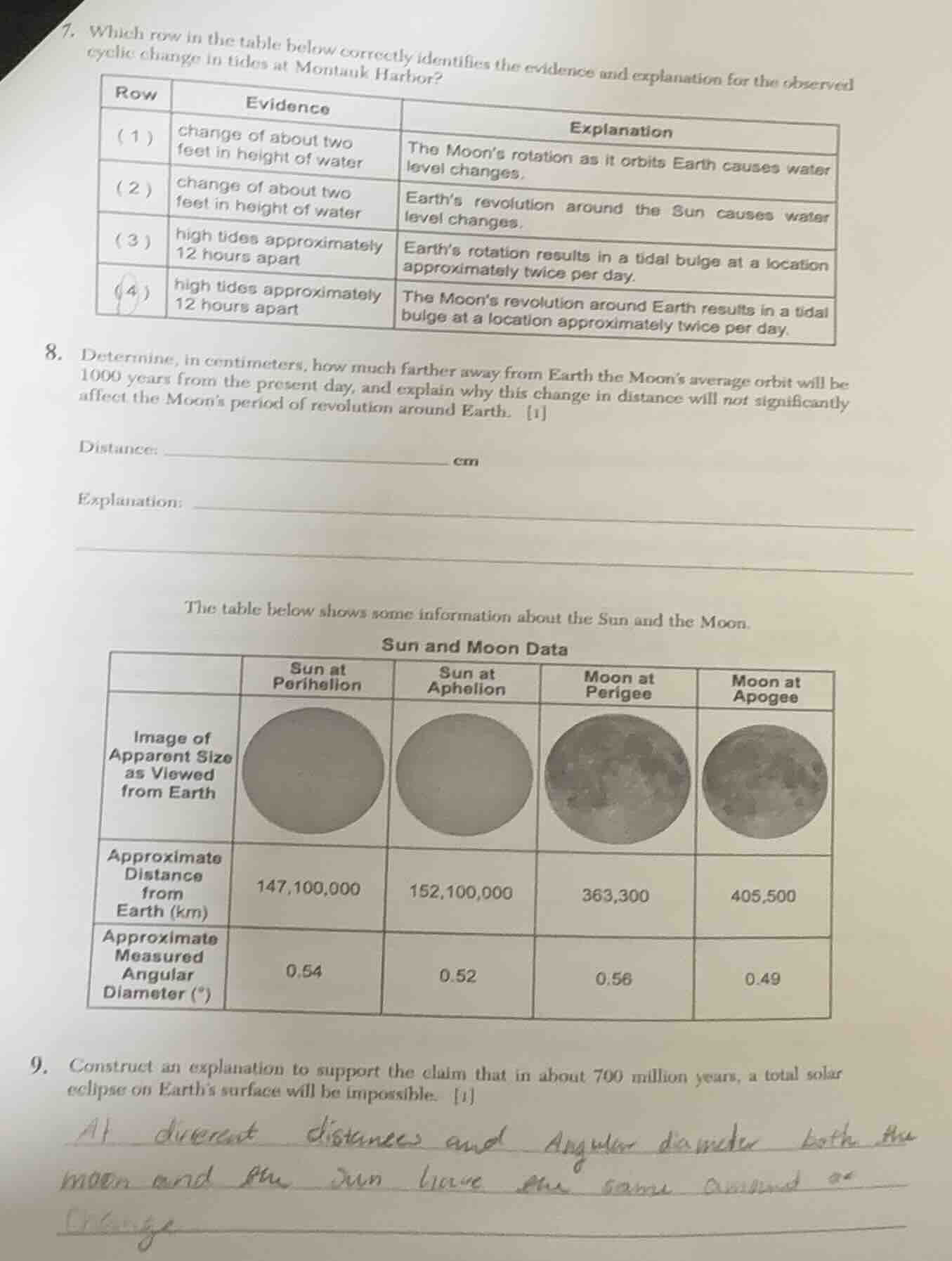
- which row in the table below correctly identifies the evidence and explanation for the observed cyclic change in tides at montauk harbor?
row (1) (2) (3) (4) evidence change of about two feet in height of water change of about two feet in height of water high tides approximately 12 hours apart high tides approximately 12 hours apart explanation the moon’s rotation as it orbits earth causes water level changes. earth’s revolution around the sun causes water level changes. earth’s rotation results in a tidal bulge at a location approximately twice per day. the moon’s revolution around earth results in a tidal bulge at a location approximately twice per day.
- determine, in centimeters, how much farther away from earth the moon’s average orbit will be 1000 years from the present day, and explain why this change in distance will not significantly affect the moon’s period of revolution around earth. 1
distance: ______ cm
explanation: ______
the table below shows some information about the sun and the moon.
sun and moon data
sun at perihelion sun at aphelion moon at perigee moon at apogee
image of apparent size as viewed from earth
approximate distance from earth (km) 147,100,000 152,100,000 363,300 405,500
approximate measured angular diameter (°) 0.54 0.52 0.56 0.49
- construct an explanation to support the claim that in about 700 million years, a total solar eclipse on earth’s surface will be impossible. 1
Question 7
Tides are primarily driven by the Moon's gravitational pull creating tidal bulges. Earth's rotation makes a location pass through these two bulges roughly every 12 hours, causing high tides ~12 hours apart. The Moon's revolution does not create the twice-daily bulge at a single location; Earth's rotation does.
Step1: State known lunar recession rate
The Moon moves away from Earth at a rate of ~3.8 cm per year.
Step2: Calculate total distance over 1000 years
$\text{Total Distance} = 3.8\ \text{cm/year} \times 1000\ \text{years} = 3800\ \text{cm}$
Step3: Explain orbital period insensitivity
Kepler's 3rd law shows orbital period depends on orbital semi-major axis, but the 1000-year distance change is negligible relative to the Moon's average orbital radius (~384,400 km), so the period change is insignificant.
The Moon moves away at ~3.8 cm/year, so over 1000 years it moves 3800 cm. This distance change is tiny compared to the Moon's total orbital radius, so it does not significantly alter the orbital period per Kepler's third law.
---
Question 9

Snap & solve any problem in the app
Get step-by-step solutions on Sovi AI
Photo-based solutions with guided steps
Explore more problems and detailed explanations
(3) high tides approximately 12 hours apart; Earth's rotation results in a tidal bulge at a location approximately twice per day.
---