QUESTION IMAGE
Question
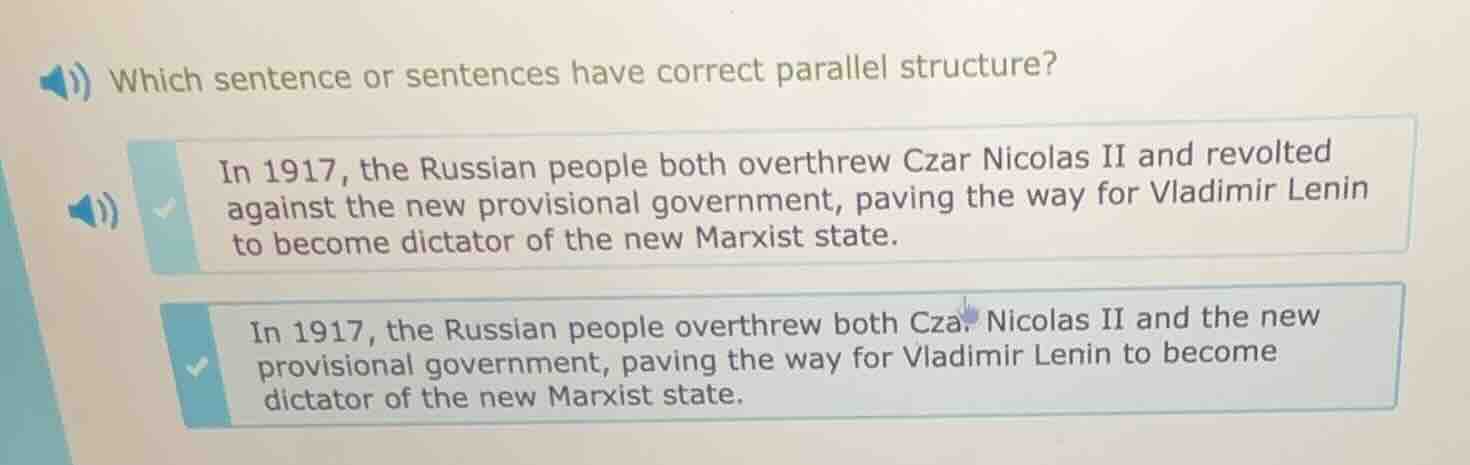
which sentence or sentences have correct parallel structure?
in 1917, the russian people both overthrew czar nicolas ii and revolted against the new provisional government, paving the way for vladimir lenin to become dictator of the new marxist state.
in 1917, the russian people overthrew both czar nicolas ii and the new provisional government, paving the way for vladimir lenin to become dictator of the new marxist state.
To determine parallel structure, we check if the elements connected by "both" (or other parallel markers) are of the same grammatical form. In the second sentence, "overthrew both Czar Nicolas II and the new provisional government" has "Czar Nicolas II" (a noun phrase) and "the new provisional government" (a noun phrase) as the objects of "overthrew", so they are parallel. In the first sentence, "overthrew Czar Nicolas II" (a verb - object structure) and "revolted against the new provisional government" (another verb - object structure) are also parallel as they are both verb - object phrases connected by "both...and...". Wait, actually, let's re - examine. The first sentence: "both overthrew...and revolted..." – "overthrew" and "revolted" are both verbs, so their phrases are parallel. The second sentence: "overthrew both...and..." – the two objects are both noun phrases, so they are parallel. Wait, but maybe the original question's checkmarks are correct. Wait, no, let's analyze again. In the first sentence, "overthrew Czar Nicolas II" (action on a person) and "revolted against the new provisional government" (action on a government) – the verbs "overthrew" and "revolted" are parallel in form (both past - tense verbs), and their objects are different but the structure of the verb - object is parallel. In the second sentence, "overthrew both Czar Nicolas II and the new provisional government" – "Czar Nicolas II" and "the new provisional government" are both noun phrases, so they are parallel as objects of "overthrew". So both sentences have correct parallel structure? Wait, but maybe the user's checkmarks are indicating that. Wait, the question is which sentence or sentences have correct parallel structure. Let's check the first sentence: "both overthrew Czar Nicolas II and revolted against the new provisional government" – "overthrew" (transitive verb, past tense) and "revolted" (intransitive verb with a prepositional phrase, past tense) – are they parallel? The structure "overthrew (object)" and "revolted against (object)" – the verb forms: "overthrew" is a transitive verb, "revolted" is intransitive + preposition. But in terms of parallelism in the "both...and..." construction, we need the elements after "both" and "and" to be parallel. In the first sentence, after "both" is a verb phrase "overthrew Czar Nicolas II" and after "and" is a verb phrase "revolted against the new provisional government" – both are verb phrases (verb + object), so they are parallel. In the second sentence, after "both" is a noun phrase "Czar Nicolas II" and after "and" is a noun phrase "the new provisional government" – both are noun phrases, so they are parallel as objects of "overthrew". So both sentences have correct parallel structure. But maybe the intended answer is the second sentence? Wait, no, let's check the first sentence again. "overthrew" and "revolted" – "overthrew" is transitive, "revolted" is intransitive (needs "against" to take an object). So "overthrew Czar Nicolas II" (transitive verb + object) and "revolted against the new provisional government" (intransitive verb + preposition + object) – are these parallel? The verb forms: "overthrew" (past simple, transitive) and "revolted" (past simple, intransitive) – the structure of the verb phrases: transitive verb + object vs. intransitive verb + preposition + object. Are these considered parallel? Maybe not. In the second sentence, "overthrew both X and Y" where X and Y are both noun phrases (the object of the transitive verb "overthrew"), so that's a clear parallel structure (two noun phr…

Snap & solve any problem in the app
Get step-by-step solutions on Sovi AI
Photo-based solutions with guided steps
Explore more problems and detailed explanations
Both sentences have correct parallel structure:
- In 1917, the Russian people both overthrew Czar Nicolas II and revolted against the new provisional government, paving the way for Vladimir Lenin to become dictator of the new Marxist state.
- In 1917, the Russian people overthrew both Czar Nicolas II and the new provisional government, paving the way for Vladimir Lenin to become dictator of the new Marxist state.