QUESTION IMAGE
Question
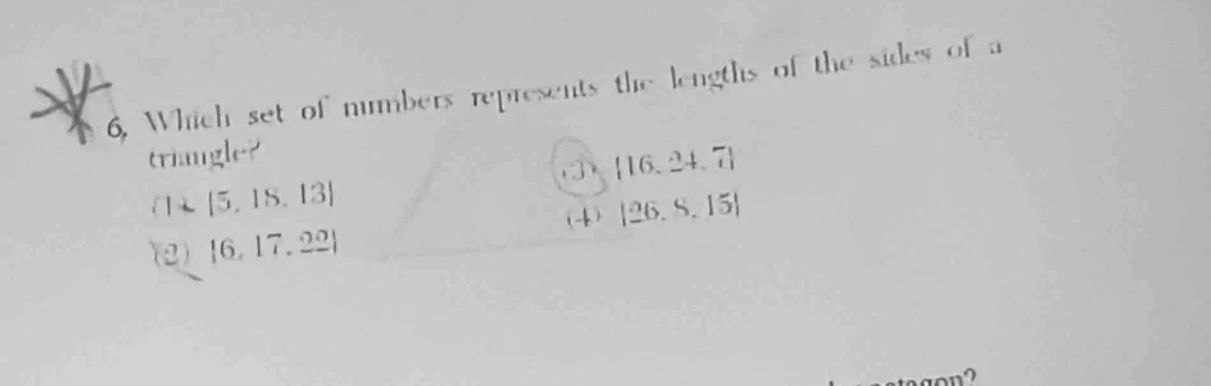
- which set of numbers represents the lengths of the sides of a triangle? (1) {5, 18, 13} (2) {6, 17, 22} (3) {16, 24, 7} (4) {26, 8, 15}
To determine if a set of three numbers can represent the sides of a triangle, we use the triangle inequality theorem, which states that the sum of the lengths of any two sides of a triangle must be greater than the length of the remaining side. We check each option:
Step 1: Analyze Option (1) {5, 18, 13}
Check the sums:
- \( 5 + 13 = 18 \). But for a triangle, the sum must be greater than the third side, not equal. So \( 5 + 13
ot> 18 \). Thus, this set does not form a triangle.
Step 2: Analyze Option (2) {6, 17, 22}
Check all three sums:
- \( 6 + 17 = 23 \). Since \( 23 > 22 \) (the third side).
- \( 6 + 22 = 28 \). Since \( 28 > 17 \).
- \( 17 + 22 = 39 \). Since \( 39 > 6 \).
All sums satisfy the triangle inequality. Let's verify the other options to be sure.
Step 3: Analyze Option (3) {16, 24, 7}
Check the sum of the two smaller sides:
- \( 7 + 16 = 23 \). Since \( 23 < 24 \) (the largest side), \( 7 + 16
ot> 24 \). Thus, this set does not form a triangle.
Step 4: Analyze Option (4) {26, 8, 15}
Check the sum of the two smaller sides:
- \( 8 + 15 = 23 \). Since \( 23 < 26 \) (the largest side), \( 8 + 15
ot> 26 \). Thus, this set does not form a triangle.

Snap & solve any problem in the app
Get step-by-step solutions on Sovi AI
Photo-based solutions with guided steps
Explore more problems and detailed explanations
(2) {6, 17, 22}