QUESTION IMAGE
Question
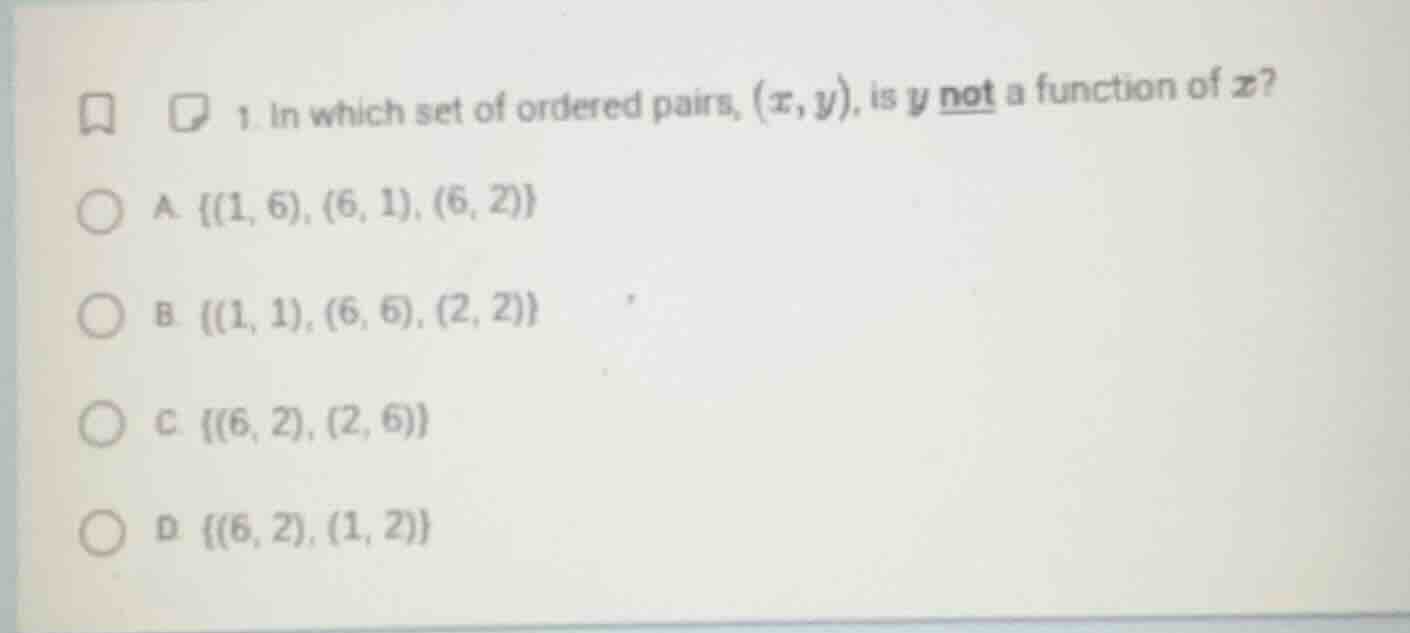
- in which set of ordered pairs, ((x, y)), is (y) not a function of (x)?
a. ({(1, 6), (6, 1), (6, 2)})
b. ({(1, 1), (6, 6), (2, 2)})
c. ({(6, 2), (2, 6)})
d. ({(6, 2), (1, 2)})
Brief Explanations
To determine if \( y \) is a function of \( x \), we use the definition of a function: each input \( x \) must have exactly one output \( y \). We check each option:
- Option A: The ordered pairs are \( (1, 6) \), \( (6, 1) \), \( (6, 2) \). Here, the input \( x = 6 \) is paired with two different outputs (\( y = 1 \) and \( y = 2 \)). This violates the function definition.
- Option B: Each \( x \) (1, 6, 2) has exactly one \( y \) (1, 6, 2), so it is a function.
- Option C: The inputs \( x = 6 \) and \( x = 2 \) each have one output, so it is a function.
- Option D: The inputs \( x = 6 \) and \( x = 1 \) both have \( y = 2 \), which is allowed (multiple inputs can have the same output).

Snap & solve any problem in the app
Get step-by-step solutions on Sovi AI
Photo-based solutions with guided steps
Explore more problems and detailed explanations
A. \(\{(1, 6), (6, 1), (6, 2)\}\)