QUESTION IMAGE
Question
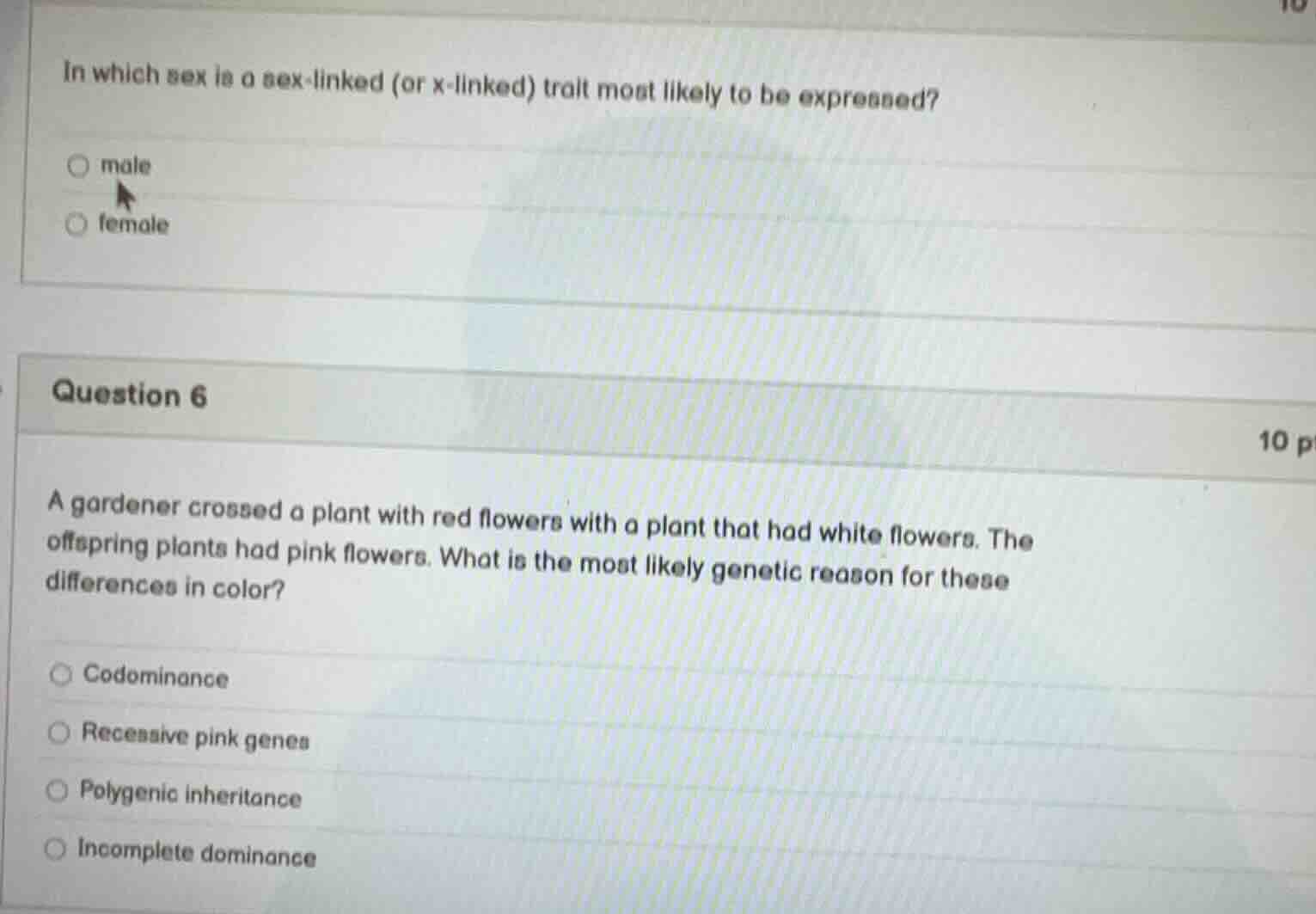
in which sex is a sex - linked (or x - linked) trait most likely to be expressed?
male
female
question 6
a gardener crossed a plant with red flowers with a plant that had white flowers. the offspring plants had pink flowers. what is the most likely genetic reason for these differences in color?
codominance
recessive pink genes
polygenic inheritance
incomplete dominance
First Question (Sex - linked trait expression)
Sex - linked (X - linked) traits: Males have one X and one Y chromosome. For X - linked recessive traits, since males have only one X chromosome, if they inherit the allele for the trait on the X chromosome, they will express it. Females have two X chromosomes, so they can be carriers (with one affected X and one normal X) and not express the recessive trait. For dominant X - linked traits, both can express, but recessive X - linked traits are more likely to be expressed in males. So a sex - linked (X - linked) trait is most likely to be expressed in males.
- Codominance: Both alleles are fully expressed, e.g., AB blood type, where both A and B antigens are present. In flower color, this would mean both red and white are seen, not pink.
- Recessive pink genes: There's no indication of pink being a recessive trait here; the offspring is a blend of red and white.
- Polygenic inheritance: Involves multiple genes, but this is a case of a single - gene (or two - allele) interaction for flower color.
- Incomplete dominance: Occurs when neither allele is completely dominant, and the heterozygous phenotype is a blend of the two homozygous phenotypes. Red (RR) and white (rr) parents producing pink (Rr) offspring is a classic example of incomplete dominance.

Snap & solve any problem in the app
Get step-by-step solutions on Sovi AI
Photo-based solutions with guided steps
Explore more problems and detailed explanations
A. male