QUESTION IMAGE
Question
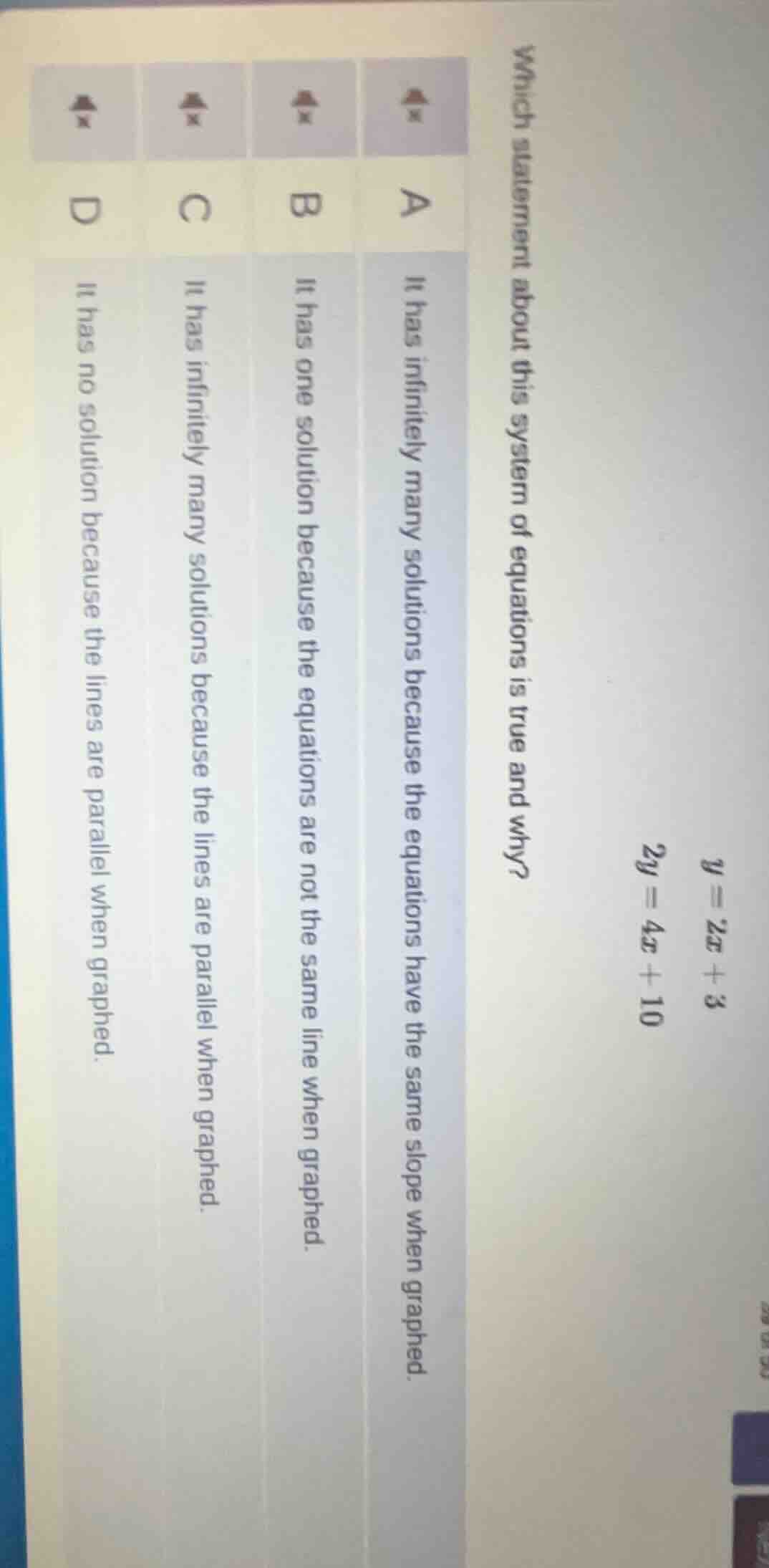
which statement about this system of equations is true and why?
y = 2x + 3
2y = 4x + 10
a it has infinitely many solutions because the equations have the same slope when graphed.
b it has one solution because the equations are not the same line when graphed.
c it has infinitely many solutions because the lines are parallel when graphed.
d it has no solution because the lines are parallel when graphed.
Step1: Analyze the first equation
The first equation is \( y = 2x + 3 \). In slope - intercept form \( y=mx + b \), where \( m \) is the slope and \( b \) is the y - intercept, the slope \( m_1=2 \) and the y - intercept \( b_1 = 3 \).
Step2: Analyze the second equation
The second equation is \( 2y=4x + 10 \). We can rewrite it in slope - intercept form by dividing both sides by 2: \( y = 2x+5 \). In slope - intercept form \( y = mx + b \), the slope \( m_2 = 2 \) and the y - intercept \( b_2=5 \).
Step3: Compare the slopes and y - intercepts
We know that for two linear equations \( y = m_1x + b_1 \) and \( y=m_2x + b_2 \):
- If \( m_1
eq m_2 \), the lines intersect at one point (one solution).
- If \( m_1 = m_2 \) and \( b_1=b_2 \), the lines are the same (infinitely many solutions).
- If \( m_1 = m_2 \) and \( b_1
eq b_2 \), the lines are parallel (no solution).
Here, \( m_1=m_2 = 2 \) and \( b_1 = 3
eq b_2 = 5 \). So the two lines are parallel. Parallel lines never intersect, so the system of equations has no solution.
Let's analyze each option:
- Option A: The equations do not have the same y - intercept, so they are not the same line. So this option is incorrect.
- Option B: The equations are not the same line (different y - intercepts) and since they have the same slope, they are parallel, not intersecting at one point. So this option is incorrect.
- Option C: Parallel lines do not have infinitely many solutions (they never intersect). So this option is incorrect.
- Option D: Since the slopes are equal (\( m_1 = m_2=2 \)) and the y - intercepts are different (\( b_1 = 3,b_2 = 5 \)), the lines are parallel. Parallel lines do not intersect, so the system has no solution. This option is correct.

Snap & solve any problem in the app
Get step-by-step solutions on Sovi AI
Photo-based solutions with guided steps
Explore more problems and detailed explanations
D. It has no solution because the lines are parallel when graphed.