QUESTION IMAGE
Question
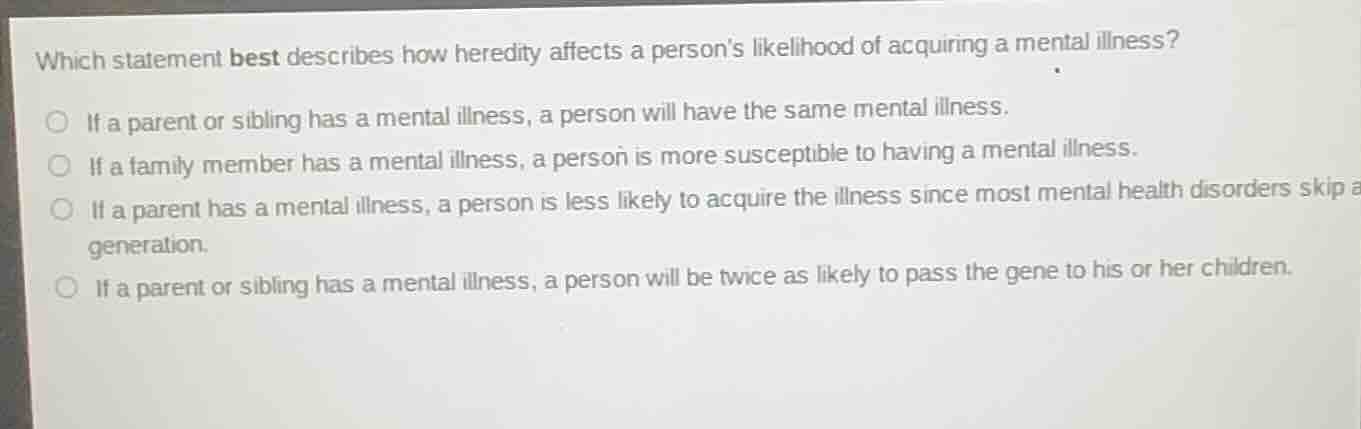
which statement best describes how heredity affects a person’s likelihood of acquiring a mental illness?
○ if a parent or sibling has a mental illness, a person will have the same mental illness.
○ if a family member has a mental illness, a person is more susceptible to having a mental illness.
○ if a parent has a mental illness, a person is less likely to acquire the illness since most mental health disorders skip a generation.
○ if a parent or sibling has a mental illness, a person will be twice as likely to pass the gene to his or her children.
- The first option is incorrect because having a family member with a mental illness doesn't mean a person will have the exact same illness; mental illnesses are complex and not solely determined by heredity in a direct, identical way.
- The second option is correct. Heredity can increase susceptibility to mental illness. If a family member has a mental illness, genetic factors can make a person more likely to develop a mental illness, though environmental factors also play a role.
- The third option is incorrect. Most mental health disorders do not "skip a generation" in a predictable way, and having a parent with a mental illness generally increases, not decreases, the likelihood of acquiring the illness.
- The fourth option is incorrect. There's no established rule that having a parent or sibling with a mental illness makes a person twice as likely to pass the gene to their children. The inheritance of mental illness - related genes is more complex and not typically described in such a simple, quantifiable way.

Snap & solve any problem in the app
Get step-by-step solutions on Sovi AI
Photo-based solutions with guided steps
Explore more problems and detailed explanations
B. If a family member has a mental illness, a person is more susceptible to having a mental illness.