QUESTION IMAGE
Question
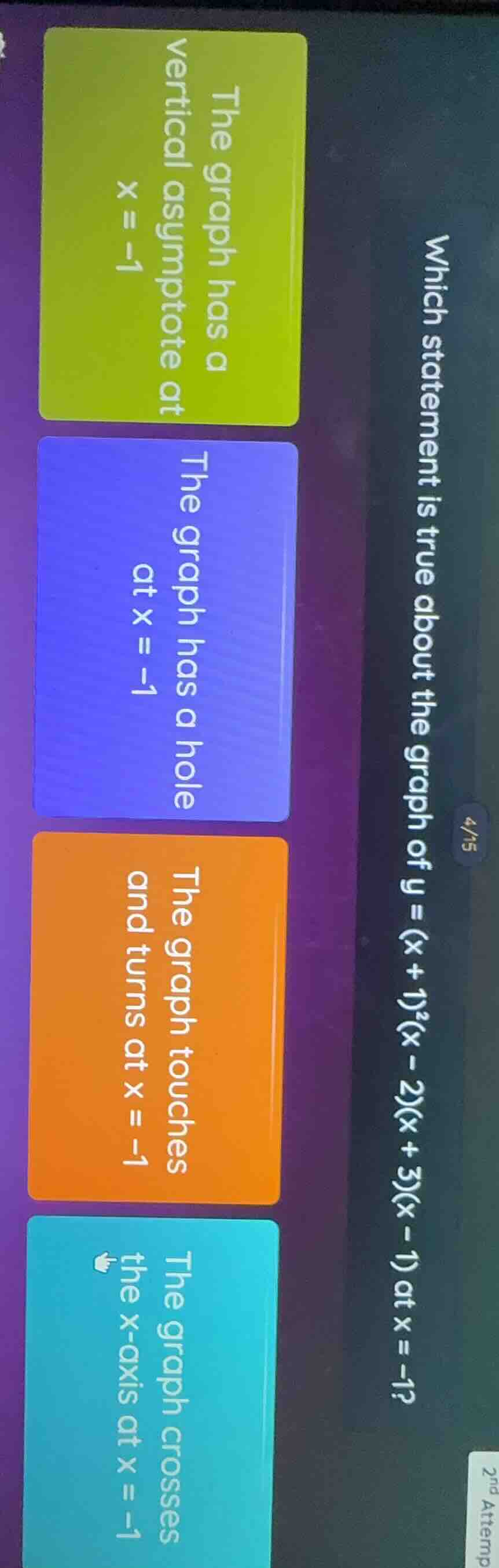
which statement is true about the graph of $y = (x + 1)^2(x - 2)(x + 3)(x - 1)$ at $x = -1$? the graph has a vertical asymptote at $x = -1$; the graph has a hole at $x = -1$; the graph touches and turns at $x = -1$; the graph crosses the x - axis at $x = -1$
Step1: Analyze the function's factor at \( x = -1 \)
The function is \( y=(x + 1)^2(x - 2)(x + 3)(x - 1) \). The factor corresponding to \( x=-1 \) is \( (x + 1)^2 \), which has an even multiplicity (multiplicity 2).
Step2: Recall the behavior of polynomial graphs at roots
For a polynomial function, if a root \( r \) has an even multiplicity, the graph touches the \( x \)-axis (or "turns") at that root; if the multiplicity is odd, the graph crosses the \( x \)-axis at that root. Vertical asymptotes and holes are features of rational functions (with denominators), but this is a polynomial function (no denominator), so there are no vertical asymptotes or holes.
Step3: Evaluate each option
- "The graph has a vertical asymptote at \( x=-1 \)": False, since it's a polynomial (no denominator), so no vertical asymptotes.
- "The graph has a hole at \( x=-1 \)": False, holes occur in rational functions when a factor cancels, but this is a polynomial with no canceled factors.
- "The graph touches and turns at \( x=-1 \)": True, because the multiplicity of the root \( x=-1 \) (from \( (x + 1)^2 \)) is 2 (even), so the graph touches the \( x \)-axis and turns around at \( x=-1 \).
- "The graph crosses the \( x \)-axis at \( x=-1 \)": False, crossing occurs for odd multiplicities, but here multiplicity is even.

Snap & solve any problem in the app
Get step-by-step solutions on Sovi AI
Photo-based solutions with guided steps
Explore more problems and detailed explanations
The graph touches and turns at \( x = -1 \) (the orange option: "The graph touches and turns at \( x = -1 \)")