QUESTION IMAGE
Question
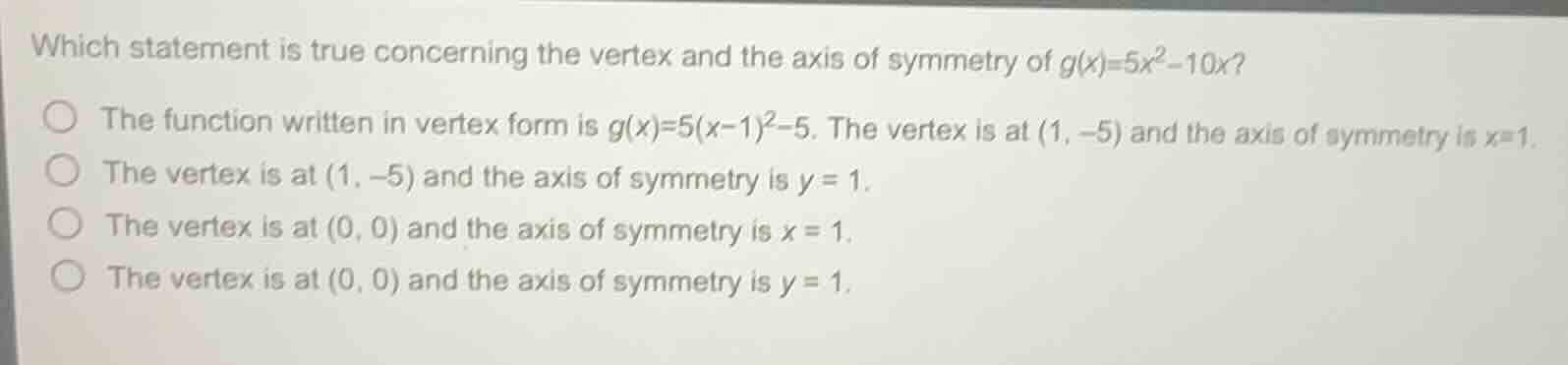
which statement is true concerning the vertex and the axis of symmetry of g(x)=5x²−10x?
○ the function written in vertex form is g(x)=5(x−1)²−5. the vertex is at (1, −5) and the axis of symmetry is x=1.
○ the vertex is at (1, −5) and the axis of symmetry is y = 1.
○ the vertex is at (0, 0) and the axis of symmetry is x = 1.
○ the vertex is at (0, 0) and the axis of symmetry is y = 1.
Step1: Recall Vertex Form of Quadratic
The vertex form of a quadratic function is \( g(x)=a(x - h)^2 + k \), where \((h,k)\) is the vertex and \(x = h\) is the axis of symmetry. We can convert \( g(x)=5x^2 - 10x \) to vertex form by completing the square.
Step2: Factor out the coefficient of \(x^2\)
Factor out 5 from the first two terms: \( g(x)=5(x^2 - 2x) \)
Step3: Complete the square inside the parentheses
To complete the square for \(x^2 - 2x\), we take half of -2 (which is -1), square it (which is 1), and add and subtract it inside the parentheses. But since we have a factor of 5 outside, we need to be careful.
\( g(x)=5[(x^2 - 2x + 1)-1] \)
This simplifies to \( g(x)=5(x - 1)^2-5 \) (because \(5\times(- 1)=-5\))
Step4: Identify vertex and axis of symmetry
From the vertex form \( g(x)=5(x - 1)^2-5 \), we can see that \(h = 1\) and \(k=-5\). So the vertex is \((1,-5)\) and the axis of symmetry is \(x = 1\) (since for a quadratic in the form \(a(x - h)^2 + k\), the axis of symmetry is \(x=h\)).
Now let's check the other options:
- The second option says the axis of symmetry is \(y = 1\), which is incorrect because the axis of symmetry for a vertical parabola (since the coefficient of \(x^2\) is non - zero) is a vertical line (of the form \(x=\text{constant}\)).
- The third and fourth options say the vertex is \((0,0)\), but from our conversion to vertex form, we know the vertex is \((1,-5)\), so these are incorrect.

Snap & solve any problem in the app
Get step-by-step solutions on Sovi AI
Photo-based solutions with guided steps
Explore more problems and detailed explanations
The function written in vertex form is \(g(x)=5(x - 1)^2-5\). The vertex is at \((1,-5)\) and the axis of symmetry is \(x = 1\).