QUESTION IMAGE
Question
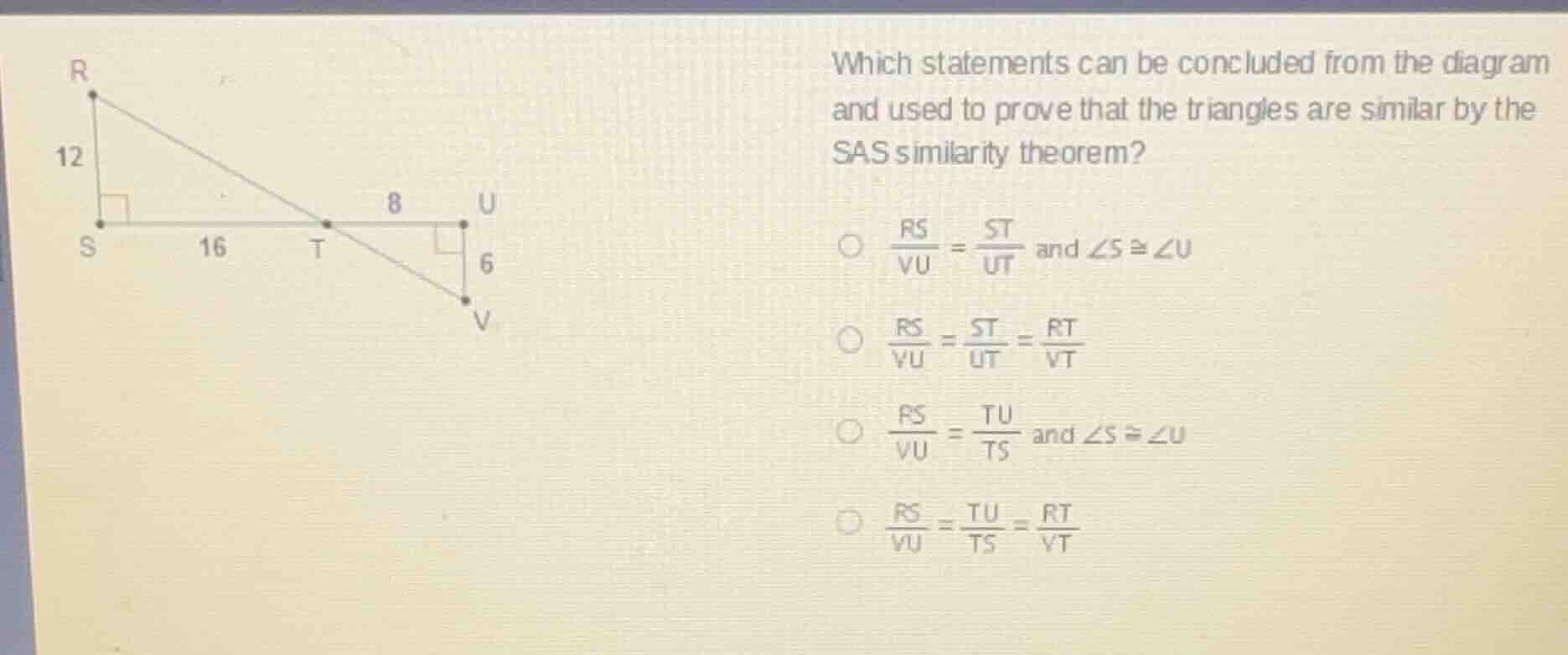
which statements can be concluded from the diagram and used to prove that the triangles are similar by the sas similarity theorem? \\(\bigcirc\\) \\(\frac{rs}{vu} = \frac{st}{ut}\\) and \\(\angle s \cong \angle u\\) \\(\bigcirc\\) \\(\frac{rs}{vu} = \frac{st}{ut} = \frac{rt}{vt}\\) \\(\bigcirc\\) \\(\frac{rs}{vu} = \frac{tu}{ts}\\) and \\(\angle s \cong \angle u\\) \\(\bigcirc\\) \\(\frac{rs}{vu} = \frac{tu}{ts} = \frac{rt}{vt}\\)
Step1: Recall SAS Similarity Rule
SAS similarity requires two pairs of corresponding sides to be in proportion, and the included angles to be congruent.
Step2: Identify side lengths
For $\triangle RST$: $RS=12$, $ST=16$, $\angle S$ is right angle.
For $\triangle VUT$: $VU=6$, $UT=8$, $\angle U$ is right angle.
Step3: Calculate side ratios
$\frac{RS}{VU} = \frac{12}{6}=2$, $\frac{ST}{UT}=\frac{16}{8}=2$. So $\frac{RS}{VU}=\frac{ST}{UT}$.
Step4: Verify included angles
$\angle S \cong \angle U$ (both are right angles, $90^\circ$), which are the included angles of the proportional sides.
Step5: Match with options
The correct pair of statements is $\frac{RS}{VU} = \frac{ST}{UT}$ and $\angle S \cong \angle U$.

Snap & solve any problem in the app
Get step-by-step solutions on Sovi AI
Photo-based solutions with guided steps
Explore more problems and detailed explanations
$\boldsymbol{\frac{RS}{VU} = \frac{ST}{UT} \text{ and } \angle S \cong \angle U}$ (first option)