QUESTION IMAGE
Question
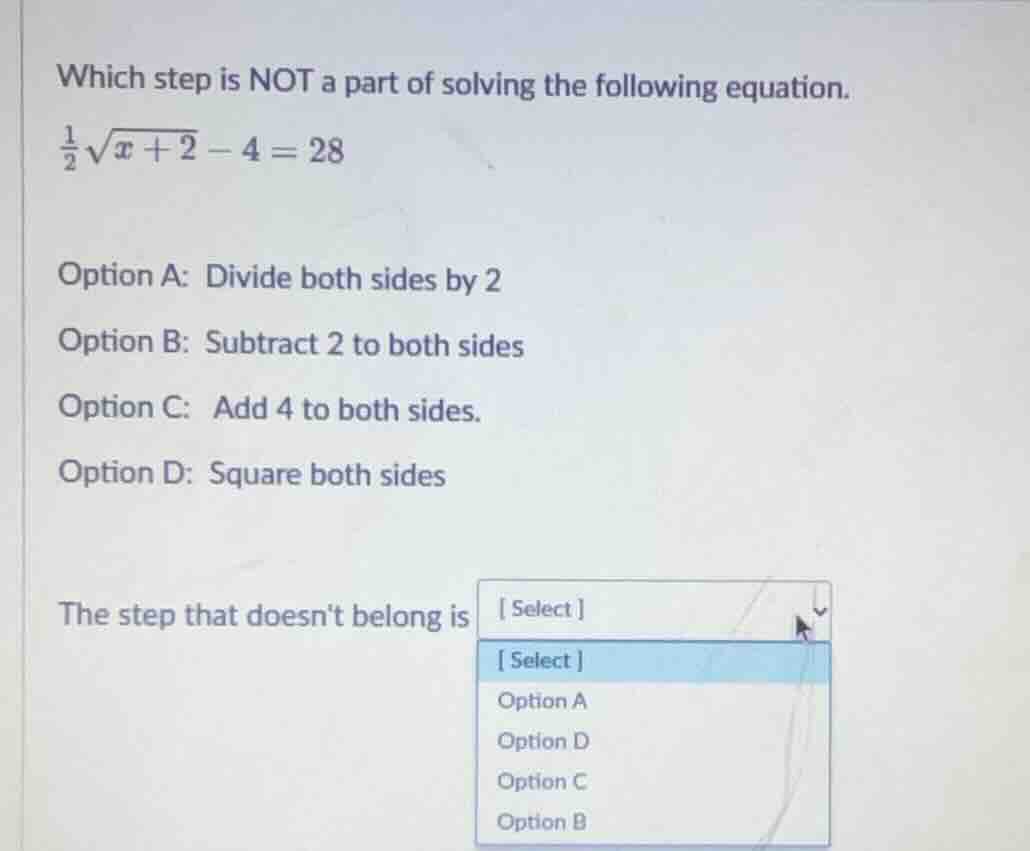
which step is not a part of solving the following equation.$\frac{1}{2}sqrt{x+2}-4=28$option a: divide both sides by 2option b: subtract 2 to both sidesoption c: add 4 to both sides.option d: square both sidesthe step that doesnt belong is
Step1: Isolate the radical term
Add 4 to both sides:
$\frac{1}{2}\sqrt{x+2} - 4 + 4 = 28 + 4$
$\frac{1}{2}\sqrt{x+2} = 32$
Step2: Eliminate the coefficient
Multiply (or divide by $\frac{1}{2}$, same as multiply by 2) both sides by 2:
$2\times\frac{1}{2}\sqrt{x+2} = 32\times2$
$\sqrt{x+2} = 64$
Step3: Remove the square root
Square both sides:
$(\sqrt{x+2})^2 = 64^2$
$x+2 = 4096$
Step4: Solve for x
Subtract 2 from both sides:
$x+2-2 = 4096-2$
$x = 4094$
Step5: Identify non-used step
Review standard solving steps; subtracting 2 is done after squaring, not before isolating the radical. The option B describes a step that is not part of the process to solve the original equation (it is a later step for x, not part of solving the radical equation itself as presented in the options).

Snap & solve any problem in the app
Get step-by-step solutions on Sovi AI
Photo-based solutions with guided steps
Explore more problems and detailed explanations
B. Subtract 2 to both sides