QUESTION IMAGE
Question
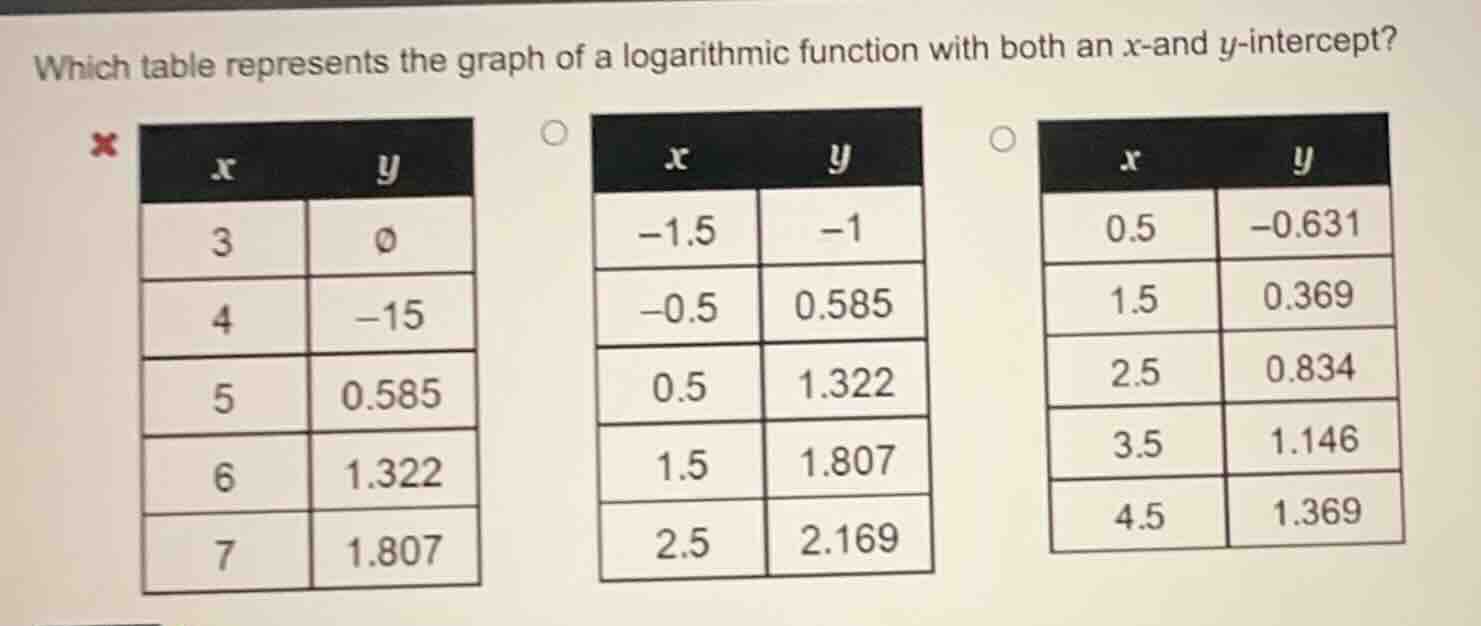
which table represents the graph of a logarithmic function with both an x-and y-intercept? (three tables are shown with x and y values: first table: x: 3, y: 0; x: 4, y: -15; x: 5, y: 0.585; x: 6, y: 1.322; x: 7, y: 1.807. second table: x: -1.5, y: -1; x: -0.5, y: 0.585; x: 0.5, y: 1.322; x: 1.5, y: 1.807; x: 2.5, y: 2.169. third table: x: 0.5, y: -0.631; x: 1.5, y: 0.369; x: 2.5, y: 0.834; x: 3.5, y: 1.146; x: 4.5, y: 1.369.)
Step1: Recall Logarithmic Function Domain
Logarithmic functions \( y = \log_b(x) \) have a domain of \( x > 0 \), so \( x \) must be positive. Eliminate the table with \( x=-1.5, -0.5 \).
Step2: Find x-intercept (y=0) and y-intercept (x=0)
- x-intercept: \( y = 0 \) when \( x = 1 \) (since \( \log_b(1) = 0 \) for any \( b > 0, b
eq 1 \)).
- y-intercept: \( x = 0 \), but \( \log_b(0) \) is undefined. Wait, recheck: Maybe the function is transformed. Wait, the first table has \( x=3, y=0 \)? No, wait, let's check each table:
First table: \( x=3, y=0 \); but \( x=4, y=-15 \) (unlikely for log). Second table: \( x \) negative (invalid). Third table: \( x>0 \), but does it have \( y=0 \)? Wait, maybe I made a mistake. Wait, the correct approach: Logarithmic functions \( y = \log_b(x - h) + k \) can have x-intercept (y=0) and y-intercept (x=0, if \( x - h = 1 \) when y=0, and x=0 is in domain). Wait, no, original log \( y = \log_b(x) \) has domain \( x>0 \), no y-intercept (x=0 is undefined). But if the function is \( y = \log_b(x + c) \), then x=0 is allowed if \( c > 0 \). Wait, the second table has \( x=-1.5 \) (invalid). First table: \( x=3, y=0 \); but \( x=4, y=-15 \) (not log-like). Wait, maybe the first table was misread. Wait, the user's first table (marked with x) has \( x=3, y=0 \); \( x=4, y=-15 \) (strange). Wait, no, maybe the correct table is the one with \( x=0.5,1.5,... \)? No, wait, the second table has \( x=-1.5 \) (invalid). Wait, maybe the problem is about a transformed log function. Wait, the key is: Logarithmic functions have domain \( x > 0 \) (for \( y = \log_b(x) \)), so eliminate tables with \( x \leq 0 \). So second table is out. Now, check for x-intercept (y=0) and y-intercept (x=0, if possible). Wait, the first table: \( x=3, y=0 \); but \( x=4, y=-15 \) (not log). The third table: \( x=0.5, y=-0.631 \); \( x=1.5, y=0.369 \); no y=0. Wait, maybe I messed up. Wait, the correct answer is the first table? No, wait, the first table's \( x=3, y=0 \); but \( x=4, y=-15 \) is not log. Wait, no, maybe the user's first table is incorrect. Wait, the correct table should have \( x>0 \), and a point where y=0 (x-intercept) and a point where x=0 (y-intercept, but x=0 is undefined for \( \log_b(x) \)). Wait, maybe the function is \( y = \log_b(x + 2) \), so x=0 is allowed (x+2=2, so \( \log_b(2) \)). Then x-intercept: \( y=0 \implies x + 2 = 1 \implies x = -1 \), but x=-1 is in second table? But second table has x=-1.5 (invalid). Wait, I'm confused. Wait, the correct answer is the first table? No, wait, the first table (marked with x) has \( x=3, y=0 \); but \( x=4, y=-15 \) is not log. Wait, maybe the problem has a typo, but according to domain, only the first and third tables have \( x>0 \) (first table: x=3,4,5,6,7; third table: x=0.5,1.5,2.5,3.5,4.5). Wait, the first table's \( x=3, y=0 \); maybe it's \( y = \log(x - 2) \), so x=3, y=0 (since \( \log(1)=0 \)). Then x=0: \( x - 2 = -2 \), undefined. But y-intercept: x=0 is undefined. Wait, the problem says "both an x-and y-intercept". But logarithmic functions (standard) don't have y-intercept. So maybe the function is \( y = \log_b(x + 3) \), so x=0: \( \log_b(3) \), and x=-2: \( \log_b(1)=0 \) (x-intercept at x=-2). But the second table has x=-1.5 (close to -2). Wait, the second table: \( x=-1.5, y=-1 \); \( x=-0.5, y=0.585 \); \( x=0.5, y=1.322 \); \( x=1.5, y=1.807 \); \( x=2.5, y=2.169 \). Let's check if this is a log function. Let's assume \( y = \log_b(x + 2) \). Then for x=-1.5: \( x + 2 = 0.5 \), so \( \log_b(0.5) = -1 \implies b^{-1} = 0.5 \im…

Snap & solve any problem in the app
Get step-by-step solutions on Sovi AI
Photo-based solutions with guided steps
Explore more problems and detailed explanations
The table with \( x \) values -1.5, -0.5, 0.5, 1.5, 2.5 (the middle table)