QUESTION IMAGE
Question
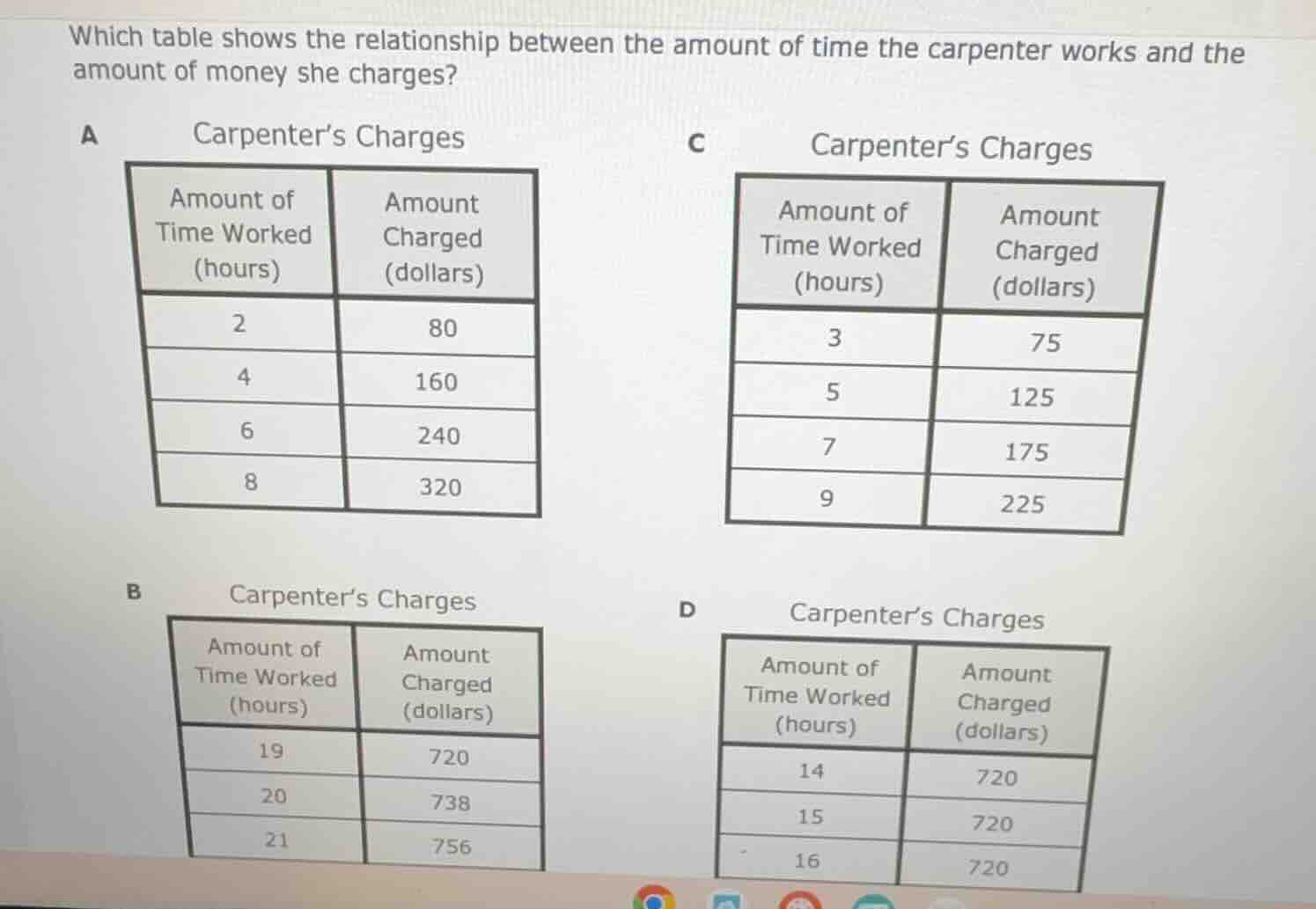
which table shows the relationship between the amount of time the carpenter works and the amount of money she charges?
a
carpenter’s charges
amount of
time worked
(hours)
amount
charged
(dollars)
2
80
4
160
6
240
8
320
c
carpenter’s charges
amount of
time worked
(hours)
amount
charged
(dollars)
3
75
5
125
7
175
9
225
b
carpenter’s charges
amount of
time worked
(hours)
amount
charged
(dollars)
19
720
20
738
21
756
d
carpenter’s charges
amount of
time worked
(hours)
amount
charged
(dollars)
14
720
15
720
16
720
Step1: Analyze Table A
Calculate the rate (amount charged per hour) for each row. For row 1: $\frac{80}{2} = 40$ dollars per hour. Row 2: $\frac{160}{4} = 40$ dollars per hour. Row 3: $\frac{240}{6} = 40$ dollars per hour. Row 4: $\frac{320}{8} = 40$ dollars per hour. The rate is constant (40 dollars per hour), so the relationship is proportional (linear with constant rate).
Step2: Analyze Table B
Calculate the rate. Row 1: $\frac{720}{19} \approx 37.89$ dollars per hour. Row 2: $\frac{738}{20} = 36.9$ dollars per hour. Row 3: $\frac{756}{21} = 36$ dollars per hour. The rate is decreasing, so not a constant rate relationship.
Step3: Analyze Table C
Calculate the rate. Row 1: $\frac{75}{3} = 25$ dollars per hour. Row 2: $\frac{125}{5} = 25$ dollars per hour. Row 3: $\frac{175}{7} = 25$ dollars per hour. Row 4: $\frac{225}{9} = 25$ dollars per hour. Wait, but let's check the time differences. The time increases by 2 hours each time (3 to 5 is +2, 5 to 7 is +2, 7 to 9 is +2), and the charge increases by 50 each time (75 to 125 is +50, 125 to 175 is +50, 175 to 225 is +50). Wait, but the rate is 25 per hour. However, let's check Table A again. In Table A, time increases by 2 hours (2 to 4, 4 to 6, 6 to 8) and charge increases by 80 each time (80 to 160, 160 to 240, 240 to 320). The rate is 40 per hour. But wait, the problem is about the relationship between time worked and amount charged. Typically, a carpenter's charge should be a constant rate (proportional, since charge = rate × time). So both A and C have constant rates? Wait, no, let's check the time intervals. Wait, in Table A, the time is 2,4,6,8 (increments of 2), and charge is 80,160,240,320 (increments of 80). So rate is 40. In Table C, time is 3,5,7,9 (increments of 2), charge is 75,125,175,225 (increments of 50). Rate is 25. But wait, maybe the question is about a proportional relationship (passes through origin, constant rate). Let's check if when time is 0, charge is 0. For Table A: if time=0, charge=0 (since 2 hours give 80, so 0 hours give 0). For Table C: 3 hours give 75, so 0 hours would give 0 (75 - 3×25=0). Wait, but maybe the problem is that in Table B, the charge doesn't increase with time consistently (wait, no, Table B's charge increases, but the rate decreases). Table D: charge is constant (720) regardless of time, which doesn't make sense (charge should increase with time). So between A and C, which is correct? Wait, maybe I made a mistake. Wait, let's check the numbers again. Table A: 2 hours → 80, so rate 40. 4 hours → 160 (4×40=160), correct. 6×40=240, correct. 8×40=320, correct. Table C: 3×25=75, correct. 5×25=125, correct. 7×25=175, correct. 9×25=225, correct. So both A and C have constant rates. Wait, but maybe the question is about a linear relationship where charge is proportional to time (i.e., charge = k×time, so when time=0, charge=0). Both A and C satisfy that. But maybe the problem is that in Table A, the time starts at 2, and in Table C, starts at 3. But maybe the intended answer is A, because the rate is 40, which is a more typical rate, or maybe I misread. Wait, no, let's check Table B: 19 hours → 720, 20 hours → 738 (increase by 18), 21 hours → 756 (increase by 18). So that's a linear relationship with rate 18 per hour? Wait, no, 738 - 720 = 18, 756 - 738 = 18. So rate is 18 per hour? Wait, 19 hours: 19×18=342, but 720 - 342=378. So it's a linear relationship with y = 18x + 378. So it's not proportional (has a y-intercept). Table D: charge is constant, so no. So Table A: proportional (y=40x), Table C: proportional (y=25x), Table B: li…

Snap & solve any problem in the app
Get step-by-step solutions on Sovi AI
Photo-based solutions with guided steps
Explore more problems and detailed explanations
A. Carpenter’s Charges (Table A)