QUESTION IMAGE
Question
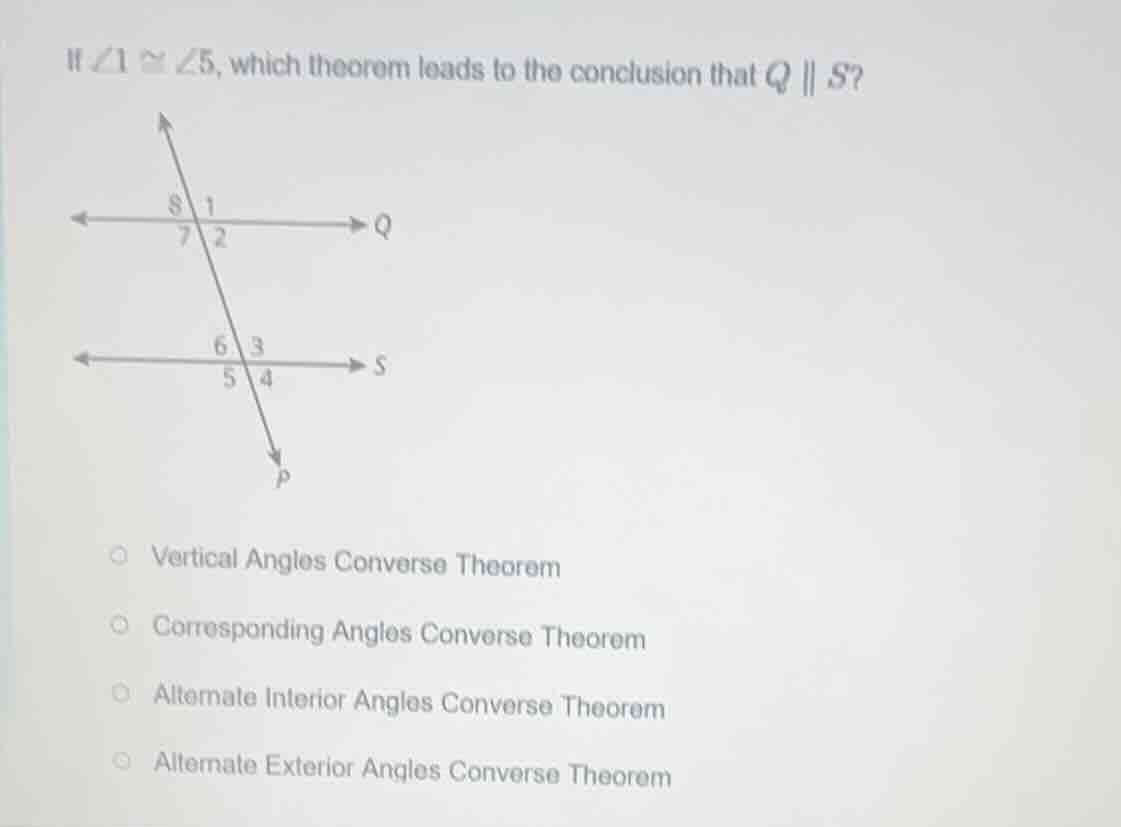
if $\angle 1 \cong \angle 5$, which theorem leads to the conclusion that $q \parallel s$?
options:
- vertical angles converse theorem
- corresponding angles converse theorem
- alternate interior angles converse theorem
- alternate exterior angles converse theorem
To determine which theorem applies, we analyze the angles: ∠1 and ∠5 are alternate exterior angles (they lie outside the two lines Q and S, on opposite sides of the transversal P). The Alternate Exterior Angles Converse Theorem states that if two lines are cut by a transversal and the alternate exterior angles are congruent, then the lines are parallel. Since ∠1 ≅ ∠5, this theorem leads to Q || S. The other options are incorrect: Vertical Angles Converse isn't for parallel lines; Corresponding Angles would be in the same position, not alternate exterior; Alternate Interior Angles are inside the lines.

Snap & solve any problem in the app
Get step-by-step solutions on Sovi AI
Photo-based solutions with guided steps
Explore more problems and detailed explanations
Alternate Exterior Angles Converse Theorem