QUESTION IMAGE
Question
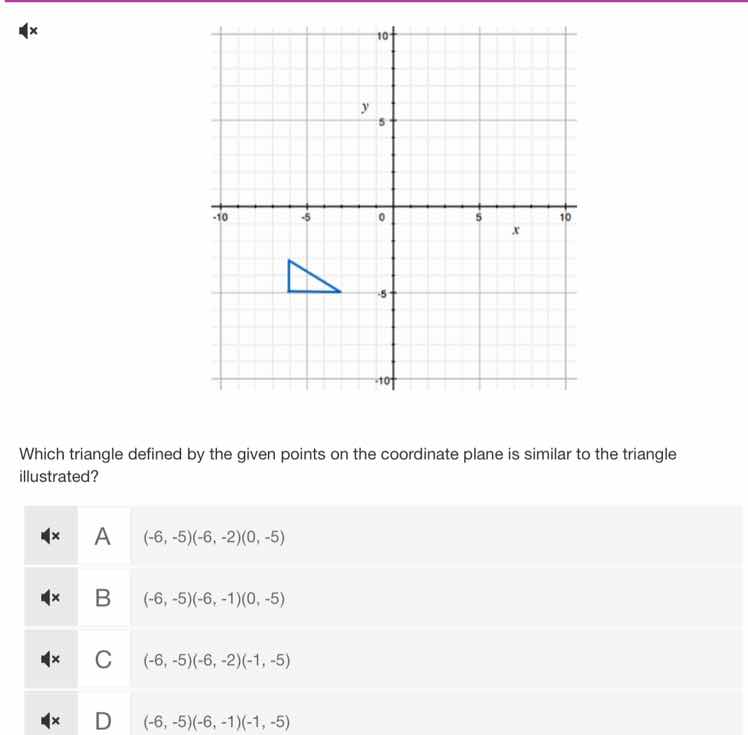
which triangle defined by the given points on the coordinate plane is similar to the triangle illustrated? a (-6, -5)(-6, -2)(0, -5) b (-6, -5)(-6, -1)(0, -5) c (-6, -5)(-6, -2)(-1, -5) d (-6, -5)(-6, -1)(-1, -5)
Step1: Find the sides of the illustrated triangle
First, identify the coordinates of the illustrated triangle. Let's assume the vertices are, for example, \((-6, -3)\), \((-6, -5)\), and \((-3, -5)\) (by looking at the grid). The vertical side length (along the x - same x - coordinate) is \(|-3 - (-5)|=2\), and the horizontal side length (along the same y - coordinate) is \(|-3 - (-6)| = 3\)? Wait, no, let's re - examine. Wait, from the grid, let's find the correct coordinates. Let's say the three vertices of the blue triangle are \((-6, -3)\), \((-6, -5)\), and \((-3, -5)\)? Wait, no, looking at the grid, the x - axis and y - axis: the blue triangle has one vertex at \((-6, -3)\), one at \((-6, -5)\), and one at \((-3, -5)\)? Wait, no, maybe the vertical leg (change in y) and horizontal leg (change in x). Let's calculate the lengths of the legs of the original triangle. Let's assume the original triangle has vertices \((x_1,y_1)\), \((x_2,y_2)\), \((x_3,y_3)\). Let's say from the graph, the vertical side (same x) has length \(a\) and horizontal side (same y) has length \(b\). Let's take the illustrated triangle: let's find two points with the same x - coordinate (vertical side) and two points with the same y - coordinate (horizontal side). Suppose the vertical side is between \((-6, -3)\) and \((-6, -5)\), so length \(=|-3-(-5)| = 2\). The horizontal side is between \((-6, -5)\) and \((-3, -5)\), so length \(=|-6 - (-3)|=3\)? Wait, no, maybe I made a mistake. Wait, let's look at the options. Let's first find the lengths of the legs of the original triangle. Let's assume the original triangle has vertices at \((-6, -3)\), \((-6, -5)\), and \((-3, -5)\). So the vertical leg (along x = - 6) has length \(y_2 - y_1=-5-(-3)= - 2\), absolute value \(2\). The horizontal leg (along y=-5) has length \(x_3 - x_2=-3-(-6) = 3\). So the ratio of vertical leg to horizontal leg is \(2:3\).
Now let's calculate the lengths for each option:
Step2: Analyze Option A
Option A: Points \((-6, -5)\), \((-6, -2)\), \((0, -5)\)
Vertical leg (same x=-6): length \(|-2-(-5)| = 3\)
Horizontal leg (same y = - 5): length \(|0 - (-6)|=6\)
Ratio of vertical to horizontal: \(3:6 = 1:2
eq2:3\)
Step3: Analyze Option B
Option B: Points \((-6, -5)\), \((-6, -1)\), \((0, -5)\)
Vertical leg (same x=-6): length \(|-1-(-5)| = 4\)
Horizontal leg (same y=-5): length \(|0 - (-6)| = 6\)
Ratio of vertical to horizontal: \(4:6=2:3\) (simplify by dividing numerator and denominator by 2)
Step4: Analyze Option C
Option C: Points \((-6, -5)\), \((-6, -2)\), \((-1, -5)\)
Vertical leg (same x=-6): length \(|-2-(-5)| = 3\)
Horizontal leg (same y=-5): length \(|-1-(-6)| = 5\)
Ratio \(3:5
eq2:3\)
Step5: Analyze Option D
Option D: Points \((-6, -5)\), \((-6, -1)\), \((-1, -5)\)
Vertical leg (same x=-6): length \(|-1-(-5)| = 4\)
Horizontal leg (same y=-5): length \(|-1-(-6)| = 5\)
Ratio \(4:5
eq2:3\)
Wait, maybe I made a mistake in the original triangle's length. Let's re - calculate the original triangle. Let's look at the grid again. The blue triangle: let's find the coordinates. Let's say the three vertices are \((-6, -3)\), \((-6, -5)\), and \((-3, -5)\). So vertical leg (y - difference): \(-3-(-5)=2\), horizontal leg (x - difference): \(-3 - (-6)=3\). So ratio of vertical to horizontal is \(2:3\).
Now Option B: points \((-6, -5)\), \((-6, -1)\), \((0, -5)\). Vertical leg: \(-1-(-5)=4\), horizontal leg: \(0 - (-6)=6\). Ratio \(4:6 = 2:3\) (divide numerator and denominator by 2). So the ratio of the legs is the same as the original triangle, so the triangles are si…

Snap & solve any problem in the app
Get step-by-step solutions on Sovi AI
Photo-based solutions with guided steps
Explore more problems and detailed explanations
B. (-6, -5)(-6, -1)(0, -5)