QUESTION IMAGE
Question
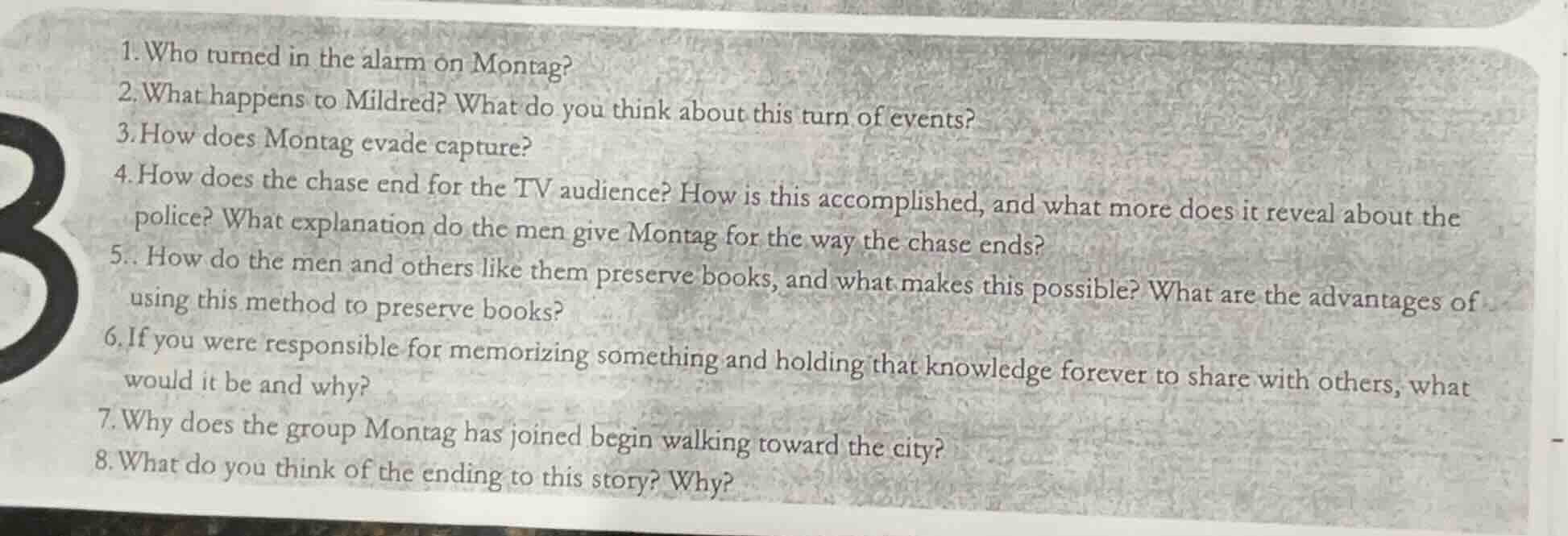
- who turned in the alarm on montag?
- what happens to mildred? what do you think about this turn of events?
- how does montag evade capture?
- how does the chase end for the tv audience? how is this accomplished, and what more does it reveal about the police? what explanation do the men give montag for the way the chase ends?
5.. how do the men and others like them preserve books, and what makes this possible? what are the advantages of using this method to preserve books?
- if you were responsible for memorizing something and holding that knowledge forever to share with others, what would it be and why?
- why does the group montag has joined begin walking toward the city?
- what do you think of the ending to this story? why?
Brief Explanations
These questions refer to Ray Bradbury's Fahrenheit 451. Answers are based on key plot points and thematic elements of the novel:
- Mildred, Montag's wife, turned in the alarm on him, along with their neighbors, after their conflict over books.
- Mildred leaves Montag, gets in a taxi, and is never seen again. This underscores her shallow, media-obsessed nature and the breakdown of their empty marriage.
- Montag uses Faber's advice: he douses himself in river water to hide his scent from the Mechanical Hound, changes clothes, and floats downstream to escape the city's perimeter.
- For the TV audience, the chase ends with the police "capturing" and killing a random, innocent man who matches Montag's general description. The police do this to maintain their image of total control and avoid admitting failure. It reveals the police prioritize public perception over justice. They tell Montag the public needs a "clean, satisfying" ending to the spectacle, not the truth of his escape.
- The men memorize entire books word-for-word, then destroy the physical copies. This is possible because they are dedicated to preserving knowledge and have trained their memories. Advantages include avoiding detection (no physical books to be seized), portability of knowledge, and the ability to "reproduce" the books by dictating them if society ever accepts literature again.
- (Subjective example) I would memorize a collection of diverse global folktales. Folktales carry cultural values, empathy, and universal human experiences; preserving them would help future generations connect across cultures and understand shared humanity, even if formal records are lost.
- The group walks toward the city because the city has been destroyed by a nuclear bomb. They intend to help any survivors and begin rebuilding society by sharing the knowledge they have memorized.
- (Subjective example) The ending is hopeful yet sobering. It is hopeful because Montag and the group survive to carry forward knowledge, offering a chance for a more thoughtful society. It is sobering because it takes total destruction to break the cycle of censorship, highlighting the high cost of reclaiming intellectual freedom.

Snap & solve any problem in the app
Get step-by-step solutions on Sovi AI
Photo-based solutions with guided steps
Explore more problems and detailed explanations
- Mildred (Montag's wife) and their neighbors turned in the alarm on Montag.
- Mildred abandons Montag and flees in a taxi, never to be seen again. This outcome highlights her detachment from real connection and her full immersion in the dystopia's superficial culture.
- Montag escapes by floating downstream (to mask his scent from the Mechanical Hound), switching clothes, and reaching the countryside.
- For TV audiences, the chase ends with the police killing an innocent man framed as Montag. The police stage this to avoid admitting they failed to catch Montag, revealing they value public control over truth. They tell Montag the public requires a "satisfying" spectacle instead of the messy reality of his escape.
- The men preserve books by memorizing entire texts, then destroying physical copies. This is possible through their dedicated memory training and commitment to knowledge. Advantages: no physical evidence to be seized, knowledge is portable, and texts can be reconstructed if society changes.
- (Sample answer) I would memorize a collection of global folktales. Folktales hold cultural wisdom and universal human experiences, so preserving them would let future generations connect across cultures and understand shared humanity, even if formal records are gone.
- The group walks toward the city because it was destroyed by a nuclear bomb; they aim to help survivors and rebuild society using the knowledge they have memorized.
- (Sample answer) The ending is cautiously hopeful. It offers a path to renewal through the preserved knowledge of Montag's group, but it is tempered by the fact that it took total societal destruction to break the censorship cycle, emphasizing the high cost of intellectual freedom.