QUESTION IMAGE
Question
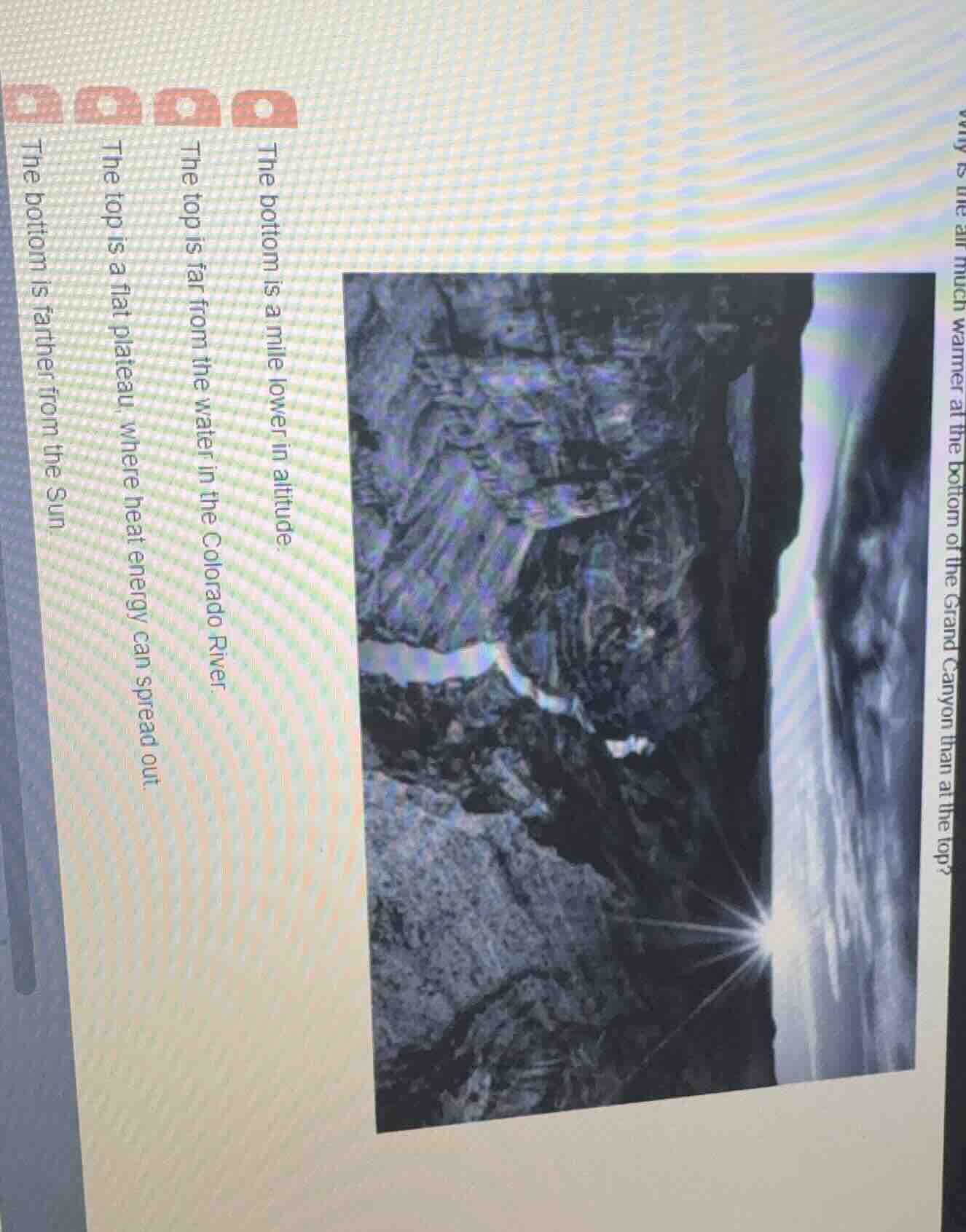
why is the air much warmer at the bottom of the grand canyon than at the top? the bottom is a mile lower in altitude. the top is far from the water in the colorado river. the top is a flat plateau, where heat energy can spread out. the bottom is farther from the sun
To determine why the air is warmer at the bottom of the Grand Canyon than at the top, we analyze the options:
- Option 1: "The bottom is a mile lower in altitude."
Atmospheric temperature generally decreases with increasing altitude (the lapse rate). Lower altitudes (like the canyon bottom) have higher air pressure and more concentrated heat - trapping gases, leading to warmer air. This aligns with basic atmospheric science.
- Option 2: "The top is far from the water in the Colorado River."
Distance from the river does not directly explain the temperature difference between the canyon’s top and bottom. Water’s thermal influence (e.g., evaporation, heat storage) is not the primary driver of this vertical temperature gradient.
- Option 3: "The top is a flat plateau, where heat energy can spread out."
While heat spreads on a plateau, this does not explain why the bottom is warmer. The key factor is altitude, not the plateau’s flatness.
- Option 4: "The bottom is farther from the Sun."
The vertical distance within the Grand Canyon is negligible compared to Earth’s distance from the Sun. Solar radiation’s intensity does not vary significantly over a mile of vertical change, so this is not a valid explanation.

Snap & solve any problem in the app
Get step-by-step solutions on Sovi AI
Photo-based solutions with guided steps
Explore more problems and detailed explanations
The bottom is a mile lower in altitude.